If you want to develop people who build AI systems at a logistics company, candidates include dispatch clerks, operations managers, and warehouse administrative staff. The goal is to enable people who know the exceptions in the field to reorganize office workflows themselves using AI. As a first project, tallying waiting-for-loading times from daily operation reports is a good fit. Final dispatch decisions and checks on duty hours, as well as negotiations with shippers, remain handled by people as before.
Why does logistics need system builders inside the office?
Because while driving time has decreased, challenges remain in office workflows.
According to materials from the Kanto Regional Transport Bureau of the Ministry of Land, Infrastructure, Transport and Tourism, working hours in the trucking industry are about 20% longer than the average across all occupations, and the job openings-to-applicants ratio is about 2. A survey for fiscal 2024 found the average duty time per run was 11 hours 46 minutes, down about 40 minutes from the previous survey. However, the main reason for the decrease was driving time; the combined time for waiting and loading/unloading remained essentially flat.
Collecting records of waiting times to use as material for discussions with shippers, and reviewing how dispatch is arranged—these tasks must be led by dispatch clerks and operations managers who know each shipper's rules. Relying solely on external parties or the systems department fails to convey the circumstances of each site.
Why choose waiting-time tallying as the first project?
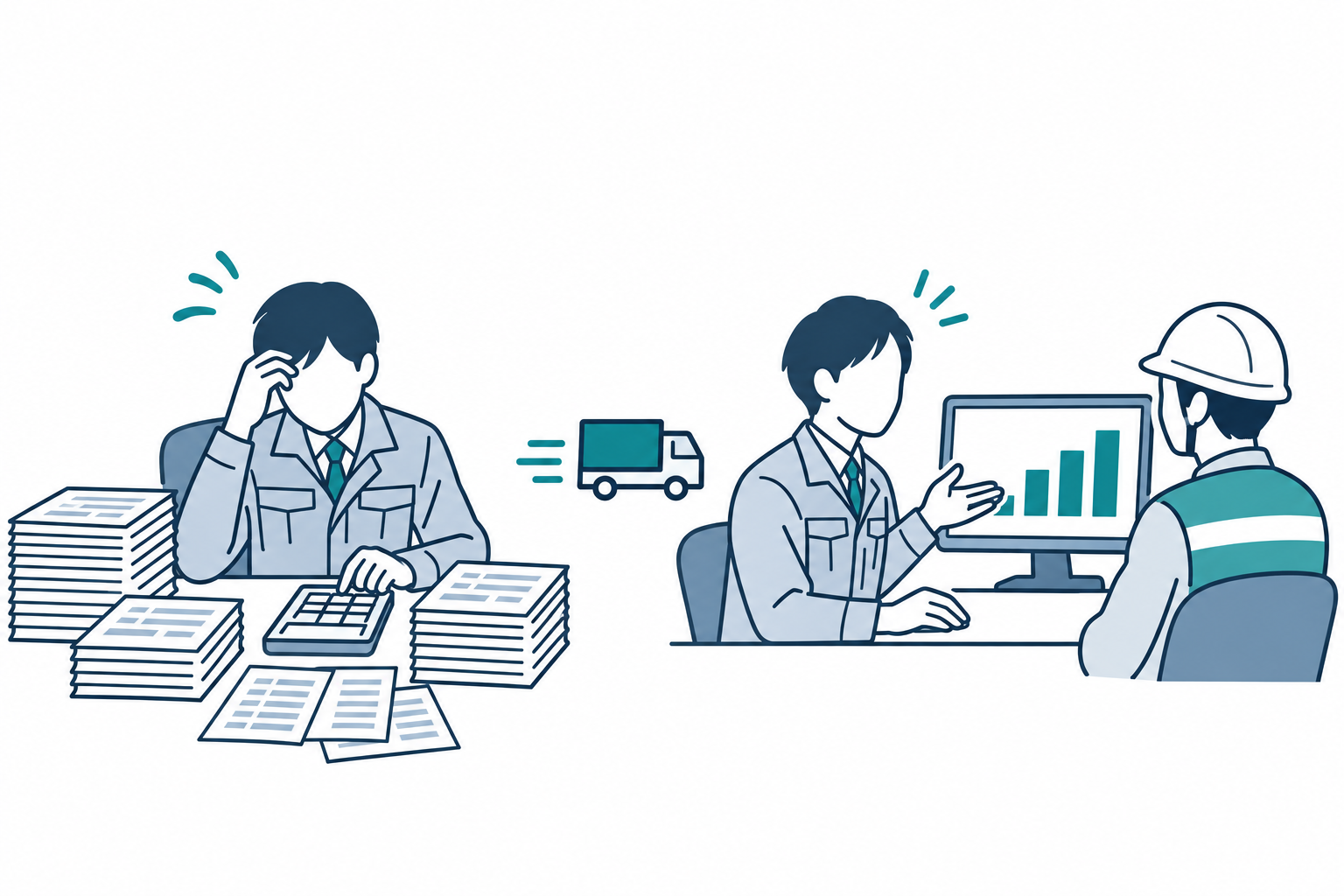
Because it is a weekly recurring task whose results directly become material for discussions with shippers.
At our company, we prepared five fictional daily operation reports with inconsistent formats and asked an AI tool to process them. They were a mix of Word, Excel, and text memos, and one report wrote "1:20" in the minutes field. The AI consolidated 16 stops into a single table in 130 seconds, excluding 2 reports where waiting time could not be determined from the subtotal. When we then asked for a per-shipper tally and duty-time calculation, the table was completed in 142 seconds, with duty times ranging from 12 hours 10 minutes to 14 hours 40 minutes.
The AI's responses also include points requiring human judgment.
| Point raised by the AI | Who judges |
|---|---|
| A row arriving 40 minutes earlier than the designated time was counted as 45 minutes as recorded; counting from the designated time would make it 5 minutes | Staff who know the agreements with the shipper |
| "Waited about 1 hour (including a 30-minute lunch break)" was treated as roughly 30 minutes | Operations manager |
| Duty time was calculated from departure and return times, so it would be longer if roll calls are included | Operations manager |
The AI cannot decide whether to include early arrival time in waiting time. This data is fictional and the result of a single run, but it clearly shows that people who know the field must review the content and give the next instructions. Once the tallying format is established, next projects could include matching freight invoices against actual results, classifying accident and near-miss reports, and reading order emails from shippers.
How should companies with different practices at each site organize this?
By developing a combination of two types of employees: business-department type and engineer type.
| 業務部門型 | エンジニア型 | |
|---|---|---|
| Main background | Dispatch clerks, operations managers, warehouse administration, order-receiving centers | Information systems department, staff for warehouse management systems or operation management systems |
| What they build | Report tallying, reports to shippers, freight invoice verification | Integration with warehouse management systems and digital tachographs |
The basic model is that the business-department type builds systems suited to their own site, and the engineer type adapts them for use at other sites. A system built at one site may not work at sites with different report formats. Before rolling out, test it with reports from other sites. Select two candidates per site, and keep a list of the systems and a manual so that successors can fix things even if the builder is transferred.
Training consists of 12 weekly lectures over 3 months, followed by 3 months of hands-on support while using it in daily work. The latter period is where people tend to get stuck on system integration and internal procedures.
Frequently asked questions
Can we put data received from shippers into the AI?
It depends on agreements with each shipper, so in the first month of training, confirm with the information systems department what may be used. Until that is settled, starting with projects that can be tested using internal records only allows progress without interruption.
Can we leave the verification of duty hours to the AI?
No. The AI produces tallies and drafts; final dispatch decisions and verification of duty hours are performed by operations managers.
Do we need to replace our warehouse management or operation management systems?
No. The initial systems read existing records such as reports and emails and turn them into tables. Integration with systems is set up later by engineer-type employees.
Read the full report
This article summarizes the key points of our report, "In-House FDE Development for the Logistics Industry: Implementation Report." The report includes the full per-shipper tally results, a list of projects by department with scoring sheets, estimated impact tables, the approach for the 3-month training and 3-month support periods, and materials for explaining the initiative to site managers and the information systems department.
Source: Kanto Regional Transport Bureau, Ministry of Land, Infrastructure, Transport and Tourism, "Background of Logistics DX and MLIT Policy" (May 2026)
If you are considering who to develop among your dispatch and operations staff, use the free 30-minute "AI Business Diagnosis" to sort out your first project and approach together.