The differences come down to three points: "where the deliverables go," "how much you're entrusted with," and "evaluation criteria." An "FDE (Forward Deployed Engineer)" is an engineer who embeds in the customer's site and handles everything from problem discovery to implementation and adoption. However, like SES (System Engineering Service), they often work on-site at the client under the same quasi-delegation contract, making them hard to distinguish from the outside. In fact, companies that provide FDE talent themselves publicly state that they operate "within the SES transaction flow."
Three differences between FDE and SES
The difference lies not in the type of contract, but in how they engage on-site. Based on our media outlet's direct survey of 43 companies in Japan and each company's official explanations, the two can be summarized as follows.
| Point of comparison | SES | FDE |
|---|---|---|
| Where deliverables go | They remain with the client company | They go to the client and also feed back into the provider's product |
| How much you're entrusted with | You receive predetermined specifications | You start from defining the problem itself |
| Evaluation criteria | Hours worked and skills provided | Problems solved on that site |
| On-site client work | Often a given | Also common for FDEs (mentioned by 23 of 43 companies) |
| Type of contract | Mostly quasi-delegation | Quasi-delegation also used (not a distinguishing factor) |
Ownership of deliverables
In SES, the code and documentation written by engineers generally become assets of the client company. The goal is simply to complete the project, and there is usually no contractual mechanism for the knowledge gained there to flow back into the employing company's products.
With an FDE, on the other hand, deliverables flow in two directions. One is, naturally, solving the customer's problems; the other is "improving one's own product." The FDE brings back to their company the messy, on-the-ground needs for specification changes and the barriers to data utilization encountered in the field, and implements them as core product features. The presence or absence of this "asset that returns to the company" is the dividing line between mere staffing and true FDE work.
Where the work begins
In SES, work begins from receiving predetermined specifications or tasks—for example, "implement this feature with these requirements." Because the role is defined in advance, engineers focus on carrying out the assigned work.
By contrast, an FDE gets involved starting from the phase of identifying "what the problem actually is." They uncover bottlenecks the customer hasn't noticed themselves, drawing on on-site data and workflows, and handle everything one-stop from proposing "this technology might solve it" through implementation. The FDE's position is not to do what they're told, but to commit to the process of deciding what should be done.
Evaluation criteria
In SES, evaluation and compensation are generally based on "hours worked" and "skills provided." The question is whether you worked the agreed hours and delivered technical skills commensurate with that time.
What matters for an FDE is not how many hours they worked, but what they solved on that site. Even with the same hours, they won't be evaluated well if the problem isn't solved. Conversely, even in a short period, they are recognized for results if they bring the site to a state where it can run on its own.
Answering the question of how FDEs differ from on-site client work
The question of whether the FDE role is "ultimately just the same as on-site SES work" is one that the companies involved themselves recognize.
Questions raised to the companies themselves
This question has been put directly to the companies in interviews. In a March 23, 2026 article, Levtech LAB asked both LayerX and Loglass: "Looking at social media and elsewhere, some people question whether the FDE position is really any different from on-site SES work or technical consulting." Their two answers follow.
LayerX's answer
One of the first companies to move on building an FDE organization was LayerX. LayerX began recruiting for FDE (Forward Deployed Engineer) positions in July 2024.
Hanae Shirai, EM of the FDE Group in the company's Ai Workforce business division, said in an interview with Levtech LAB that "FDE is closer to a business model than a role," and explained the decisive differences from SES and technical consulting as follows.
SESや技術コンサルタントとの決定的な違いを一言で言うなら「プロダクトを持っている」ことです。FDEは自社プラットフォームという制約の中で動きますが、この制約こそが強みでもあります。顧客の課題を解くたびに、その知見がプロダクトに実装され、次の顧客への価値になっていく。SESは顧客企業を離れたら終わりですが、FDEが解いた課題は会社の資産として積み上がっていきます。
Does the relationship end once you leave the client company, or do the problems you solved continue to remain with your own company? He cites this point as the line separating the two.
Related article: What's the difference between an FDE and a consultant? The reality across 42 companies in Japan and what to check before ordering
Loglass's answer
Regarding the unique difficulties and value of the FDE role, Ryuta Sakamoto of Loglass emphasizes the point of carrying two goals simultaneously: individual optimization for the customer and the scalability (extensibility) of one's own product.
The more a product is tailored to an individual customer, the more specialized it becomes and the less general-purpose it is. Sakamoto says it is the FDE's responsibility to determine, through that process, "which parts can be generalized" and feed them back into the core product. Solving the problem for the customer in front of you, and shaping it into a form that can be widely used as a product—taking on both simultaneously is, according to him, what makes the FDE role unique.
They can't be distinguished by contract type
The three points above are differences on the ground, but what's visible before placing an order or changing jobs is the contract. The problem there is that the two cannot be distinguished by contract type alone (quasi-delegation, fixed-price contracting, etc.).
A specialist desk within the SES transaction flow
The Japan AI Center, which operates a dedicated FDE desk, wrote the following in a July 31, 2026 article.
よくある誤解が「SES=準委任、FDE=別の契約形態」というものですが、これは違います。FDEも常駐・準委任の商流で成立します。実際、自分たちはSESの商流のままFDE型の人材を提供しています。違いは契約書ではなく、現場での任され方に現れます。
The provider itself, which supplies FDE-type talent, explicitly states that it operates within the SES transaction flow. The explanation is that even when the contract type is the same, how much you're entrusted with on-site is determined separately. Therefore, views like "it's quasi-delegation, so it's SES" or "it's FDE, so it must be a different contract type" cannot distinguish between the two.
Only 14 companies publish their rates
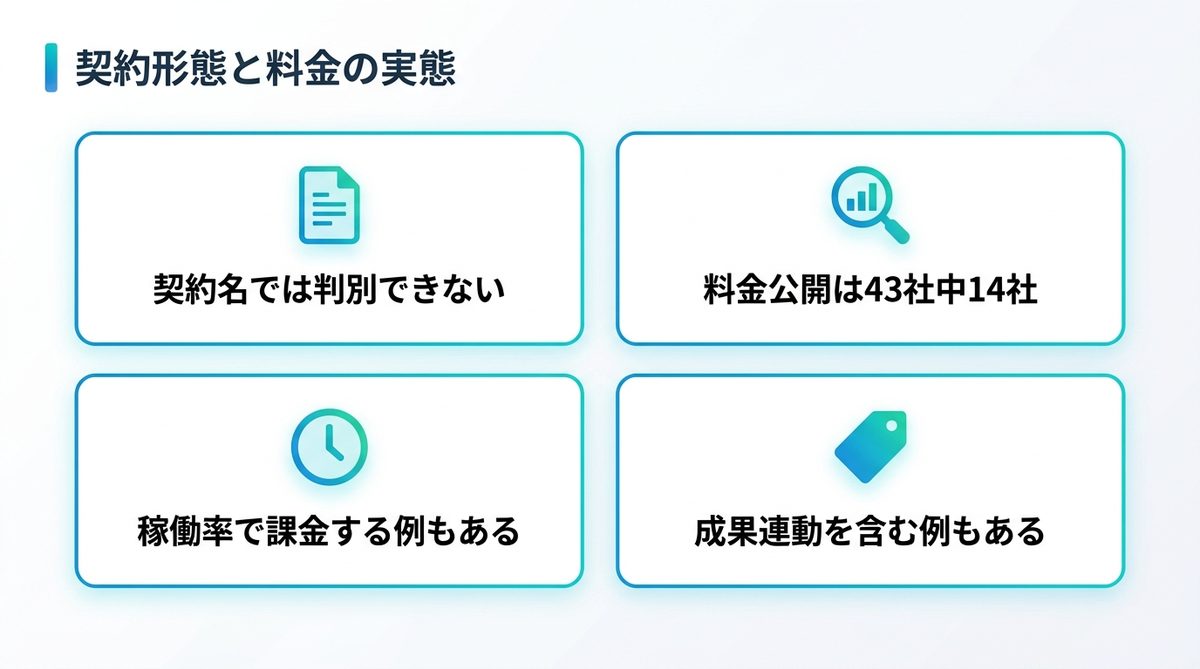
When our media outlet surveyed 43 companies in Japan as of September 2026, 14 companies published their rates or contract terms on their official websites or elsewhere. The remaining 29 companies do not list terms on their official sites and instead use an "individual quotation" model that assumes an inquiry first.
In other words, only about one-third of companies allow outsiders to compare contract terms. If you want to use pricing or contract structure as a decision factor, publicly available information alone is insufficient, and you need to confirm individually.
Benchmarks for published rates
Looking at published rate examples, the basis for billing differs from company to company.
- Thirteen: "Full-capacity plan: 1.65 million yen (tax included) per month (100% utilization)" = utilization rate as the billing basis
- Green Waters: "Contract period: 3-month units; Fee: from 300,000 yen per month (excluding tax)" = period and monthly fee
- FDX Inc.: "Standard model is 6 months, total 1.8–2.4 million yen (excluding tax)" = total for the period
- Healthy Pirates: "A hybrid of software usage fees plus performance-based compensation." = includes performance-based compensation
Some charge monthly fees based on utilization rates, while others incorporate performance-based compensation. Both are publicly offered as services calling themselves FDE, so you cannot draw a line between them and SES based on billing structure alone.
Commerce Robotics' "Global AI Lab" publishes monthly fees by role, such as "Consulting (on-site visits and resident placement)" at 1.5 million yen and "SE (resident placement)" at 800,000 yen, and explicitly states "quasi-delegation contract" and "available from a minimum of 3 people." Conditions such as resident placement, quasi-delegation, and per-head pricing overlap with the SES delivery model.
On the other hand, DeFactory states, "This is a development support business committed to business outcomes through completed quasi-delegation," publicly declaring that it does not set compensation based on working hours. Even under the same FDE banner, billing and contract design differ from company to company.
The reality of resident placement among 43 domestic companies
Among the 43 company introductions compiled by this media outlet based on official information, 23 companies include engagement styles described as "resident placement" or "working alongside" (per this media outlet's research). Entering client sites is widely practiced even among companies calling themselves FDE.
FDE providers themselves do not deny resident placement
What should be noted here is that FDE providers do not deny "resident placement." In this media outlet's classification, the most common type is the "implementation resident type," and quite a few companies make resident placement itself their selling point. Whether or not one enters a client site is not the axis that separates FDE from SES. What differs is what they are entrusted with once they are there.
The implementation resident type is the most common
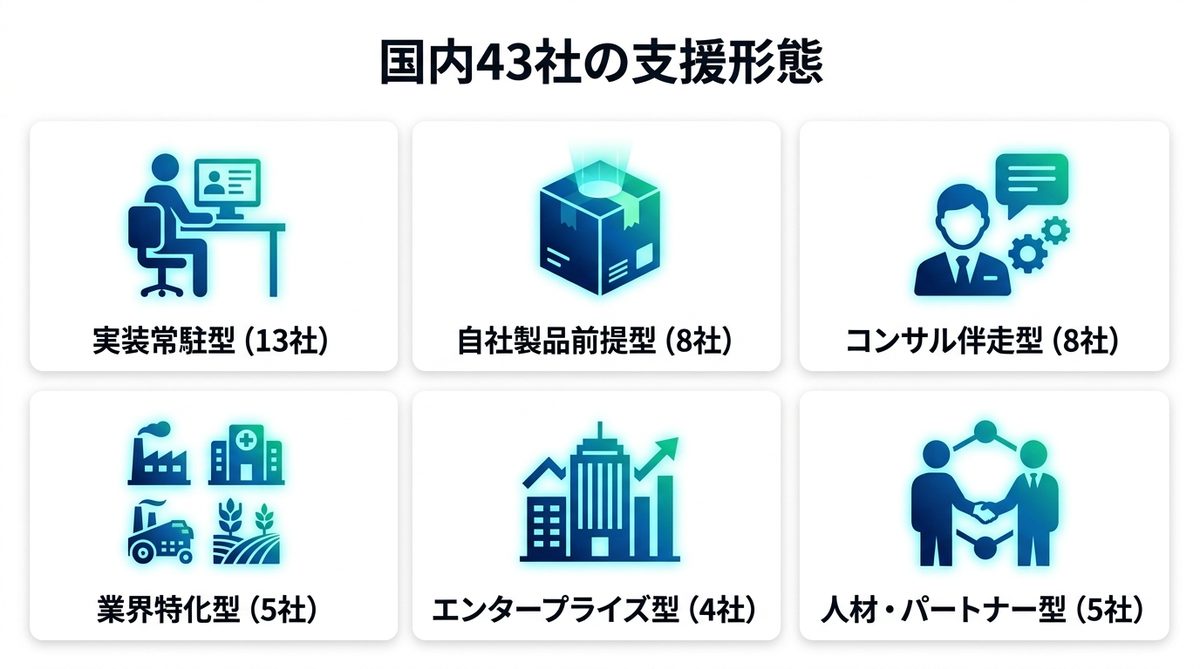
Looking at the classification of the 43 surveyed companies, the breakdown is as follows.
- Implementation resident type: 13 companies (most common)
- Own-product-based type: 8 companies
- Consulting accompaniment type: 8 companies
- Industry-specialized type: 5 companies
- Enterprise type: 4 companies
The most common "implementation resident type" refers, in this media outlet's classification, to a form in which "engineers embed themselves in the client's site and take the lead in AI development and implementation." From the outside, this way of working overlaps with SES, making it difficult to distinguish by classification name or self-designation alone.
Related article: What is FDE? Meaning and List of FDE Companies | Forward Deployed Engineer
Types whose pathway is continuous with SES
In addition, there are 4 talent-matching type companies and 1 certified partner program type company. The talent-matching type is a pathway of introducing and assigning FDE talent to companies, and some companies also take on projects directly. Since the pathway of people entering the field is common with SES, what should be examined here again is not the commercial flow, but the scope of what that person is entrusted with.
As for the certified partner program type, Salesforce certified 9 domestic companies, which corresponds to major SIers themselves taking on FDE work. The differences from SIers are covered in a separate article.
Related article: What is the difference between FDE and SIer? The domestic reality of major SIers starting FDE
*Please note that these 43 companies are those that could be verified under this media outlet's listing criteria, and this is not an exhaustive survey of all domestic companies.
Summary: How to distinguish them by 3 points
Judgments such as "it's SES because of resident placement at the client" or "it's not FDE because it's a quasi-delegation contract" lead to misreading the reality. Use the following 3 axes to determine which category a given engagement belongs to.
- Where the deliverables go: Does the knowledge gained from development end up as "customer assets only," or is it also fed back into the developer's "own product"?
- How they are entrusted: Does the work start from receiving completed "specifications," or from "identifying problems" on-site?
- Evaluation criteria: Is performance measured by "person-hours and working hours" provided, or by "the size of problems solved" through technology?
To distinguish whether the project in front of you is SES-type or FDE-type, rather than poring over the contract, it is important to directly confirm with the client or the affiliated company "what kind of outcomes the work will produce, and as whose assets they will accumulate." FDE is not a term found in a contract's title; it is a word that refers to a "way of being" in the field.