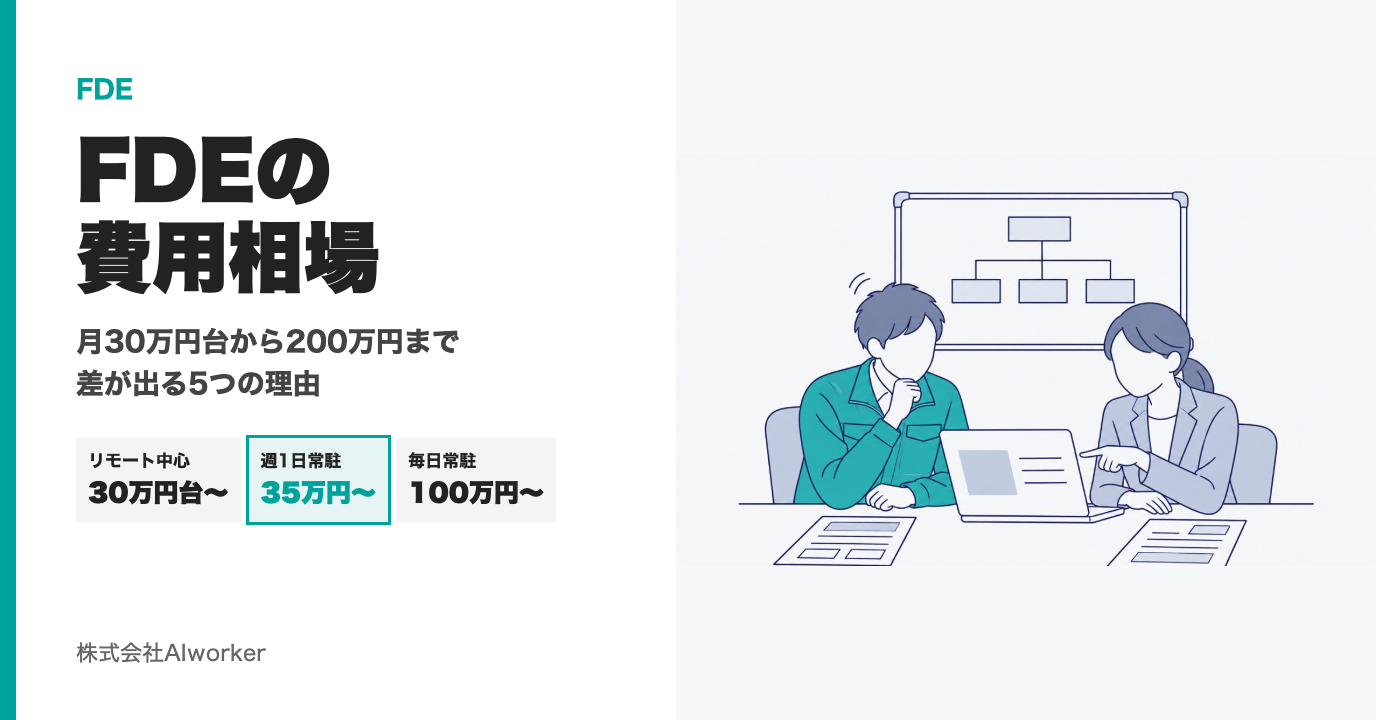
This is for executives and DX managers considering FDE-style support who are puzzled by large gaps in quotes and unsure which option to choose. For FDE (Forward Deployed Engineer) style support, some companies charge around ¥300,000 per month, while others charge close to ¥2,000,000 per month per person.
This gap is not determined simply by the number of people who come on-site. It is mainly determined by "how deeply they embed themselves in your operations" and "what your company is left with after the engagement ends." This article summarizes the five reasons costs vary, along with three questions to help you determine which type fits your company. Finally, we will also introduce what our one-day-per-week on-site model actually involves.
Why is there such a wide range in costs for FDE-style support?
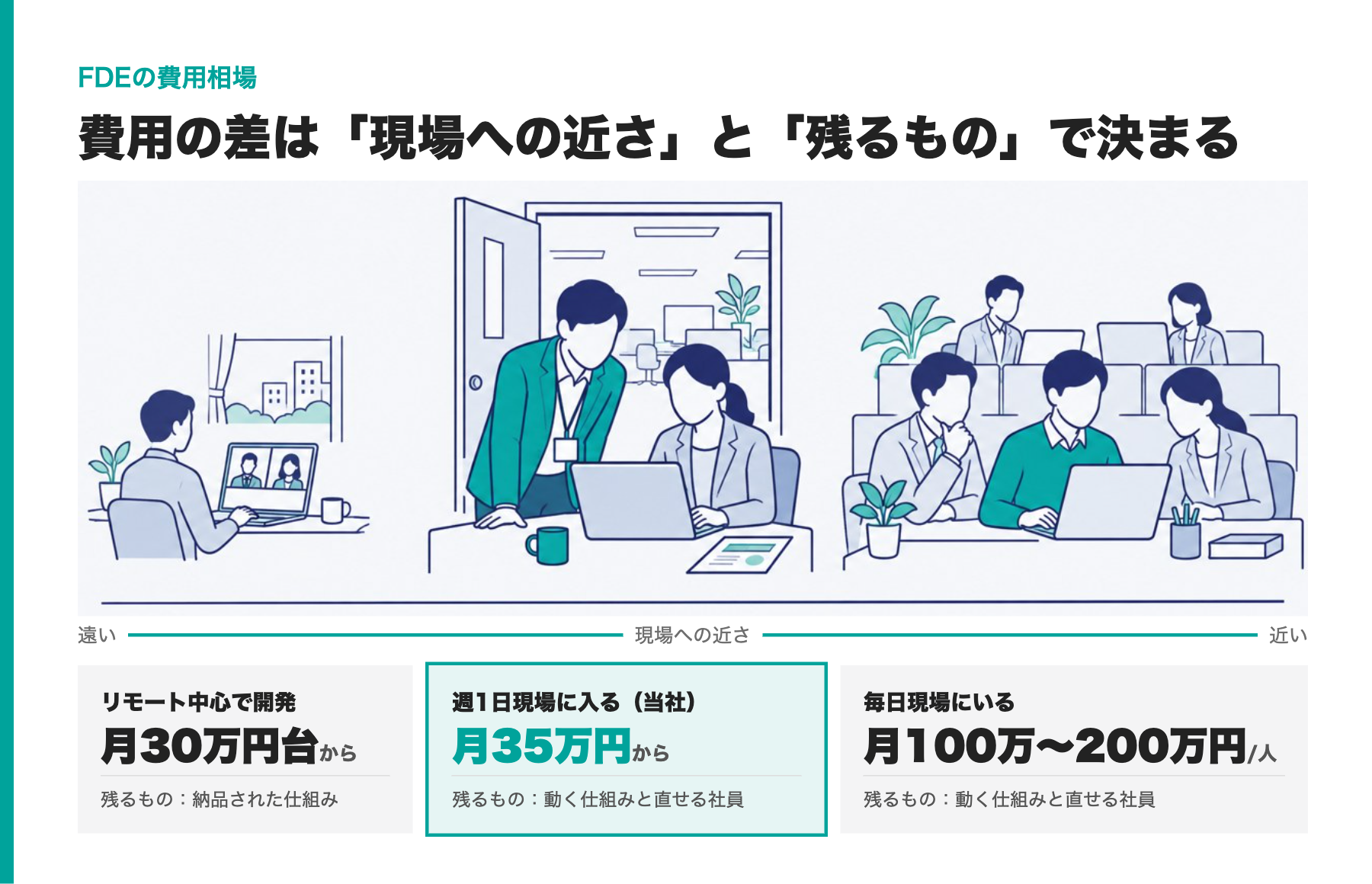
Because even when called the same "FDE," the substance differs considerably. FDE originally refers to engineers who go into the customer's workplace and solve problems with technology, starting from identifying the issues themselves (see the article What is an FDE for details). Recently, this name has also come to be used for remote development arrangements.
Here are some examples of published pricing. An FDE-style service for small and medium-sized businesses announced in November 2026 starts at ¥330,000 per month (tax included) for development. On the other hand, for person-month contracts where engineers or consultants are on-site every day, based on competitors' quotes we hear about from clients during sales meetings, the typical range seems to be around ¥1,000,000 to ¥2,000,000 per month per person.
Lined up by price alone, it looks like a question of expensive versus cheap. In reality, however, you are buying different things. Let's look at what differs, broken down into the following five points.
What are the five reasons costs vary?
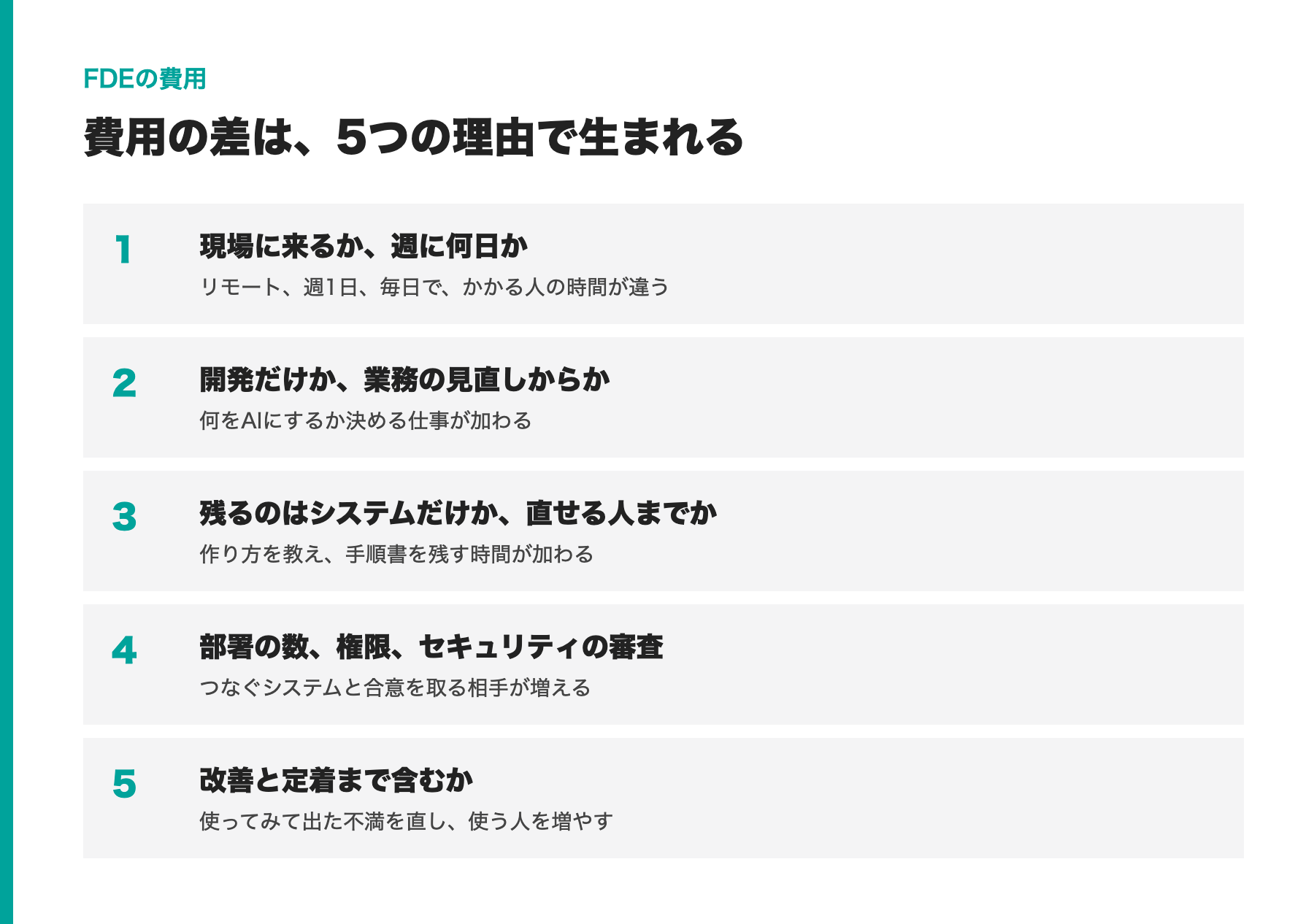
1. Whether they come on-site, and if so, how many days per week
The biggest factor is the number of days spent on-site. The time required from people differs completely between a remote meeting-and-development model, a one-day-per-week on-site model, and a full-time on-site model.
Being on-site allows them to pick up things that never come up in meetings. For example, spreadsheets that a staff member manually fixes every morning, or exception rules that only veterans know. These become candidates for work that AI should handle.
2. Development only, or starting from a review of business processes
If what to build is already decided and you only request development, costs can be kept relatively low. If you start from the stage of "we don't know what to hand to AI," the work of examining operations and deciding which tasks to stop and in what order is added, raising costs accordingly.
Skipping this step makes it easy to end up with systems built to spec that no one uses. Reviewing business processes is a reason costs go up, but it is also a procedure for avoiding building systems that go unused.
3. Is only the system left behind, or also people who can modify it and the underlying framework?
What remains when the engagement ends also separates costs. With a model that simply delivers a system, you will need to request additional development every time your operations change.
With a model that hands over to the point where your employees can make changes themselves, time for teaching how things are built and time for leaving behind procedure documents and design records are added. Costs rise, but subsequent additional orders decrease.
4. Company size, authority, and security reviews
The workload also changes depending on whether the target is one department or multiple, whether connection to internal systems is needed, and whether the IT department requires a security review. The larger the company, the more systems to connect to and the more stakeholders to get agreement from.
This is an area that is hard to see at the quoting stage. Reviews and authority coordination can sometimes take a month, so when comparing quotes, it is reassuring to check whether this work is included.
5. Whether post-build improvement and adoption are included
A newly built system is at its most likely to go unused. Costs change depending on whether support includes fixing dissatisfactions that emerge from actual use and expanding the number of users.
When not included, post-build maintenance is generally billed separately. Even if monthly costs look low, you need to decide who within your company will handle the adoption work.
Comparing the three types: what differs?
Combining the five reasons, FDE-style support falls roughly into three types.
| リモート中心で開発する型 | 週1日現場に入る型 | 毎日現場にいる型 | |
|---|---|---|---|
| Cost guideline | From around ¥300,000 per month | From ¥350,000 per month (in our case) | ¥1,000,000–2,000,000 per month per person |
| Engagement with the workplace | Meetings and online | One day per week on-site, online on other days | Embedded in the department every day |
| Suited to companies that | Have mostly decided what to build | Want to decide what to build together | Have many urgent issues and want to build in parallel |
| What remains at the end | A delivered system | A working system and employees who can modify it | A working system and employees who can modify it |
The around-¥300,000-per-month type is a rational choice for companies that have decided what to build and already have people in-house who can modify it. The full-time on-site type suits companies with many issues that want to move forward urgently and in parallel. In between lies the one-day-per-week on-site type.
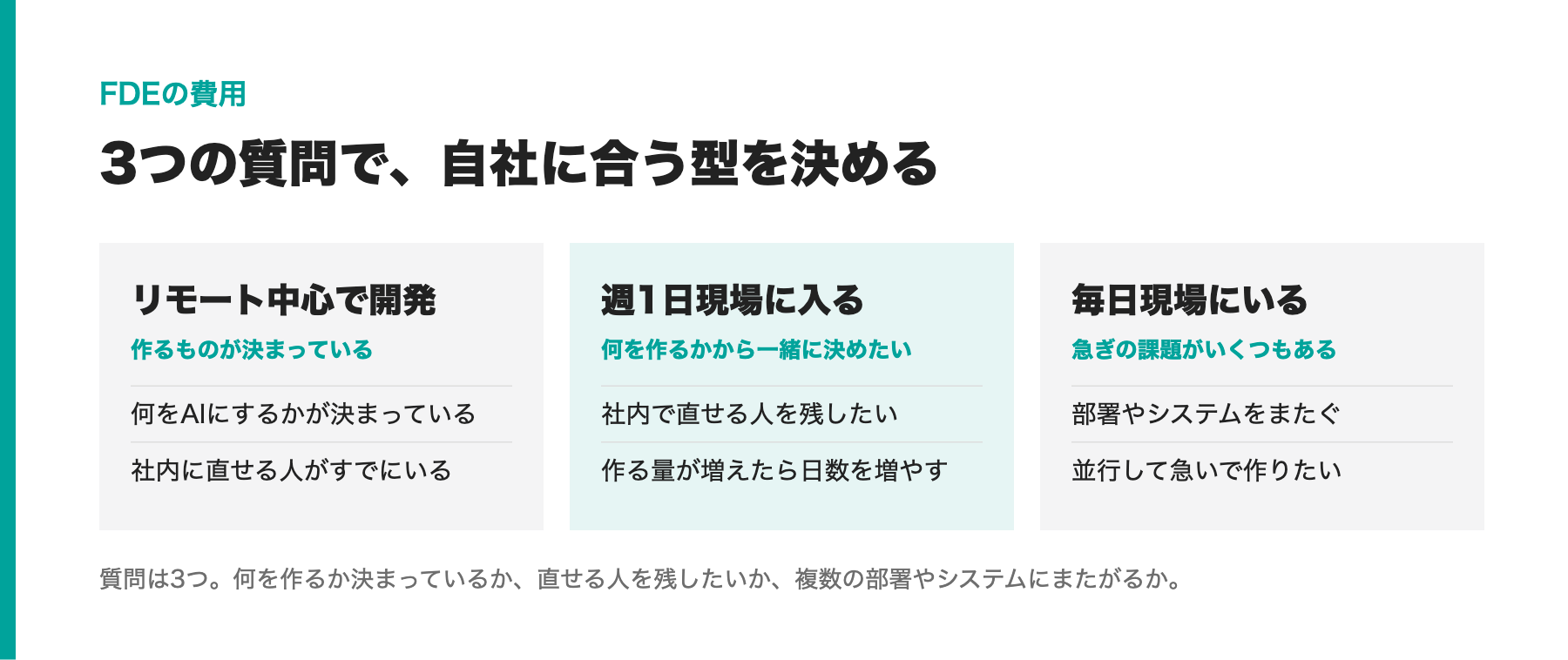
Which type fits your company? Check with three questions
Try answering the following three questions.
- Have you already decided what to hand to AI?
- After the engagement ends, do you want to leave behind people in-house who can make modifications?
- Does it span multiple departments, or require connection to internal systems?
If "yes" to 1 and "no" to 2, the remote-centered development type will often be sufficient. If "yes" to 2, the type that comes on-site and builds together with you is a good fit. If you also answer "yes" to 3 and have several urgent issues, the full-time on-site type suits you. If there is no urgency, you can start with one day per week and increase the number of days as the volume of work grows.
What happens during the one-day-per-week on-site arrangement?
Our AIworker FDE is based on our engineers spending one or more days per week on-site at your workplace.
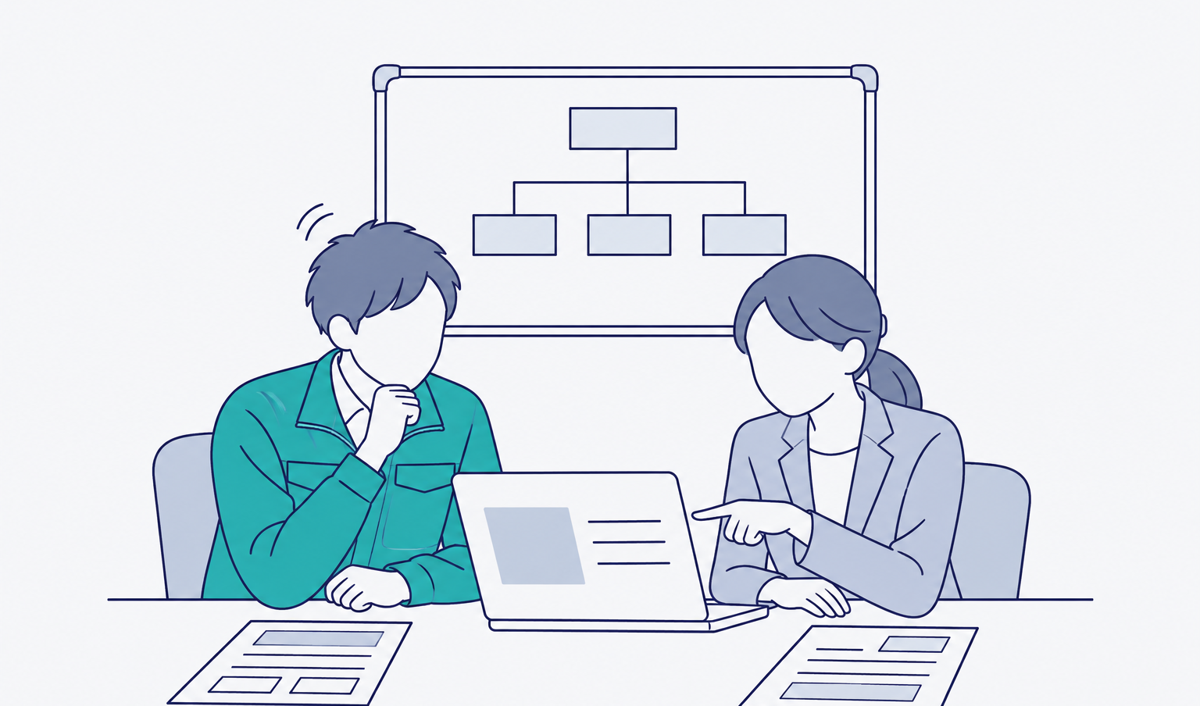
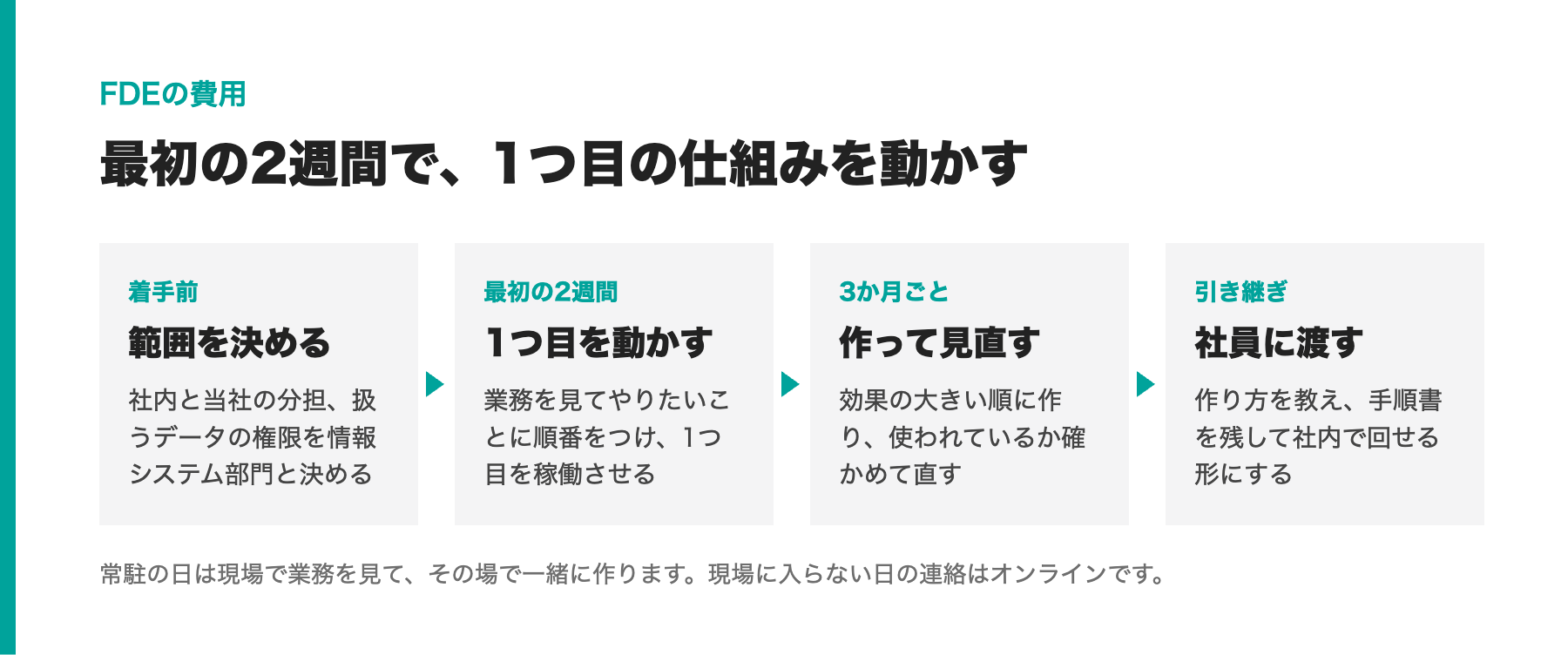
On on-site days, they observe operations in the workplace, listen to people, and build or modify systems together on the spot. Communication on non-on-site days is online. Results from experiments by your employees are brought to the next on-site day. In the first two weeks, we review operations, prioritize what to do with AI, and get the first system running. After that, the flow is to review what to build next every three months.
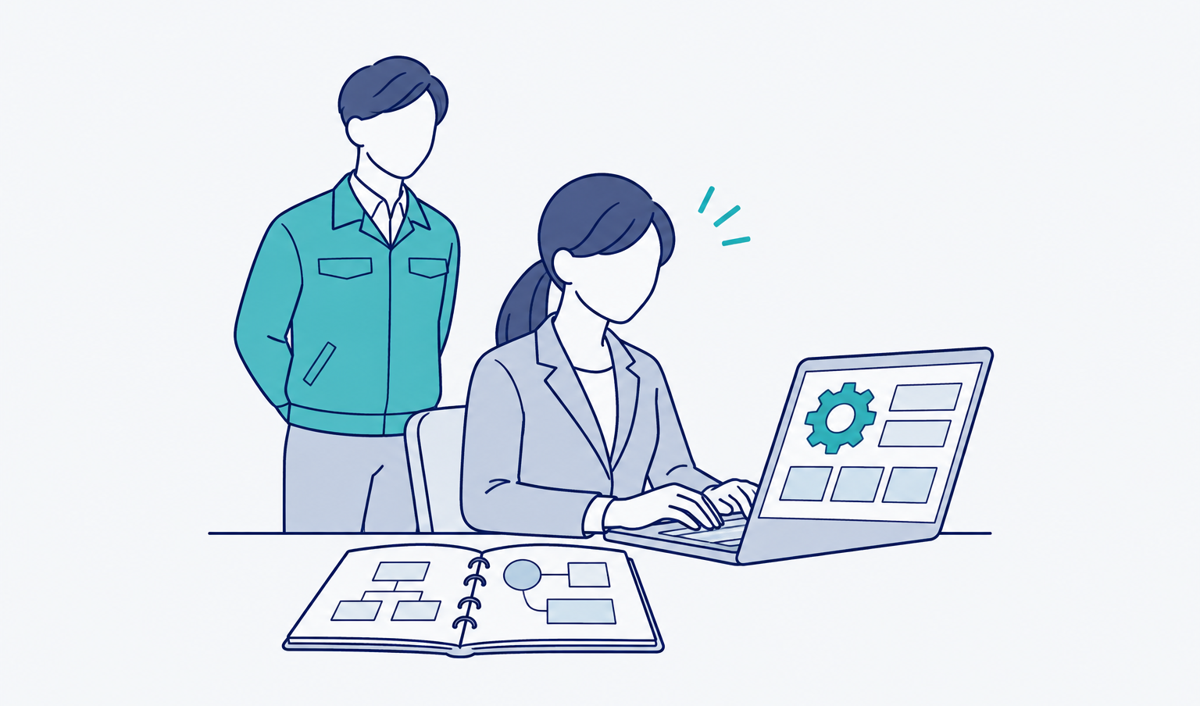
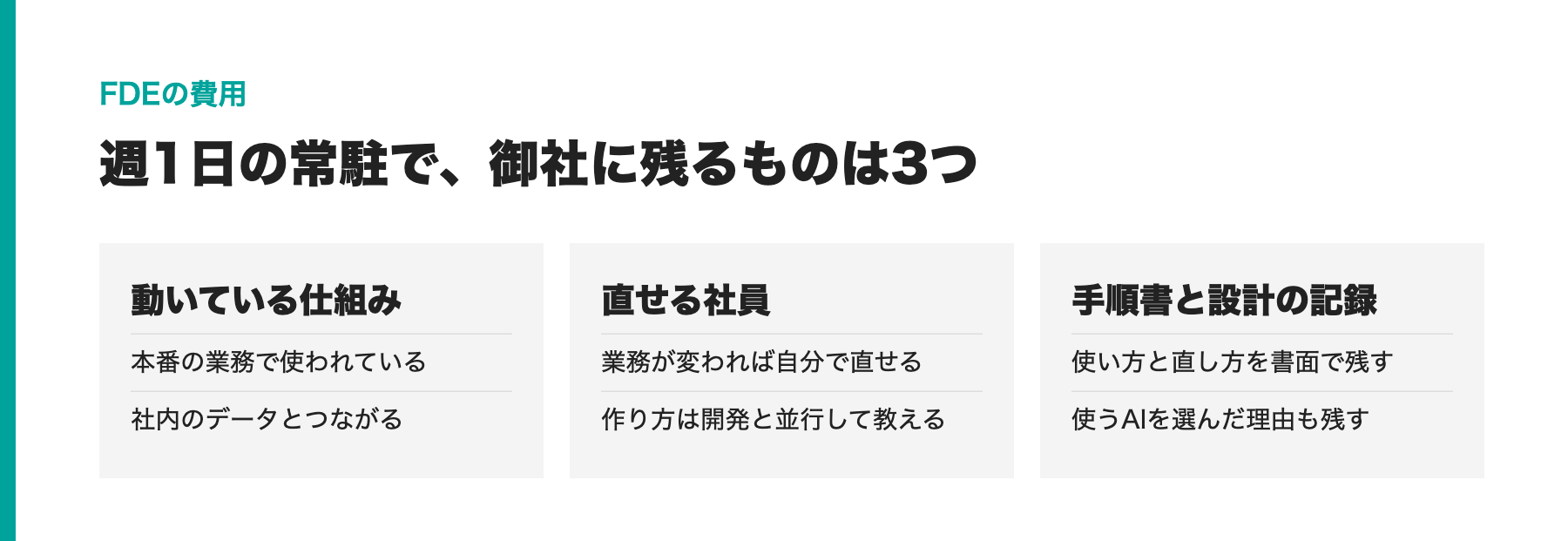
After our support, three things remain with your company. First, the systems actually used in daily operations. Second, employees who can make adjustments themselves when operations change. Third, manuals describing how to use and modify the systems, along with design documentation.
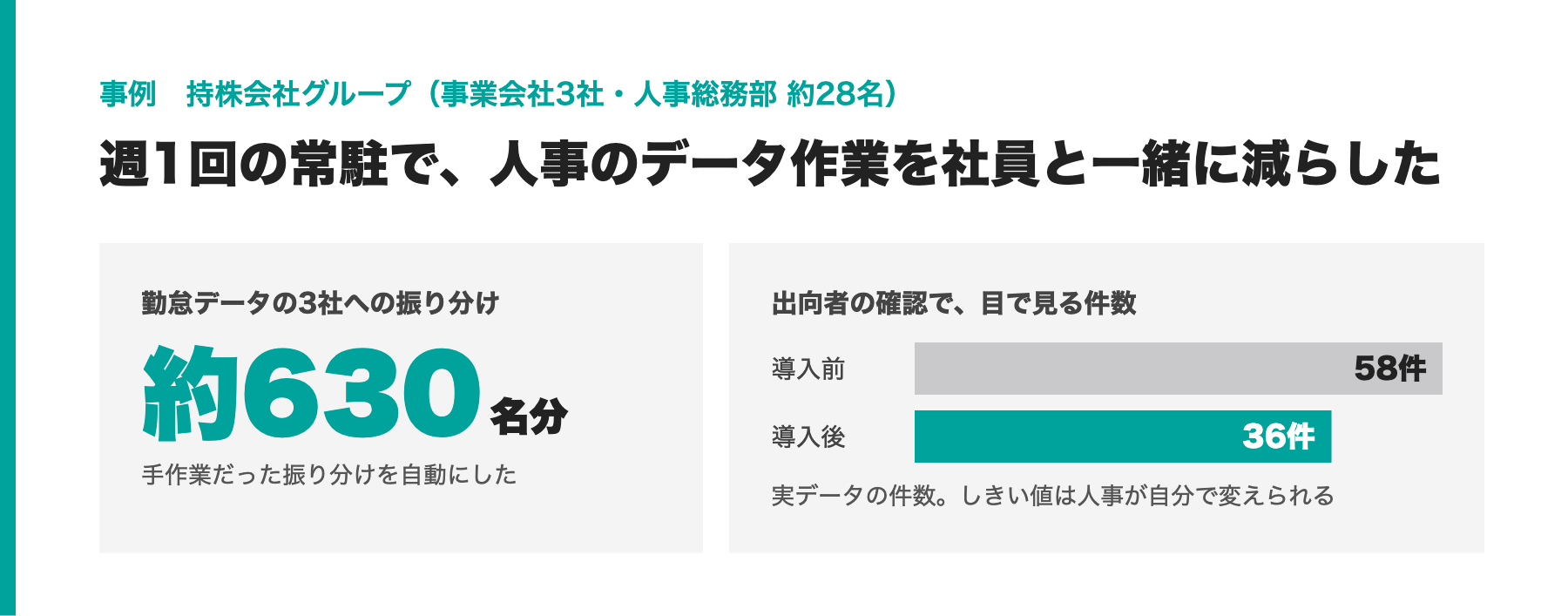
As an example, we supported a holding company group (3 operating companies, HR/general affairs department of about 28 people). Since attendance, payroll, and secondment data were inconsistent across companies, we worked on-site one day a week to build systems together with the staff. The allocation of attendance data to the 3 companies was automated for about 630 employees, and the number of secondment records requiring manual review dropped from 58 to 36. Thresholds and monitored items were handed over so the HR team could change them themselves.
How much does one day per week of on-site support cost?
Our one-day-per-week on-site support starts at 350,000 yen per month (excluding tax). The price varies mainly based on the following three factors.
- The number of days on-site (one day a week, two to three days a week, or full-time)
- The number of departments involved and whether integration with internal systems is needed
- The effort required for security reviews and permission arrangements
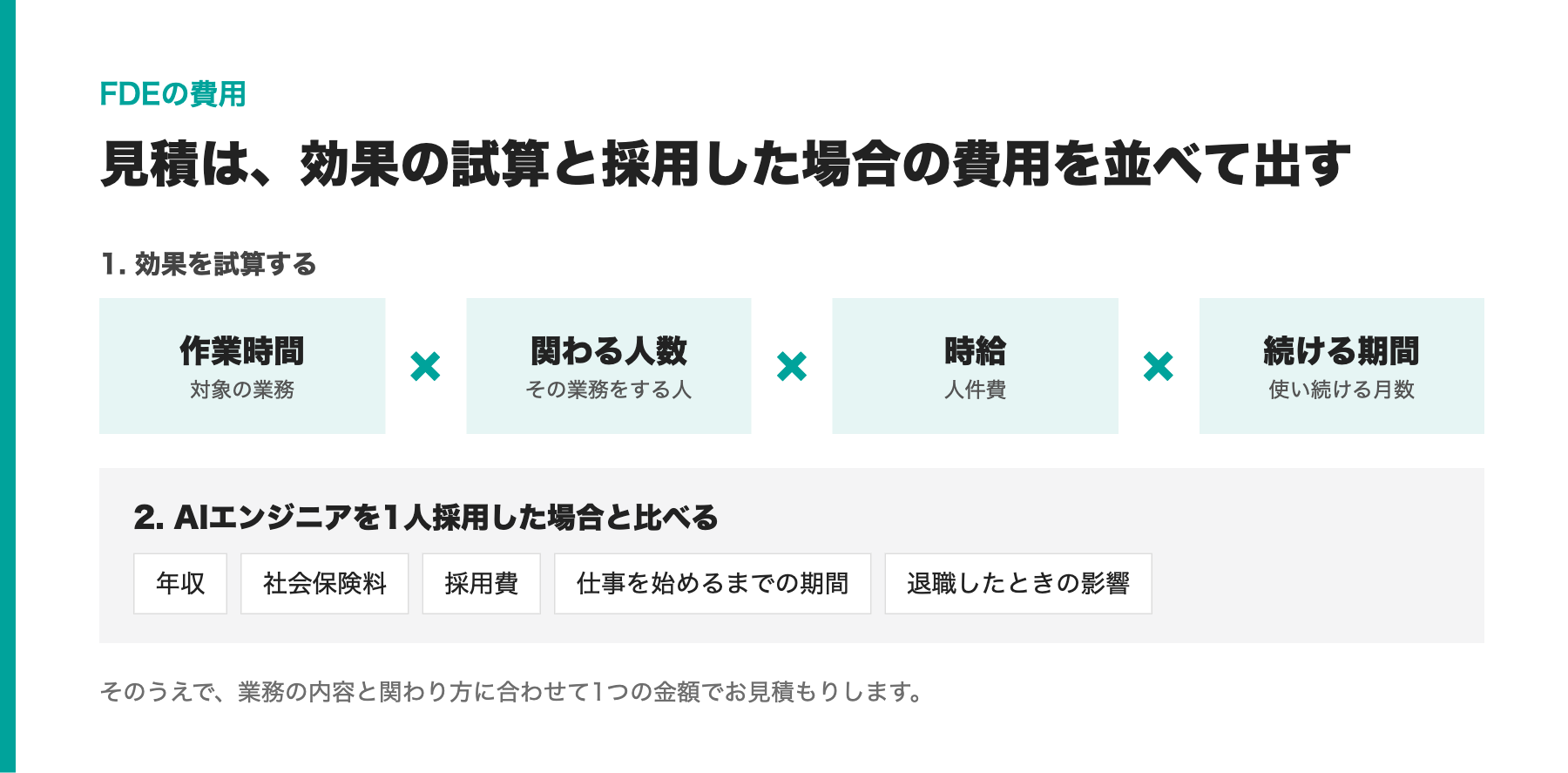
We provide a single quote after learning about your operations and the desired level of involvement. At that time, we estimate the impact as: hours spent on the target operations × number of people involved × hourly rate × duration, and compare it with the cost of hiring one AI engineer. Contracts are quasi-delegated and monthly, with an initial term of three months or more.
Frequently asked questions
Q. With FDE-style support, what accounts for the difference between the 300,000-yen-per-month range and over 1,000,000 yen per month?
A. The main differences are the number of days on-site and what remains when the support ends. Building fixed deliverables remotely keeps costs down. Working on-site to review operations and handing over to the point where employees can make changes themselves adds that time to the cost.
Q. Can we request support even if we haven't decided what to build?
A. Yes. In our case, we start by reviewing your operations in the first two weeks and creating a prioritized list of what you want to do with AI.
Q. If we start with one day a week, can we increase the days later?
A. Yes. If the workload grows, we will discuss and decide on switching to two to three days a week or full-time on-site support.
Q. Can we request support entirely online?
A. Our FDE model is premised on developing while observing operations on-site, so we work on-site at least one day a week. If you prefer primarily online support, we offer other formats such as accompaniment support.
Read more in our report
The content of this article is covered in more detail in our report. It includes results from actually running AI on fictional data, as well as materials for explaining the initiative internally.
Guide to Choosing Between FDE-Style Support and In-House FDE Development (Free Download)
Let's determine together in 30 minutes which model fits you
For how our FDE engagements work and case studies, please see the AIworker FDE page.
AIworker Inc. offers a free 30-minute consultation. We will ask about the operations that currently take up your time and what you want to keep in-house, and together determine which model fits you: primarily remote, one day a week, or full-time on-site. Consultations at the stage where you haven't yet decided what to build are also welcome.