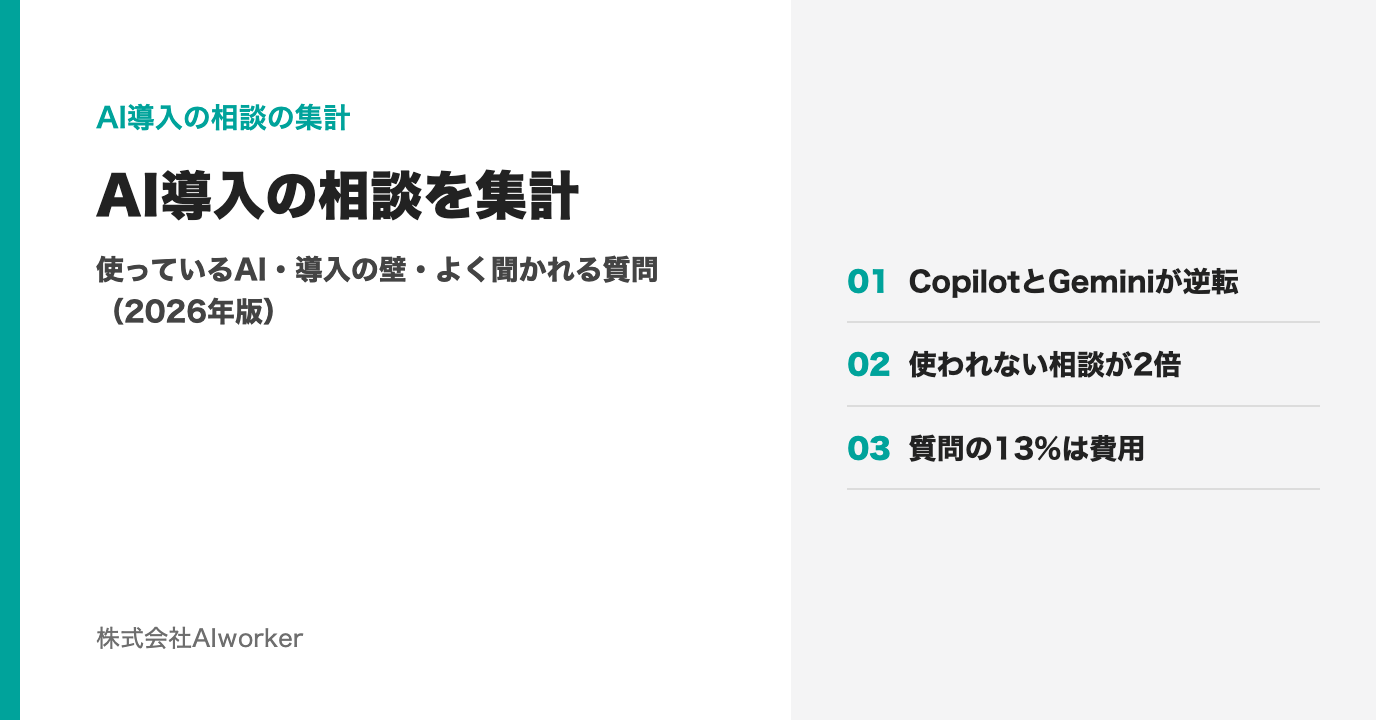
I'm Sugimoto, CEO of AIworker, Inc. Among the new AI adoption consultations our company received from May 2025 to November 2026, I re-read the initial meetings for which recordings remain, and counted the AI tools the client companies use, the reasons they are stuck in adoption, and the questions they asked us. Company names are withheld; only the numbers are published.
First, here are three conclusions.
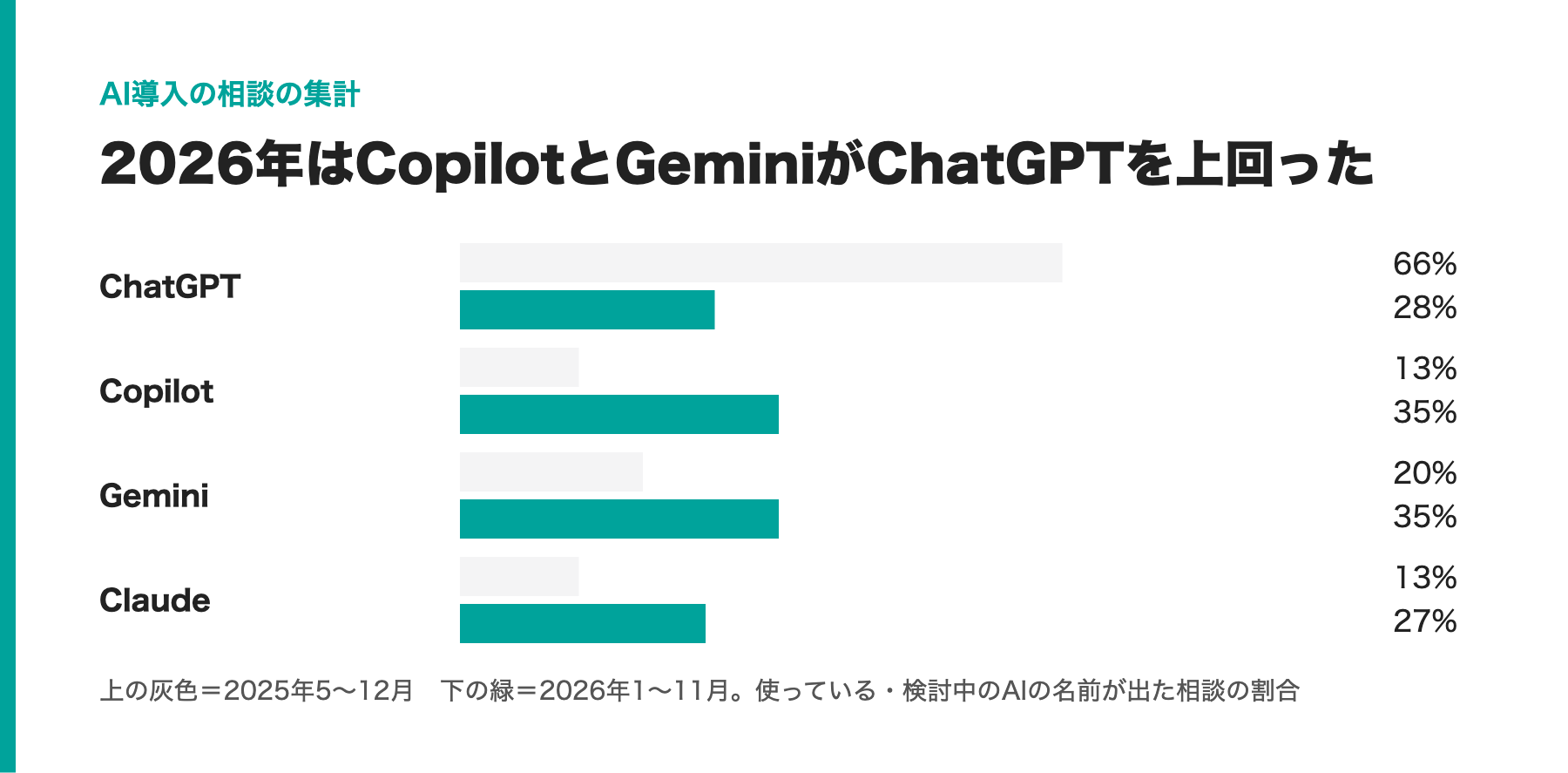
- The lineup of AI tools in use has changed. In 2025, ChatGPT was at 66%, but in 2026 Copilot and Gemini are both at 35%, surpassing ChatGPT's 28%.
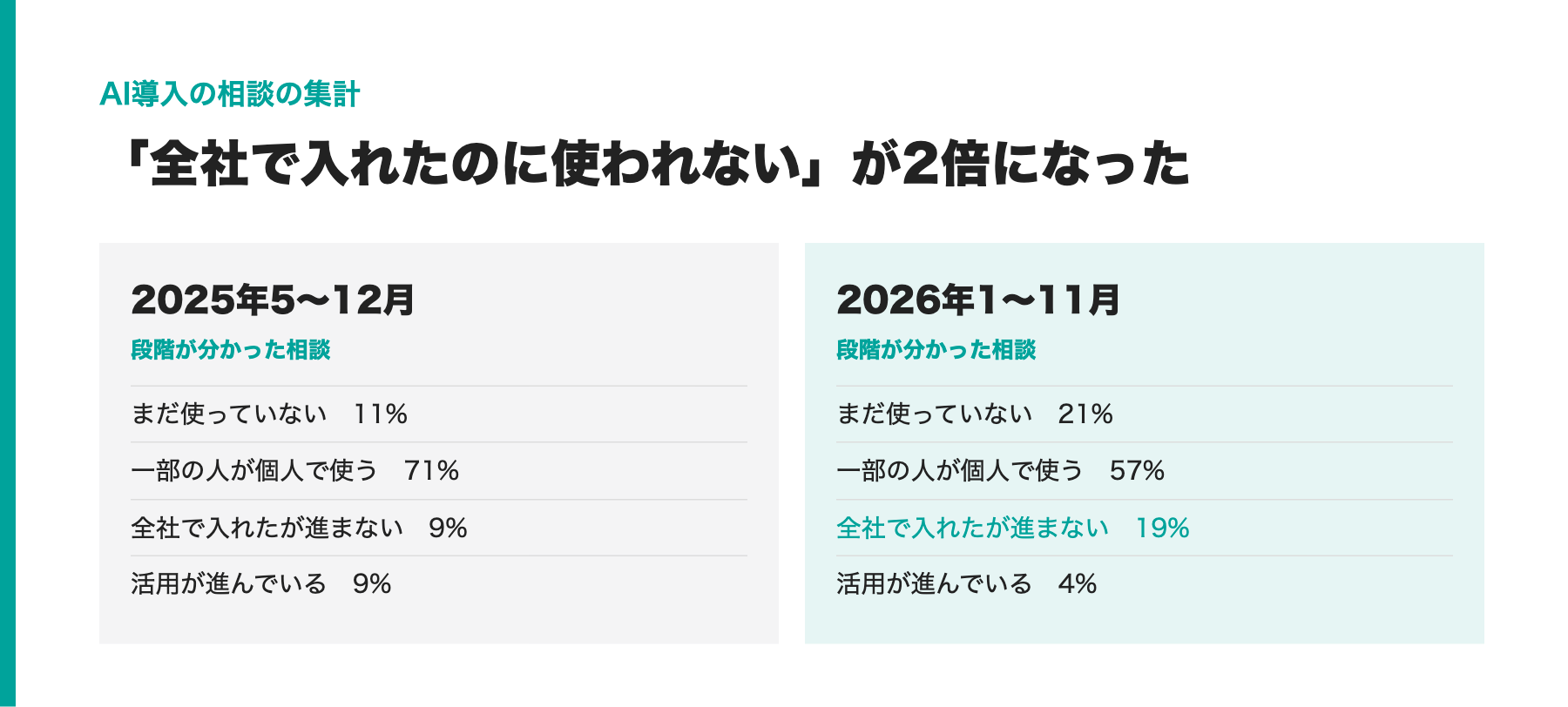
- Consultations about "we rolled out AI company-wide but nobody uses it" increased from 9% in 2025 to 19% in 2026.
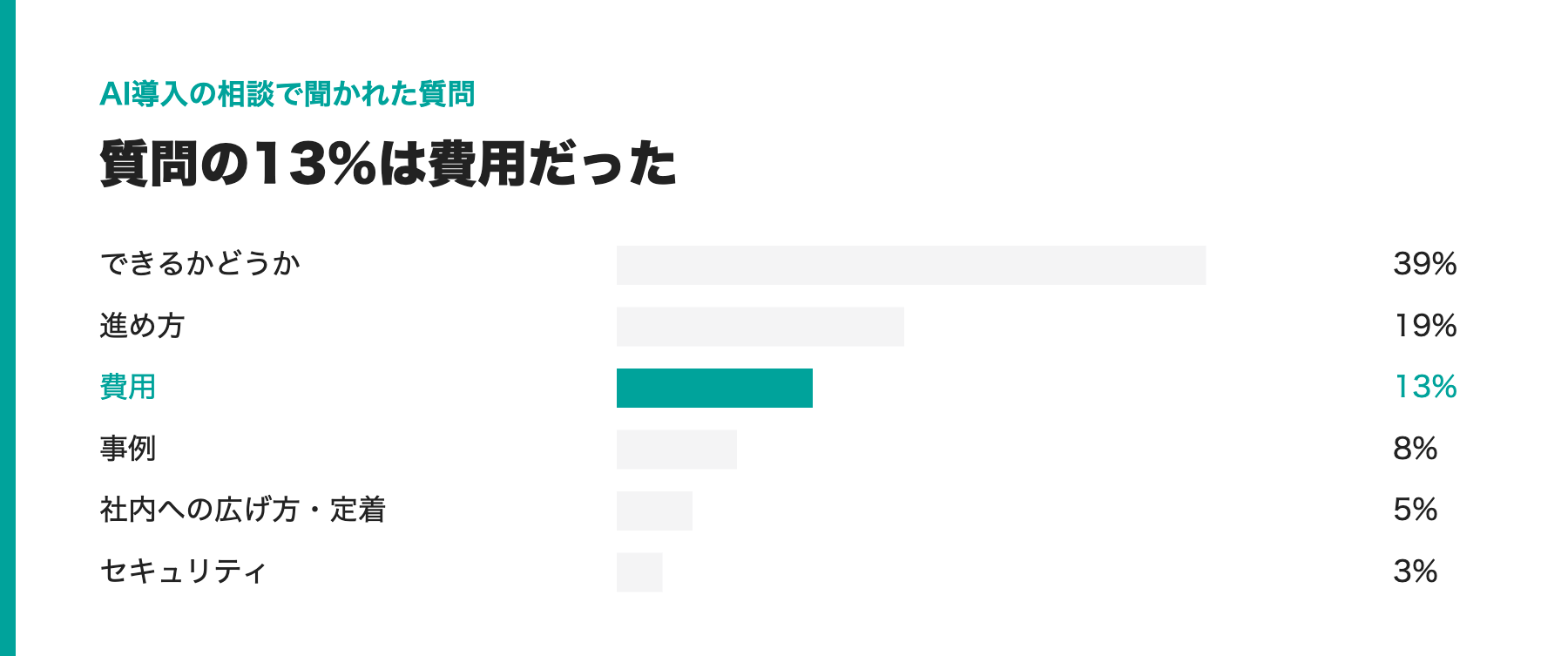
- Of the questions asked in consultations, 13% were about cost. This means many companies are evaluating AI without knowing "how much it will cost."
Scope of the aggregation
| Item | Details |
|---|---|
| Period | May 2025 – November 2026 |
| Target | New AI adoption consultations among meetings with recordings and transcripts |
| Range read | The first 15 minutes of each meeting |
| Counting method | Items were classified using AI, and the aggregation was done with a program (details at the end of the article) |
Regular meetings with existing clients, meetings with partner companies, internal meetings, and recruitment interviews were not counted.
AI tools in use: from ChatGPT to Copilot and Gemini
I counted the companies whose consultations mentioned the names of AI tools they use or are considering in-house. Since a single company may use multiple AI tools, the totals do not add up to 100%.
| AI | May–Dec 2025 | Jan–Nov 2026 |
|---|---|---|
| ChatGPT | 66% | 28% |
| Copilot (Microsoft 365) | 13% | 35% |
| Gemini (Google Workspace) | 20% | 35% |
| Claude | 13% | 27% |
| Custom AI built in-house | 16% | 17% |
In the consultations, many companies said they had started using the AI that comes bundled with business software they already have under contract, such as "all employees have Microsoft 365 accounts, and Copilot is already installed." In about 20% of the new consultations in 2026, the names Copilot or Gemini came up together with talk of contracts or company-wide rollout.
As a result, in 2026 consultations, worries in the form of "we installed Copilot but don't know what to use it for" or "we opened Gemini to the whole company, but only a few people use it" are increasing.
"Installed but unused" has doubled
I classified the client companies' AI usage into four stages (only consultations where the stage could be determined were included in the base).
| Stage | May–Dec 2025 | Jan–Nov 2026 |
|---|---|---|
| Not yet using | 11% | 21% |
| Some individuals using it on their own | 71% | 57% |
| Rolled out company-wide but adoption is not progressing | 9% | 19% |
| Adoption is progressing | 9% | 4% |
The most common stage is still "some individuals using it on their own." However, in 2026, "rolled out company-wide but adoption is not progressing" reached 19%, roughly double the 2025 figure.
Many companies have progressed to the point of rolling out tools company-wide. An increasing number are stuck at the next step: making AI actually used in daily work.
Reasons for being stuck in adoption
I grouped consultations that discussed reasons for being stuck in adoption into similar categories and counted them. A single company may have mentioned multiple reasons.
| Reason | Share |
|---|---|
| No one who can use it well or drive adoption | 34% |
| Cannot get internal buy-in, procedures not progressing | 30% |
| No budget, cannot build a cost justification | 29% |
| Concerns about security and information leaks | 24% |
| Cannot predict effectiveness or accuracy | 17% |
| Data and internal systems not ready | 8% |
In addition, 34% had individual reasons that did not fit any of the above.
The most common issue was "people." Even when tools are ready, there is no one to figure out how to use them for the business and spread that usage to others.
By department, among consultations from DX promotion or information systems departments, 41% were about internal capability building, wanting to "develop people who can build AI in-house." Among consultations from executives it was 13%, showing that the departments handling AI on the ground are more inclined to develop people internally rather than keep relying on outside providers.
Frequently asked questions
I converted the questions asked during consultations into single-sentence forms, like something you would type into ChatGPT, and counted them.
| Question type | Share |
|---|---|
| Feasibility (can it be built, can it be connected) | 39% |
| Approach (where to start, training formats, etc.) | 19% |
| Cost | 13% |
| Case studies | 8% |
| Spreading adoption internally, making it stick | 5% |
| Security | 3% |
| How to choose a vendor | 2% |
| Other | 11% |
Below are the most common questions by topic and our answers. All prices exclude tax.
How much does AI system development cost, and how long does it take?
In our case, validation (PoC) starts at 3 million yen, full development starts at 10 million yen, and post-launch operation and maintenance starts at 150,000 yen per month. We first narrow down to a single business process and build a prototype, then proceed to full development only for the parts proven to work. Details are on our AI agent development page.
How much does AI training for employees cost per person? Can subsidies be used?
Job-specific training of 12 hours costs 400,000 yen per trainee. It can be structured to qualify for the Human Resources Development Subsidy, but eligibility and the subsidy amount are determined by the Labor Bureau. Under the August 2026 revision, training on generic prompting is no longer eligible, so the program must be tailored to job content. For details, see our generative AI training page.
Can you build an AI that searches internal past documents and manuals to answer questions?
Yes, we can build it. What determines cost and accuracy is where and in what form your documents are stored, and what counts as a passing answer. First, we confirm where the documents are kept, then make it able to answer frequently asked questions in order.
I don't know which of our business processes would benefit from using AI
We start by mapping out your workflows together. We ask the people in charge to walk us through their daily work; tasks that are time-consuming and also have well-defined decision rules are the first candidates to tackle.
Can you build AI that uses drawings and past project data to assist with design and quoting decisions?
Yes, we can. For example, we developed an AI that creates quotes for custom industrial machinery from drawings and past quotes, reducing the time per quote from 150 minutes to 30 minutes. Details are on our quoting AI page.
For work involving confidential information, can we use AI in a way where inputs are not used for training and nothing leaks outside?
Yes. With business contracts, inputs can be configured so they are not used for AI training. In addition, it is important to establish internal rules on what information may be entered into the AI, and to define access permissions in advance.
We introduced AI company-wide, but nobody uses it. How can we make it stick?
In most cases, the reason it goes unused is that each department hasn't decided "what to use it for." With our accompaniment support, we go into the field, find use cases together with your team, and turn them into working systems on the spot. Pricing is 200,000 yen per month (Ume), 450,000 yen per month (Take), and 950,000 yen per month (Matsu). Details are on our accompaniment support page.
After outsourcing AI development, can we transition so that we can fix things in-house?
Yes. What we do is develop "in-house FDEs"—training employees who know the business to become people who can build and fix AI systems. Starts from 1.95 million yen for three people. See our in-house FDE development page for details.
What these results tell us
Most companies have moved past the stage of deciding "whether to adopt tools." In 2026, the focus of consultations has shifted to how to use the tools already adopted within actual work, and who will take ownership of that.
The fact that 13% of questions were about cost is also an important point from the perspective of those evaluating options. AI development and support services vary widely in price from company to company, and many companies were stuck, unable to produce figures for internal approval without knowing market rates. This is exactly why we publish our pricing.
Methodology and caveats of this analysis
- The data covers only meetings for which we kept recordings and transcripts. These are figures for companies that consulted us, not an average across all Japanese companies.
- We used AI (Claude) to classify the transcripts of the first 15 minutes of each meeting by category. Classification results were saved per meeting, and the aggregation was done programmatically.
- Meetings judged as "unclear" were excluded from the sample for that category. Therefore, the sample size differs by category.
- Questions were counted after converting what the other party said into single-sentence form, with company names removed, and entering them into the AI. Question themes were determined from a randomly selected subset of questions, and all questions were then assigned to those themes.
- Company names, individual names, and the contents of individual sales negotiations are not disclosed.
We plan to update this analysis every six months.
Read the full report
The content of this article is covered in more detail in our report. It includes detailed results of the analysis, as well as materials you can use when presenting internally.
Sort out where to start with AI adoption in 30 minutes
At AIworker Inc., we offer a free 30-minute consultation. We ask about your current workflows and how you use AI, and provide you with a clear picture of where to start.