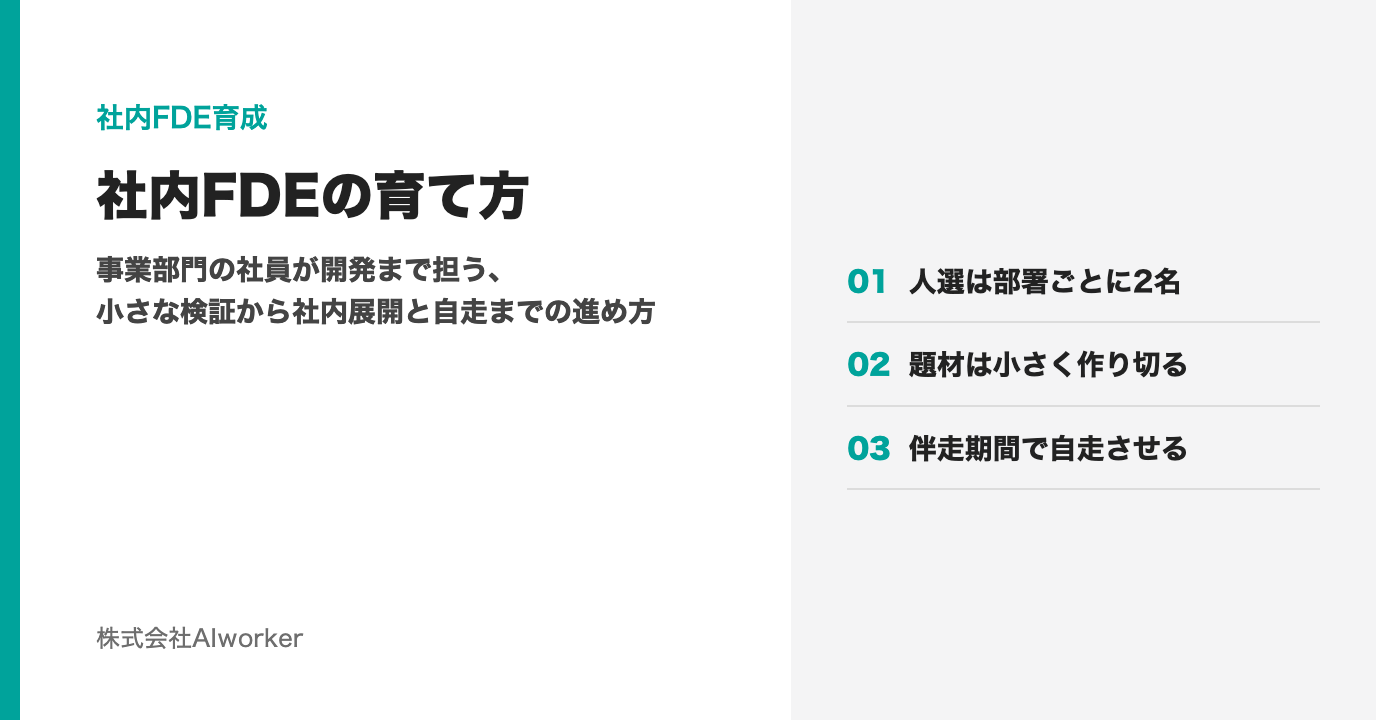
For HR and DX promotion managers who want business division staff to take on everything, including building AI-powered systems. In-house FDEs cannot be developed through training alone. You select employees who know the work, have them complete one small project, go through a period of using and refining it in production, and only then do they become people who can fix things themselves.
In this article, we explain step by step, based on the design of our own training program, how a company with no in-house development expertise can combine training with on-the-job support and move from small validation to company-wide rollout and self-sufficiency. We also summarize key points when developing people in multiple business divisions simultaneously.
What kind of person is an in-house FDE?
FDE (Forward Deployed Engineer) originally refers to engineers who embed themselves at customer sites, identify problems, and solve them with technology (see the article What is an FDE for details). At our company, we call people who take on this role internally "in-house FDEs."
An in-house FDE is someone who looks at their own department's work, finds areas that AI can change, actually builds the systems, and spreads them to other employees. Being able to write code is not a requirement. The people who know the exceptions and the reasons behind procedures best are the employees who have been doing that work.
Can they be developed even without in-house development expertise?
Yes, they can. However, having them attend a training session once is not enough. After training, if there is no opportunity to try things in their own work, get stuck, and resolve those issues, the actual work on the ground often remains unchanged even after completing the course.
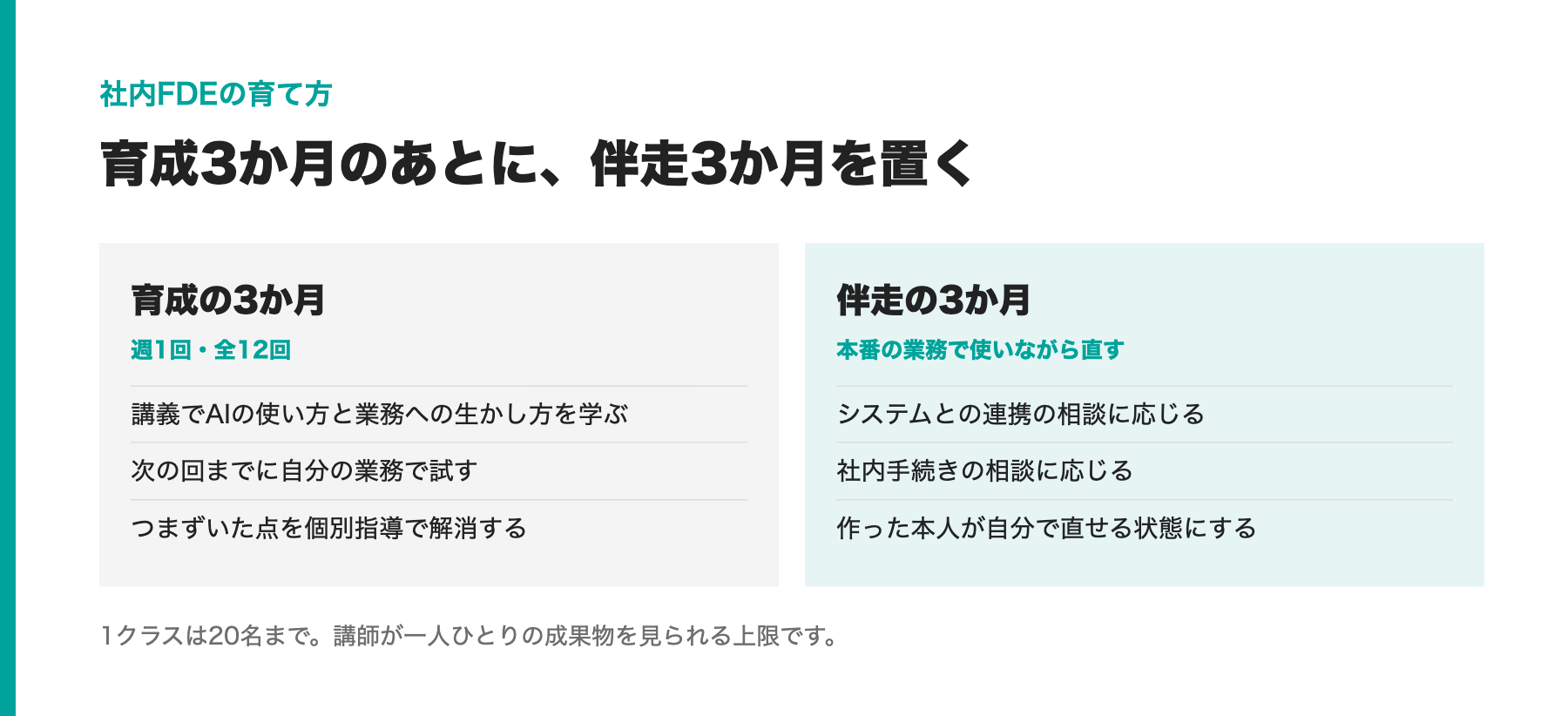
That is why our in-house FDE development program combines training with hands-on support. In the first three-month training phase, held once a week for 12 sessions total, participants learn how to use AI and apply it to their work in lectures, try it in their own work before the next session, and resolve any issues through individual coaching—a cycle repeated every week.
The second three-month support phase is a period of using and refining the tools in real work. Our instructors handle consultations on system integration and internal procedures. We cap each class at 20 participants because that is the maximum number for which instructors can review each person's deliverables. The standard is six months combining training and support, but you can also choose only the three-month training phase.
Who should be selected as participants?
The difference between companies where training ends as a one-off and companies where employees keep building systems themselves often comes down to who is selected. We look at the following five criteria when selecting people.
- Has handled the work for at least two years and can explain the exceptions and the reasons behind procedures
- Can articulate problems in their own words, such as "this reporting takes several hours every week"
- Does not mind testing and iterating
- Their manager has committed in advance to allowing 20% of working hours for lectures and assignments
- There are colleagues in the same section who will use the prototypes
When selecting, we choose two people per department. With only one person, there is no one to consult with, and progress tends to stall. We also avoid selecting only volunteers; choosing based on both manager recommendations and the individual's own interest keeps the work aligned with the department's priority issues.
What kind of project should the first validation start with?
Choose something small for the first project. A good rule of thumb is a task that recurs weekly or monthly, takes 30 minutes or more each time, and has a mostly fixed procedure. Then, start with something where failure has no direct impact on customers or partners. If a large system is chosen as the first project, it often cannot be finished in three months. Tasks centered on documents and spreadsheets that occur every month are commonly chosen—for example, in manufacturing, compiling daily reports or drafting defect reports; in logistics, aggregating waiting times from operation records.
What happens during the three-month training phase?
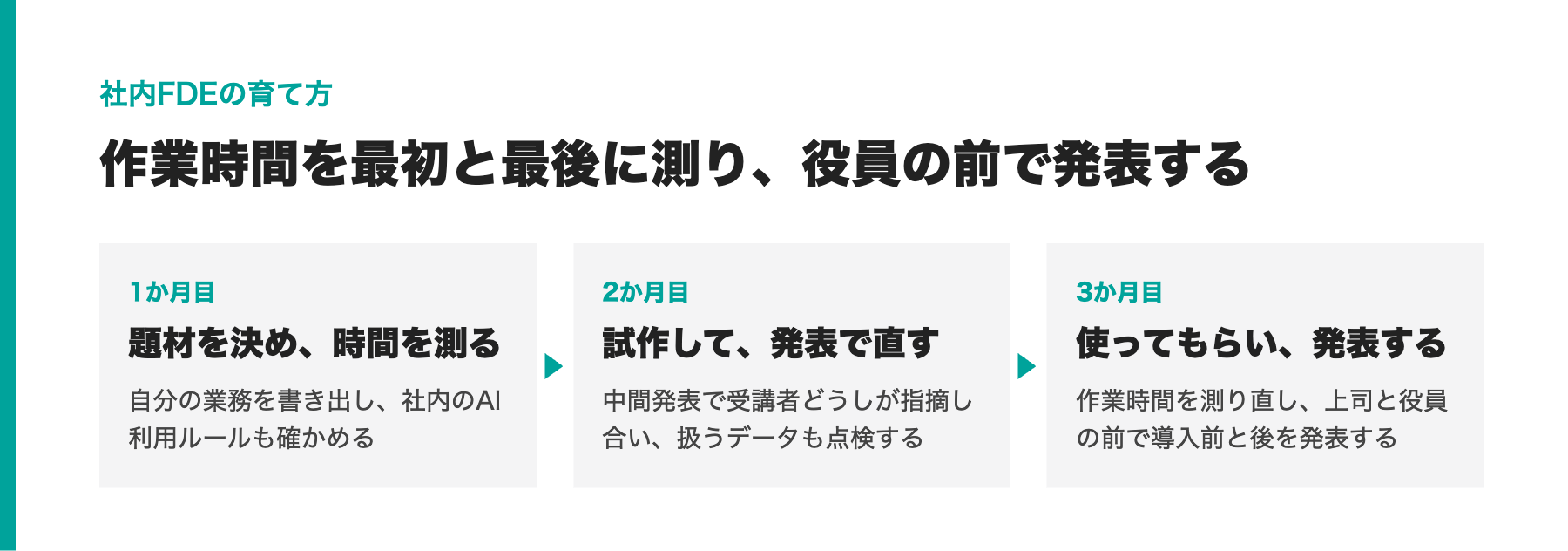
In the first month, participants document their own work, choose one project, and measure the current time spent on it. This is also the time to confirm the company's rules for AI use.
In the second month, they build a prototype and give each other feedback in an interim presentation. This is also the stage to check whether the data being handled complies with internal rules.
In the third month, they refine the tool while having colleagues use it. They re-measure the time spent and present the before-and-after results to their manager and executives. The time measured in the first month becomes the material for explaining the results here.
Can business division staff really handle development on their own?
Business division staff can handle building systems for use within their own department. However, the parts that connect to internal systems are where business divisions alone tend to get stuck.
That is why at our company, we develop people by combining a "Business Division Course" for business division staff and an "Engineer Course" for in-house engineers and IT departments. Business division staff alone may build systems that cannot connect to internal systems, while engineers alone may build systems that connect but are not used in the field.
| 業務部門コース | エンジニアコース | |
|---|---|---|
| Target | Sales, administration, management, production control, quality assurance, etc. | In-house engineers, IT departments, production engineering, etc. |
| Goal after 3 months | Complete one system that is used within their own department | Get what business division staff built running in the production environment |
| Milestone at 6 months | Fix things themselves when the work changes, and choose the next project on their own | Run and maintain what the business division built in the production environment |
The two courses can be run separately or simultaneously. When there is urgent development work, our engineers can build it on-site in parallel, with a gradual transition to in-house ownership.
What we delegate to in-house FDEs is building systems for drafting, aggregation, cross-checking, and similar tasks. Final decisions involving quality, safety, or money remain with people even after the systems are built.
How do you move from small validation to company-wide rollout and self-sufficiency?
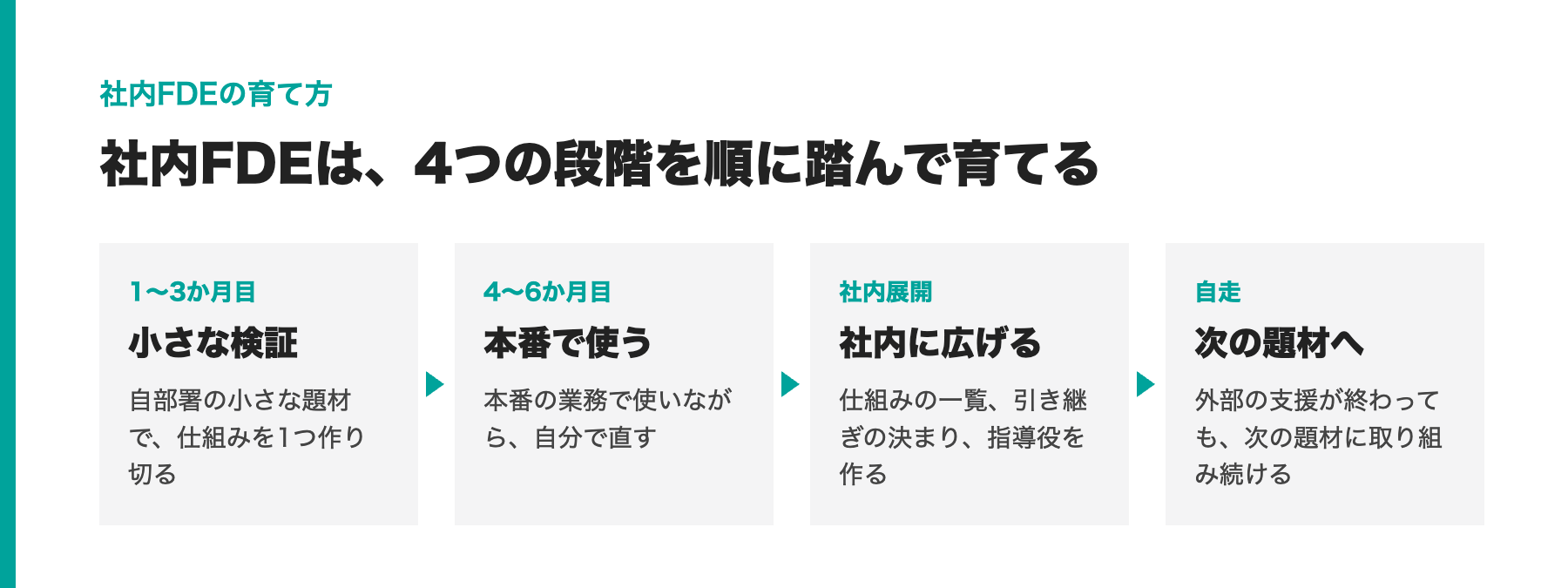
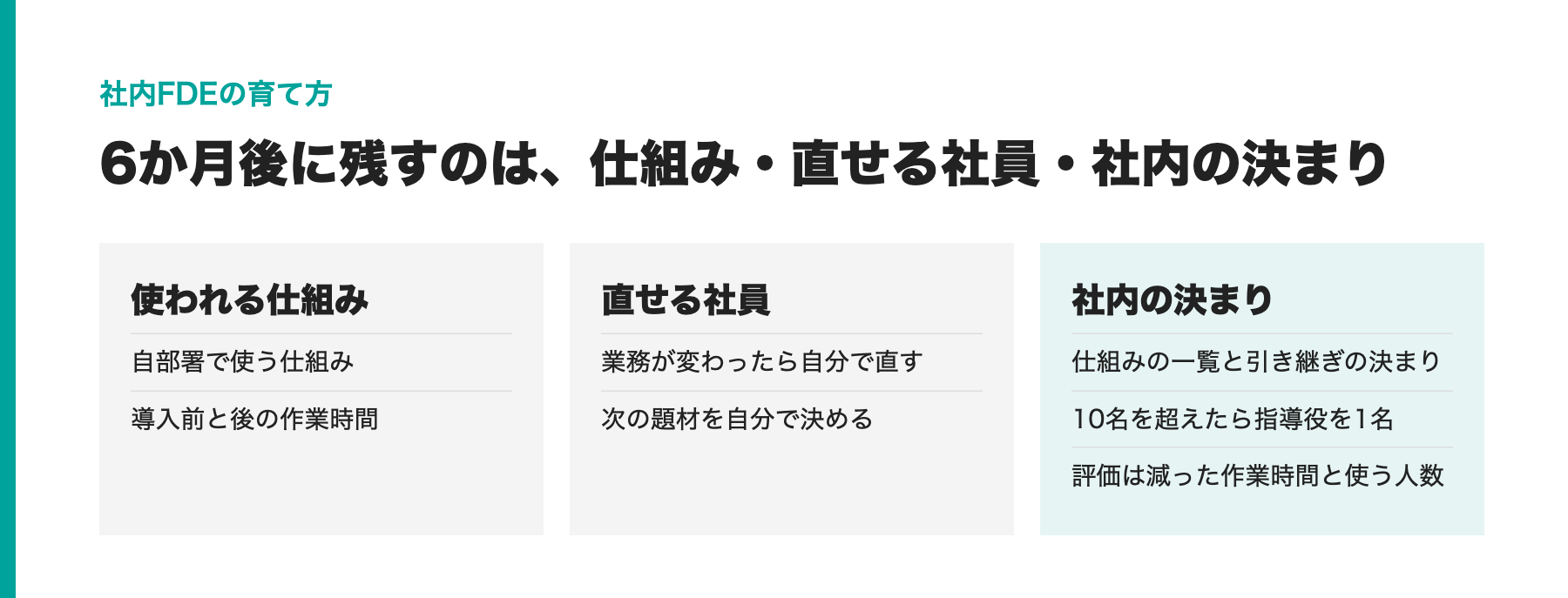
The turning point toward self-sufficiency is not stopping at the third-month presentation, but setting aside months 4 through 6 as a period of using and refining the tools in real work. On that foundation, establish rules for spreading adoption across the company.
First, register the built systems in a catalog. Record the name, the builder, the departments using it, and the data handled, and establish a rule that when someone transfers, the guidebook is handed over to their successor along with the system. This way, the system keeps running even if the builder leaves.
Next, once in-house FDEs exceed 10 people, designate one as a mentor responsible for checking compliance with internal rules and handling consultations. At the same time, have each department list candidate projects to tackle next, and use reduced work hours and number of users as evaluation metrics. With all of this in place, the company can keep taking on new projects internally even after external support ends.
What about developing people in multiple business divisions simultaneously?
The basic approach is to select two people per deployment, each working on a topic from their own department. Since they tackle tasks their department is actually struggling with, the training results remain in place as working systems on the ground.
At a major payment services company we accompanied, employees from non-IT departments who learned the basics at an internal hackathon received support through six one-hour weekly sessions so they could build business apps and AI for their own departments. We did not build anything ourselves; the employees built everything. Over two cohorts we supported 11 departments in total, and all 11 completed working deliverables within the period. These included automatic reminders for unfinished tasks and an AI that answers internal inquiries.
What determines the cost of developing internal FDEs?
The cost mainly depends on the number of people being trained and the duration. It also varies depending on whether you choose the business department course, the engineer course, or both, and whether you include only the three-month training period or the accompanying support as well. That is why we provide a custom quote after learning your headcount and timeline.
Training based on your own business operations may qualify for the Human Resources Development Subsidy. Under the August 2026 revision, generic training content is no longer eligible, and executives are also excluded. To be safe, check eligibility at the stage when you are deciding the curriculum.
Frequently Asked Questions
Q. Can employees without programming experience become internal FDEs?
A. Yes. We do not require the ability to write code. In the major payment services company case, most participants were non-IT department employees who had never used Power Platform (Microsoft's tool for building business apps).
Q. Can we do just the training without the accompanying support?
A. You can apply for just the three-month training period. However, months 4 to 6, when participants refine their tools while using them in real operations, are the turning point toward independent operation, so if there is no one internally to consult with, we recommend including the accompanying support.
Q. What is the minimum number of participants?
A. Our basic unit is two people per department. Each class is capped at 20 participants, a size that allows the instructor to review each person's deliverables.
Q. Can we consult with you even before things are settled internally?
A. Yes. Even if participants and topics have not been decided, we will help you sort out which department and which tasks to start with.
Read More in Our Report
The content of this article is covered in more detail in our report, which includes results from actually running AI on fictional data, as well as materials for presenting the idea internally.
Report on the Strengths and Process of Developing Internal FDEs for All Industries (Free Download)
We will help you sort out, in 30 minutes, which department and which tasks to start with
For details on the training process and the two courses, please see the internal FDE development page.
AIworker Inc. offers a free 30-minute consultation. We will ask which departments and tasks you want to develop, and help you sort out who to select and which topics to start with. Consultations at the stage before internal discussions have begun are also welcome.