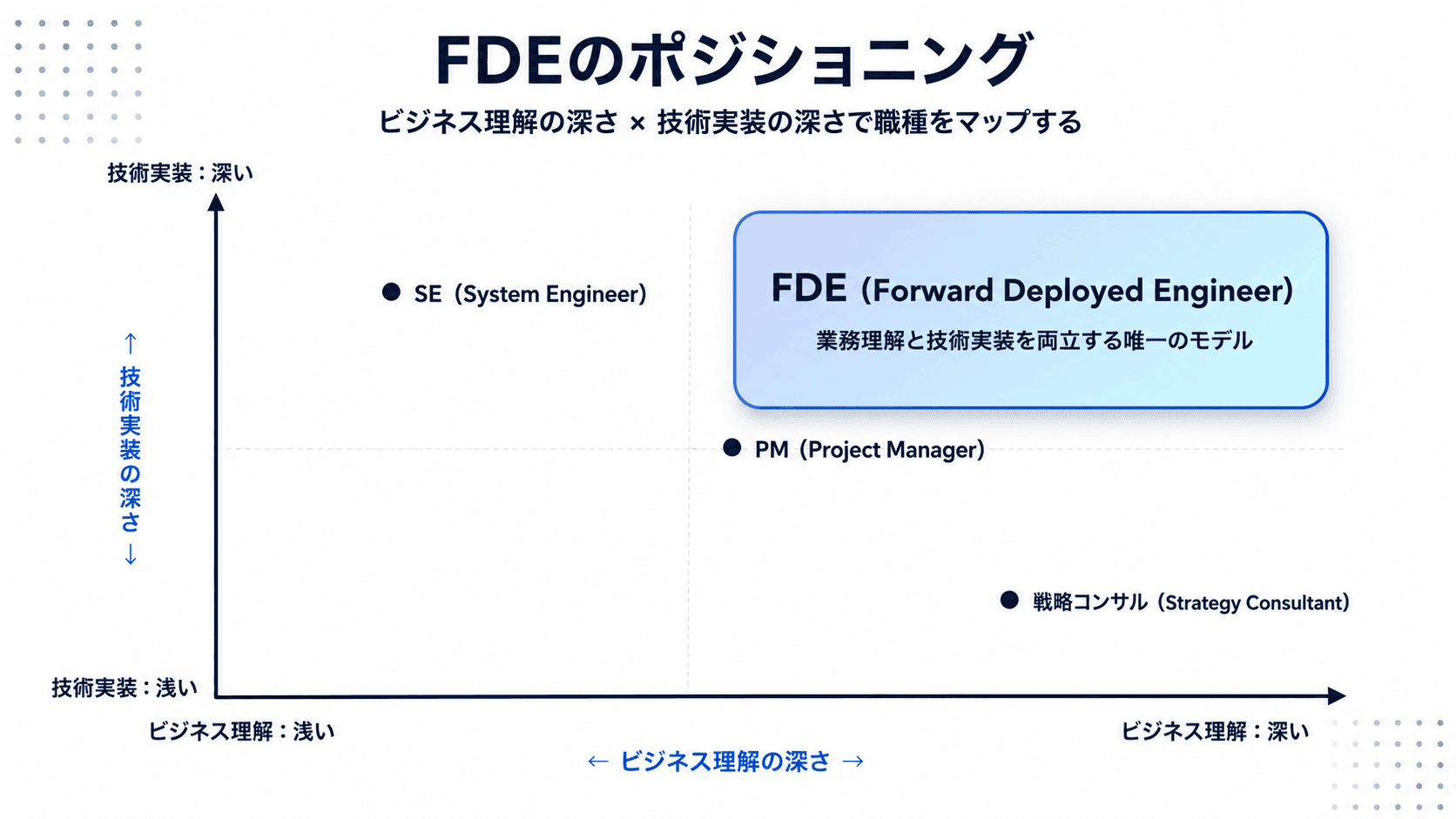
Sharing strategic perspectives and implementation know-how on Forward Deployed Engineers (FDE), AI implementation, moving beyond PoCs, in-house development, and business process redesign. Explained under the principle of "making the complex simple."
Latest Insights
67 articles total / FDE (Forward Deployed Engineer) Special Feature
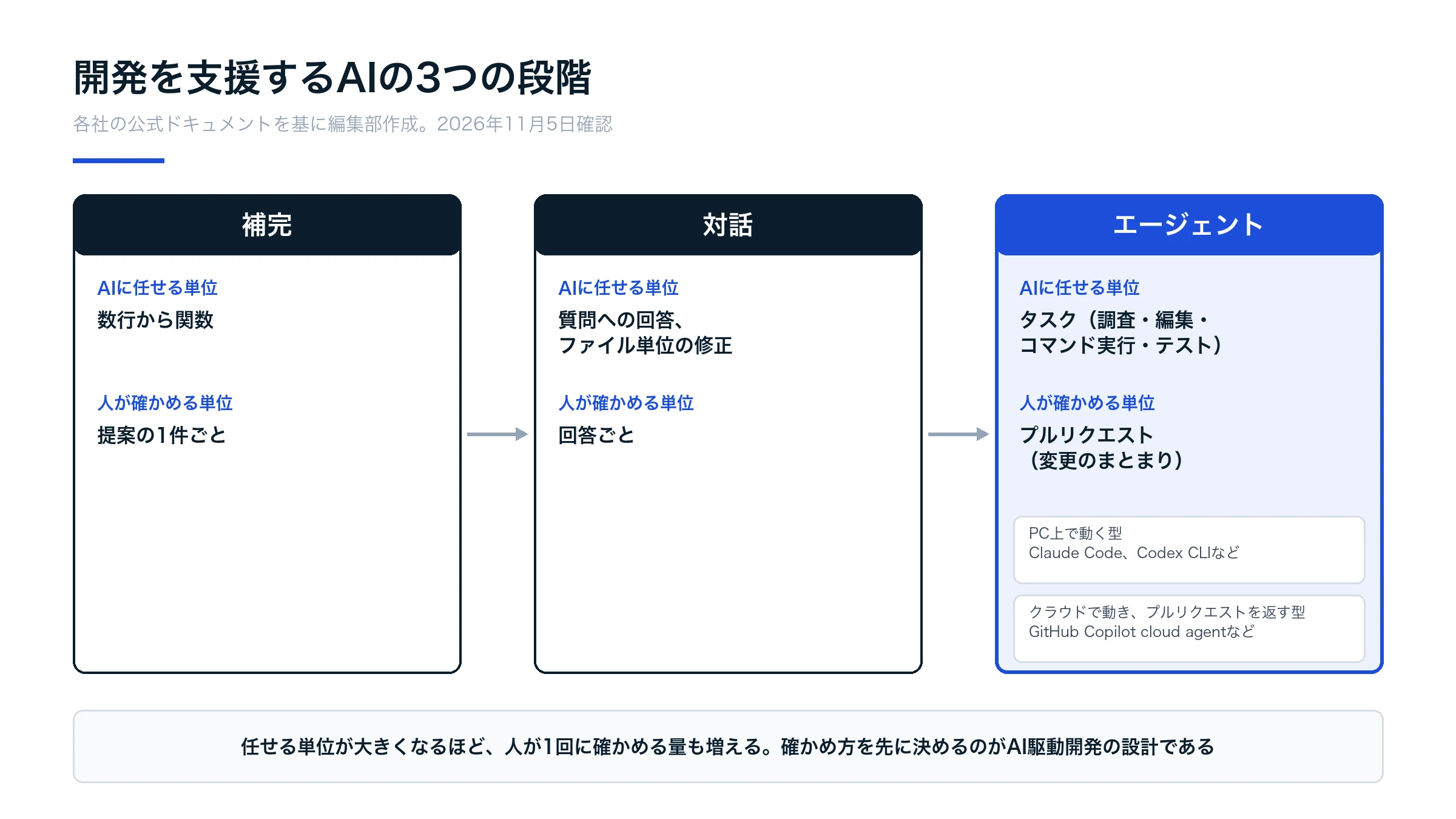
What Is AI-Driven Development? Enterprise Adoption and Operational Design of Coding Agents
AI-driven development is an approach where coding agents handle implementation and testing, while humans own specifications and decision-making. FDX Inc. explains how it differs from spec-driven development and vibe coding, the governance features of major tools, research findings on productivity, and the 5 design decisions for enterprise adoption.
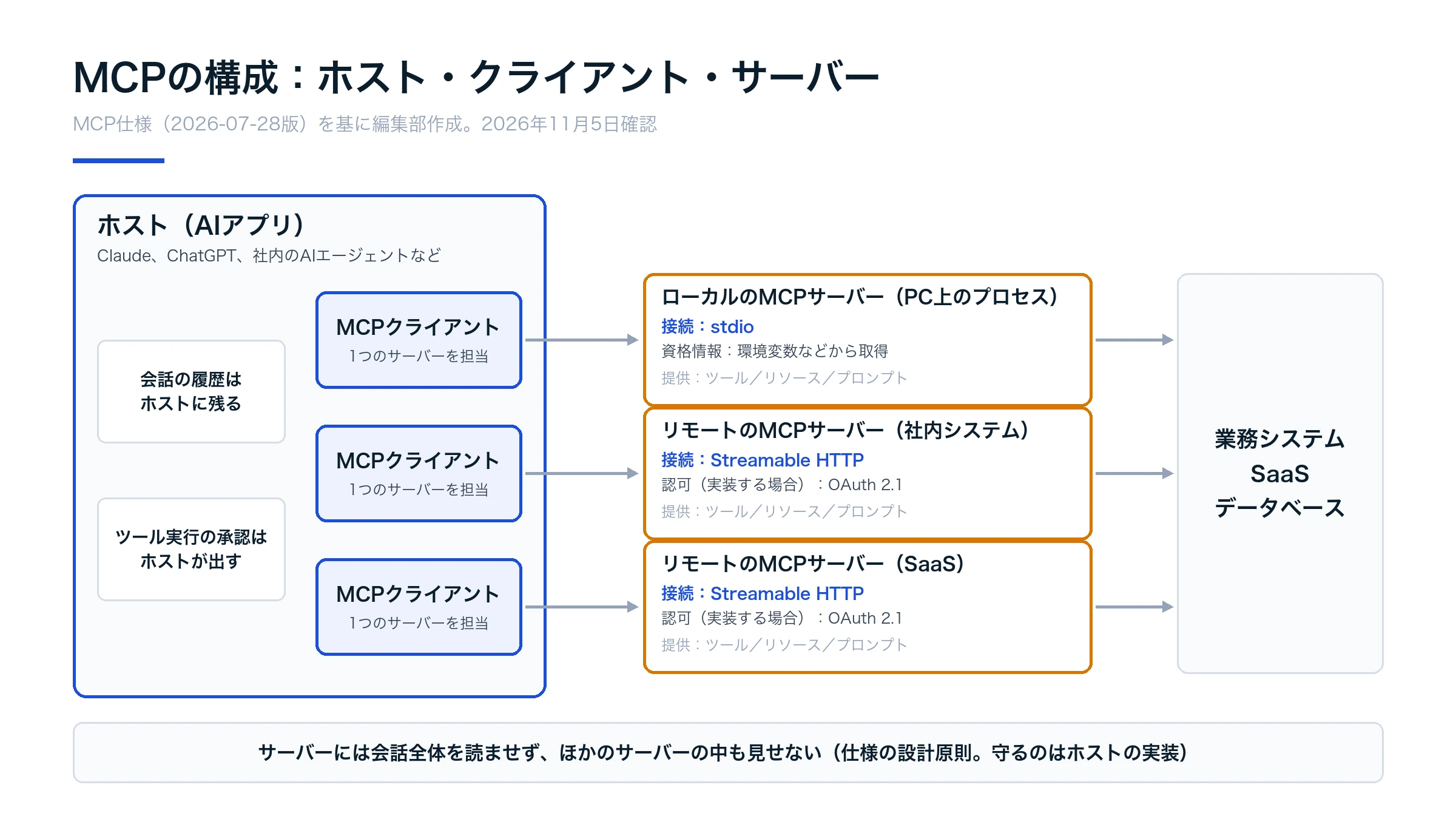
What Is MCP? How MCP Servers Work and Permission Design for Enterprise Adoption
MCP (Model Context Protocol) is a common connection standard that links AI applications with internal systems and SaaS. FDX Inc. explains what changed in the 2026-07-28 specification, how MCP servers work, and the 5 permission design decisions enterprises need to make.
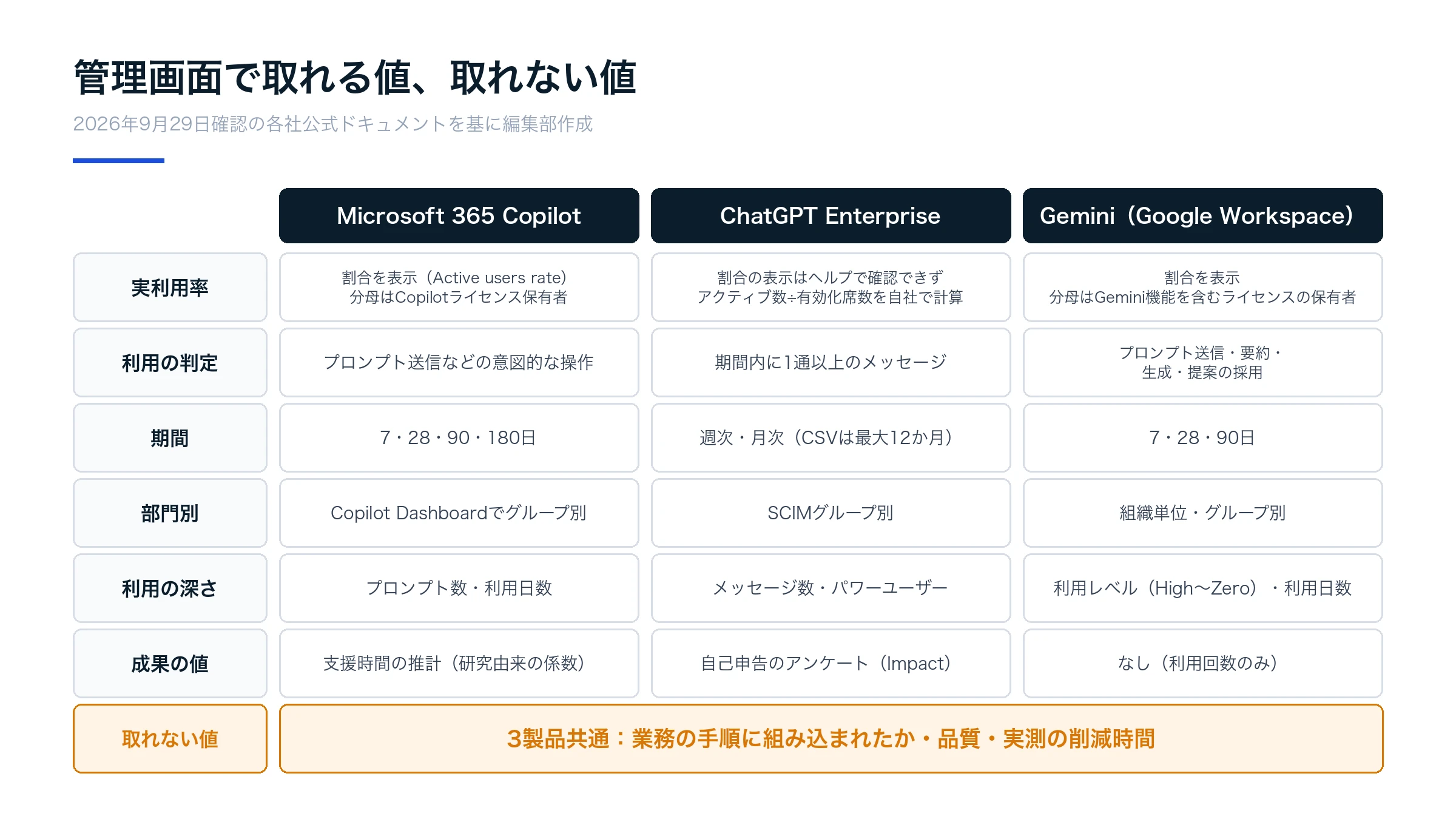
Generative AI Adoption and Usage Rate KPIs | Measurement Sources and Improvement Decisions for Copilot and More
Generative AI usage rates should be measured across distribution rate, active usage rate, and retention rate. FDX Inc. organizes what can and cannot be measured in the admin consoles of Microsoft 365 Copilot, ChatGPT Enterprise, and Gemini, along with improvement decisions by department.
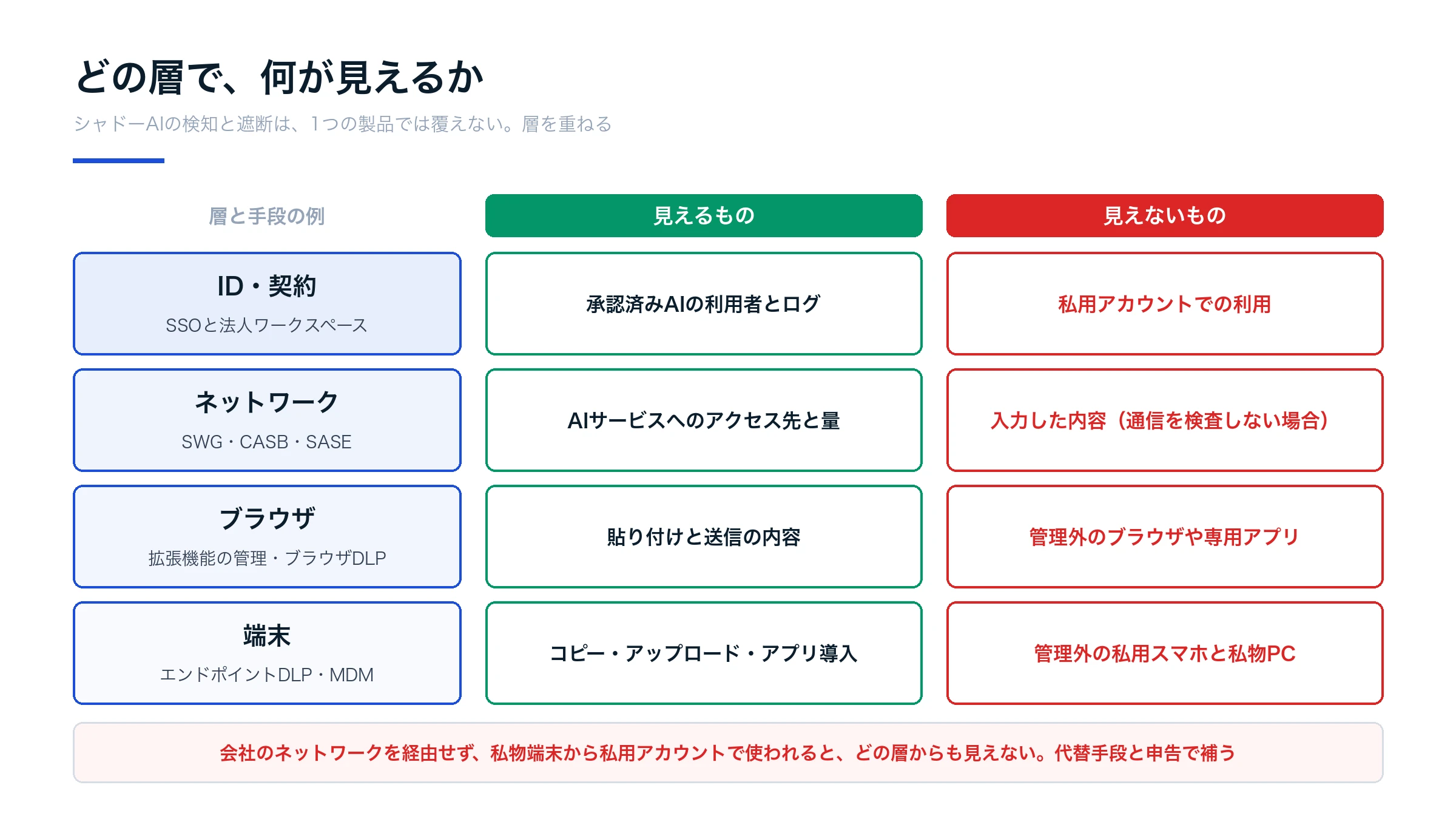
Shadow AI Countermeasures | Why Prohibition Alone Isn't Enough and 4 Control Points
Shadow AI refers to employees using generative AI tools not approved by their company. Based on official announcements about the RIZAP subsidiary incident, FDX Inc. explains shadow AI countermeasures through 4 control points: alternatives, detection, input classification, and initial response.
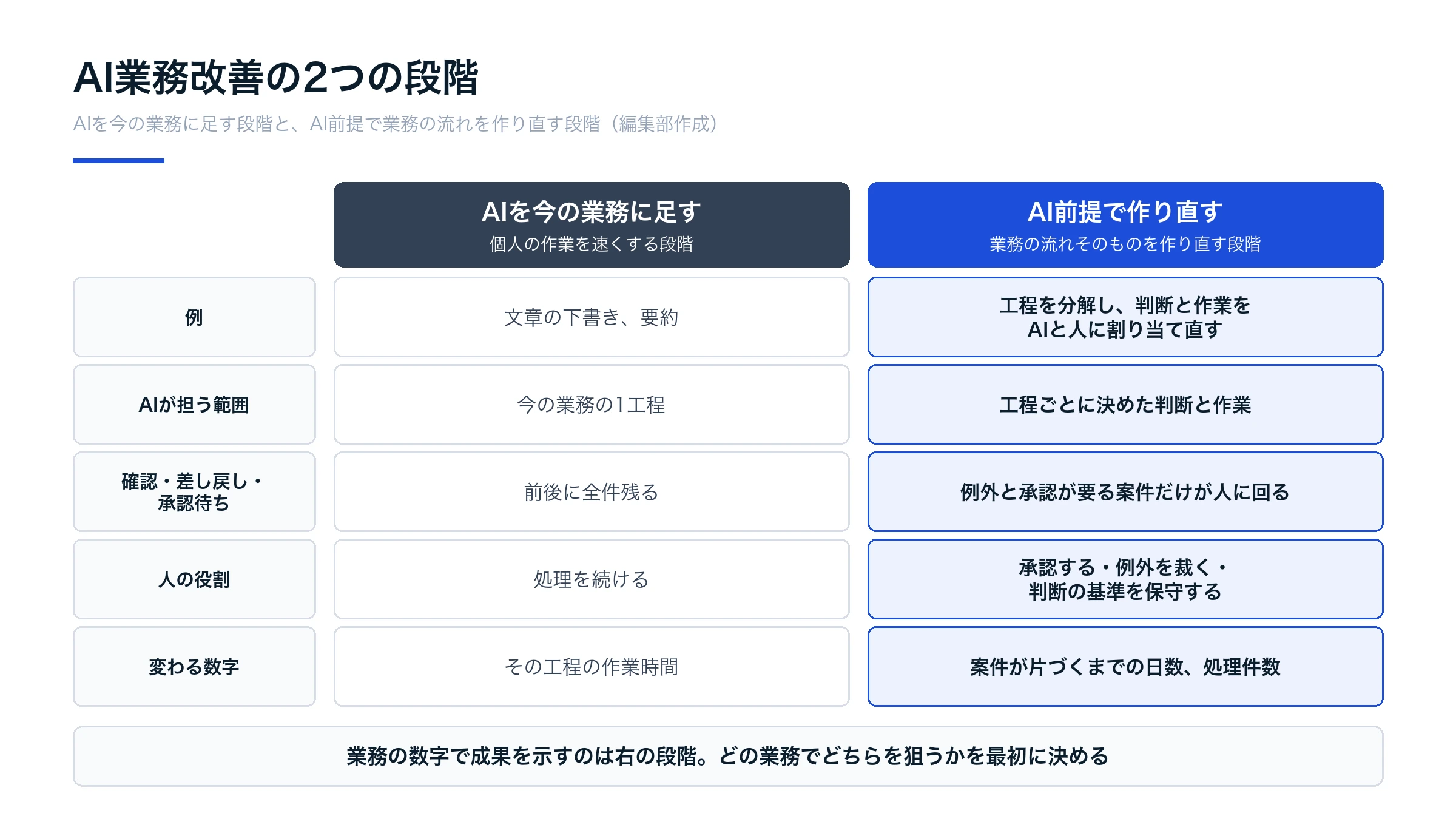
What Is AI-Driven Business Improvement? A 5-Step Process and How to Choose Where to Start
We've organized an approach to AI-driven business improvement that doesn't end with just adding tools. FDX Inc. explains, from the implementation front lines, which processes to start with, how to choose between RPA, generative AI, and AI agents, 5 steps for rebuilding processes with AI in mind, and how to measure results.
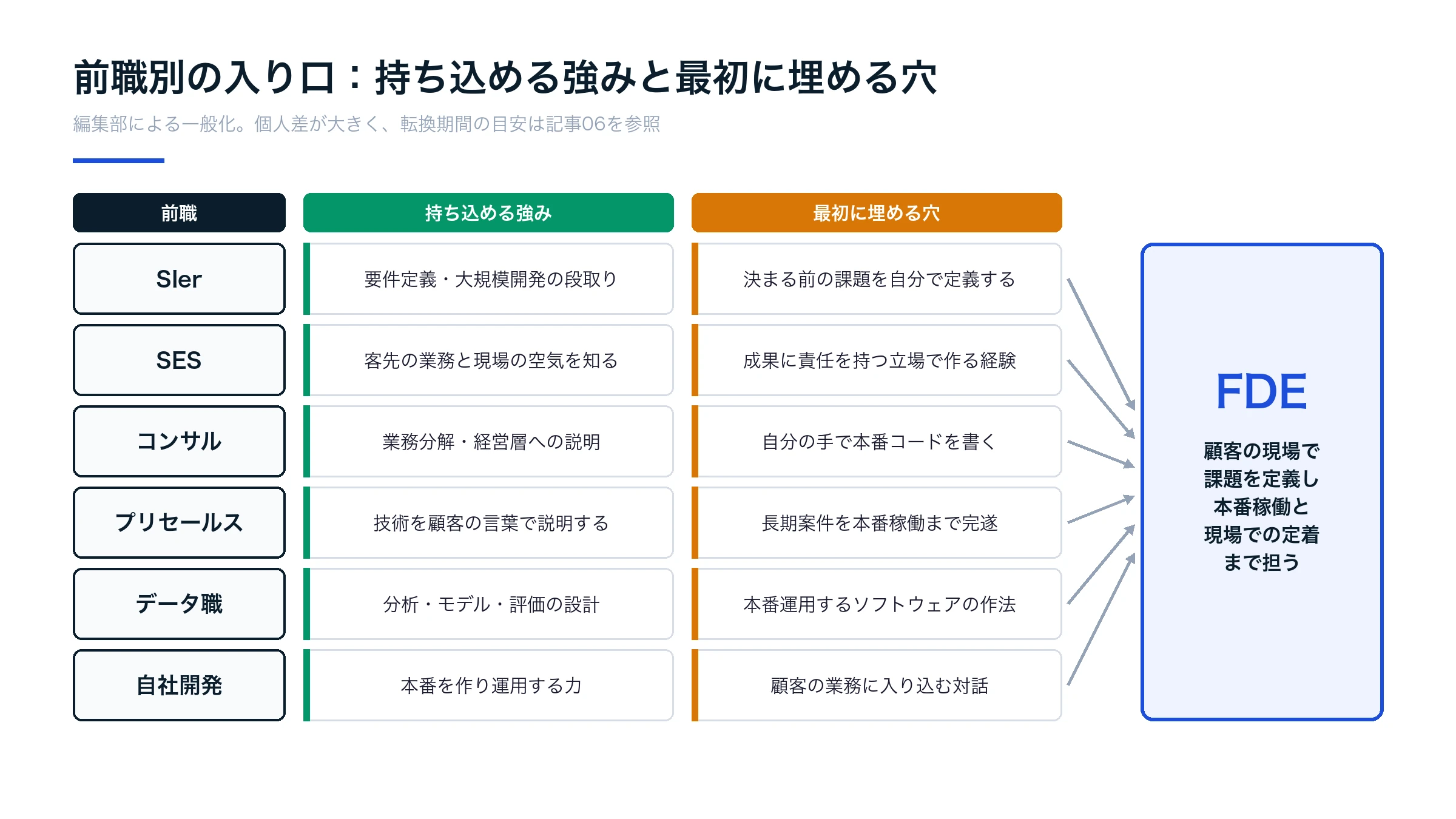
How to Become an FDE? Career Entry Points and How to Read Job Postings
What does it take to become an FDE (Forward Deployed Engineer)? For job seekers, we cover the reality of the work, who it suits, entry points by prior career (SIer, SES, consulting, etc.), how to identify genuine FDE job postings, what interviews evaluate, and what the first year looks like.
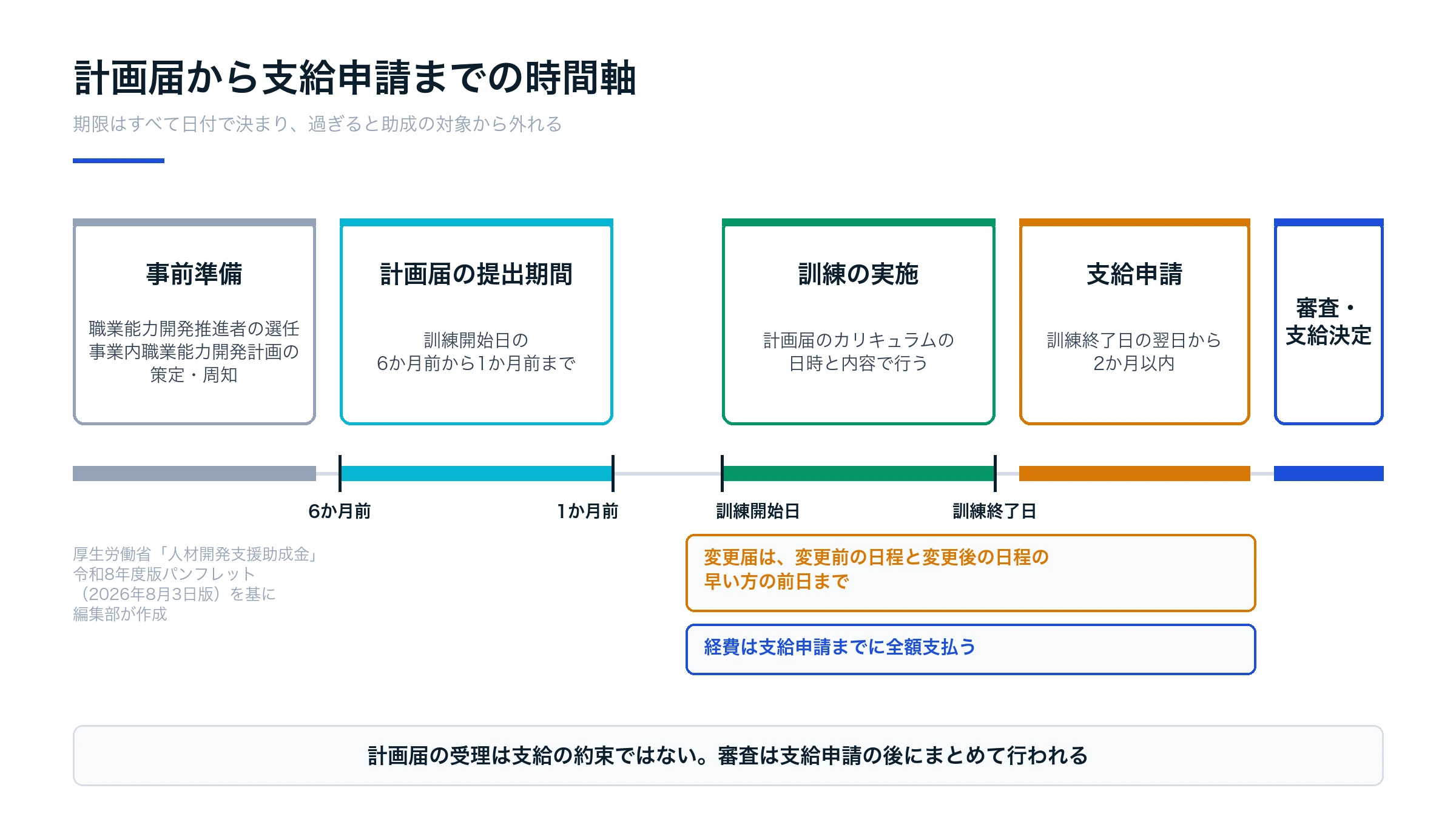
Subsidies for Generative AI Training | Practical Guide to Applying for the Human Resources Development Subsidy
We reviewed the Human Resources Development Subsidy available for generative AI training using the Ministry of Health, Labour and Welfare's FY2026 materials. FDX Inc. organizes the subsidy rates and caps for the two eligible course types, planning notification deadlines, training excluded by the August 2026 revision, and how to prepare documentation.
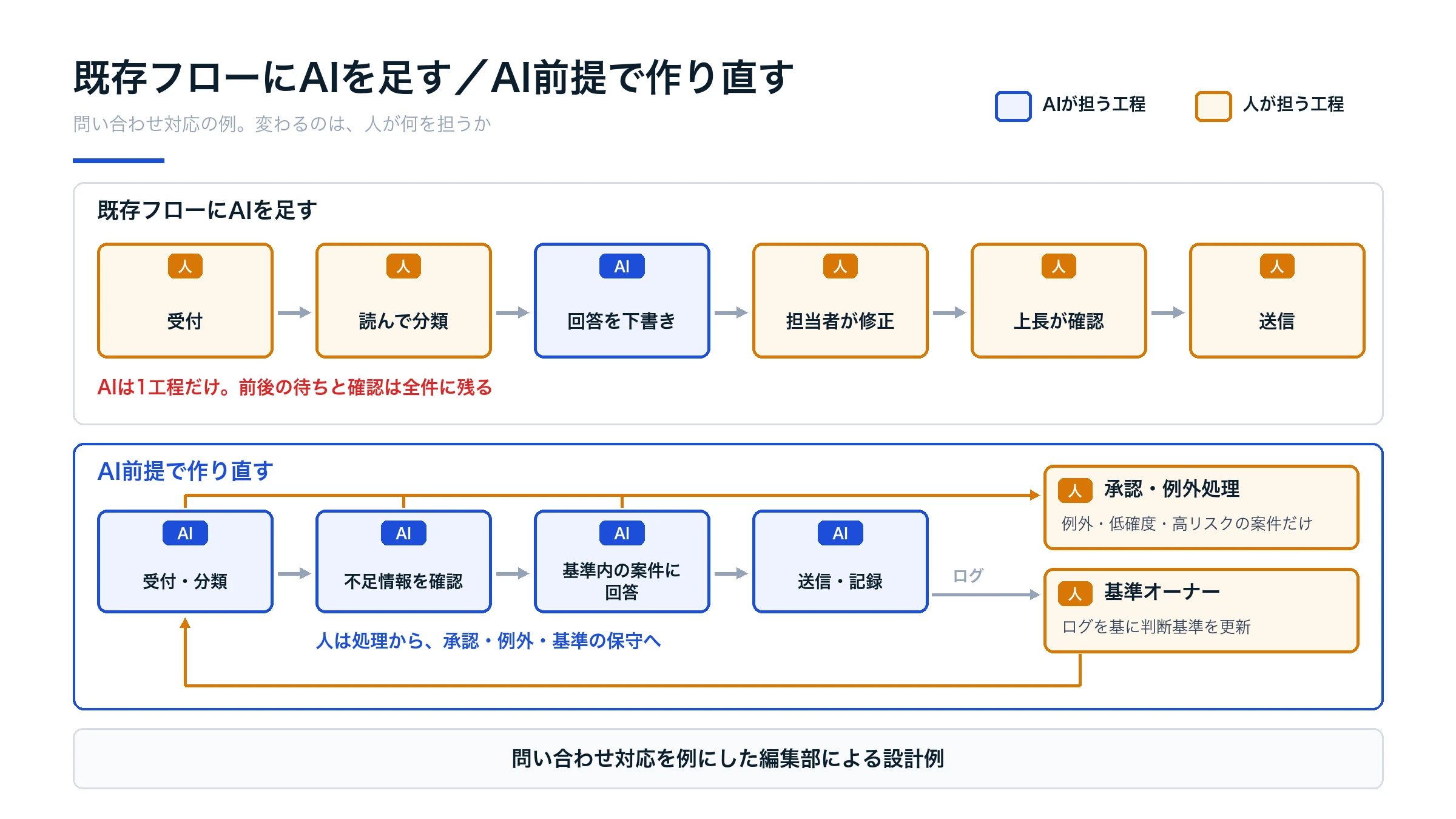
AI-First Business Process Redesign | 5 Steps of AI BPR
AI-first business process redesign (AI BPR) means not just adding AI to existing flows, but reassigning decisions and tasks between AI and humans to rebuild the flow. FDX Inc. explains 5 steps, from breaking down current flows and handling exceptions to measuring results after redesign.
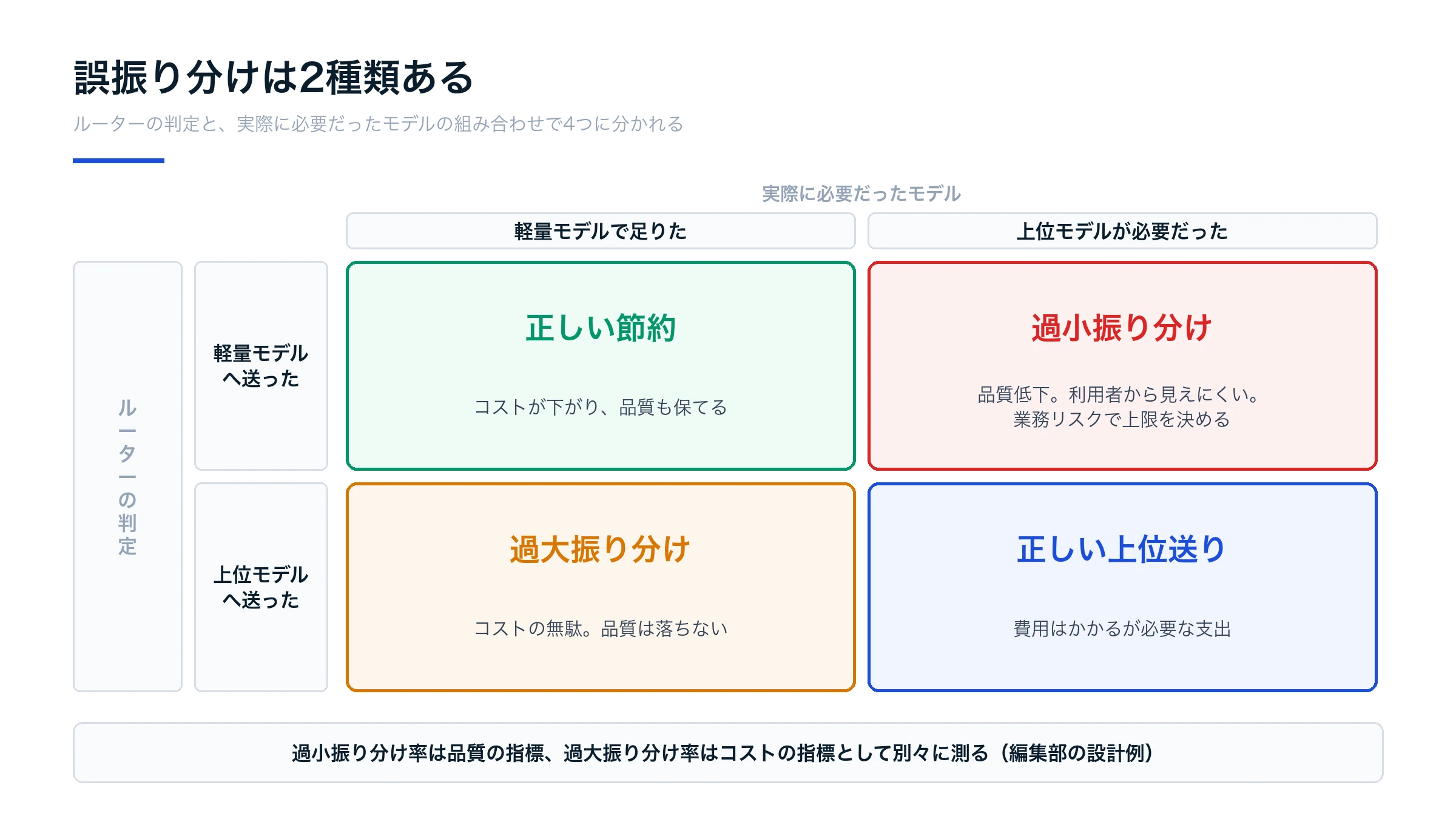
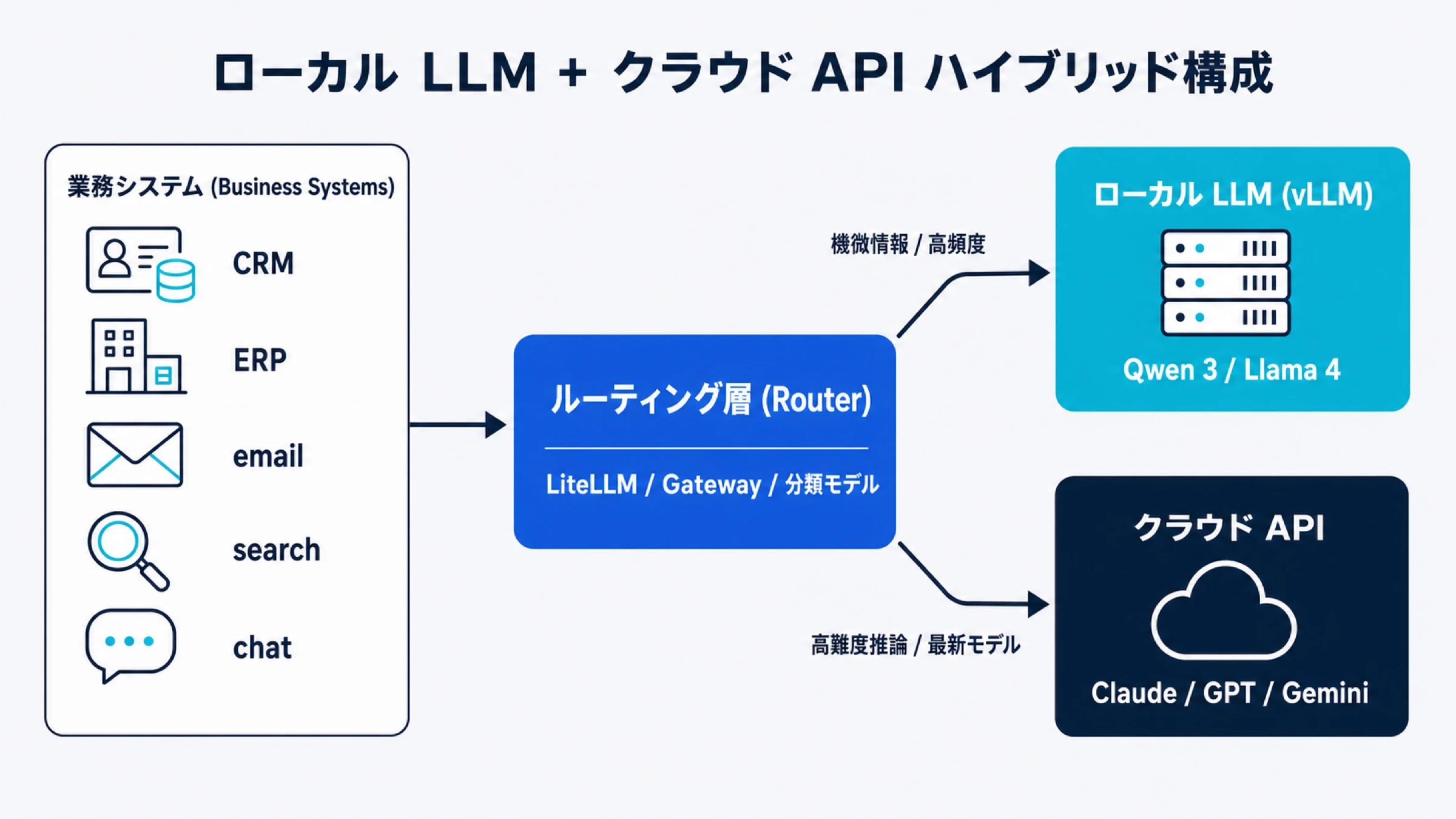
What Is LLM Routing? Evaluating and Operating Model Assignment
LLM routing (model routing) is a mechanism that assigns each request to either a lightweight or a high-end model. FDX Inc. focuses on routing between cloud APIs and covers how to choose a decision method, how to measure misrouting rate and cost savings, and post-adoption operations.
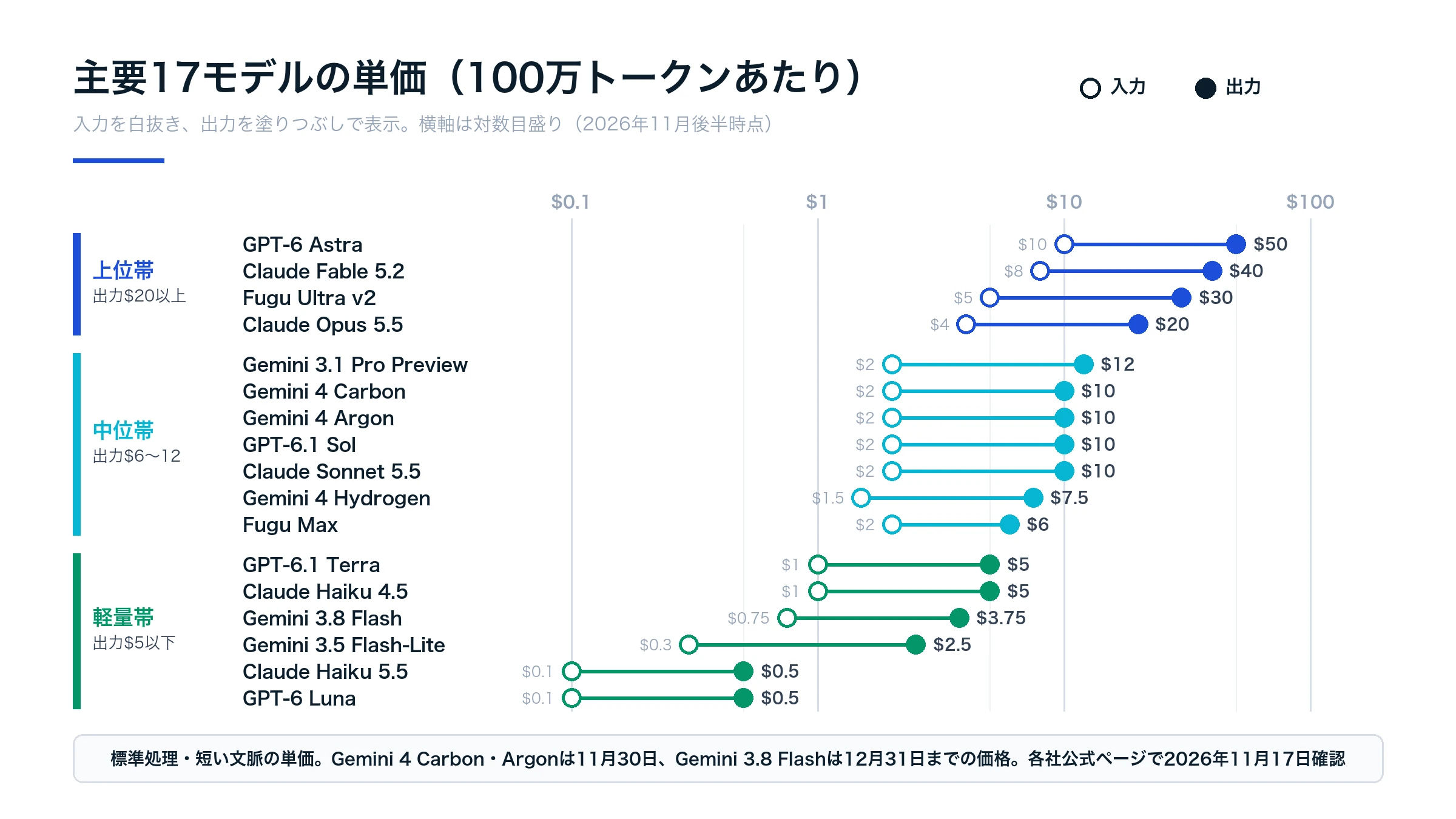
LLM API Comparison and Pricing List | As of Early November 2026
We compared business-use LLM APIs and compiled a list of pricing for the latest models from OpenAI, Anthropic, Google, and Sakana AI, verified against their official pages. FDX Inc. organizes price ranges to try by use case and data handling points Japanese companies should check.
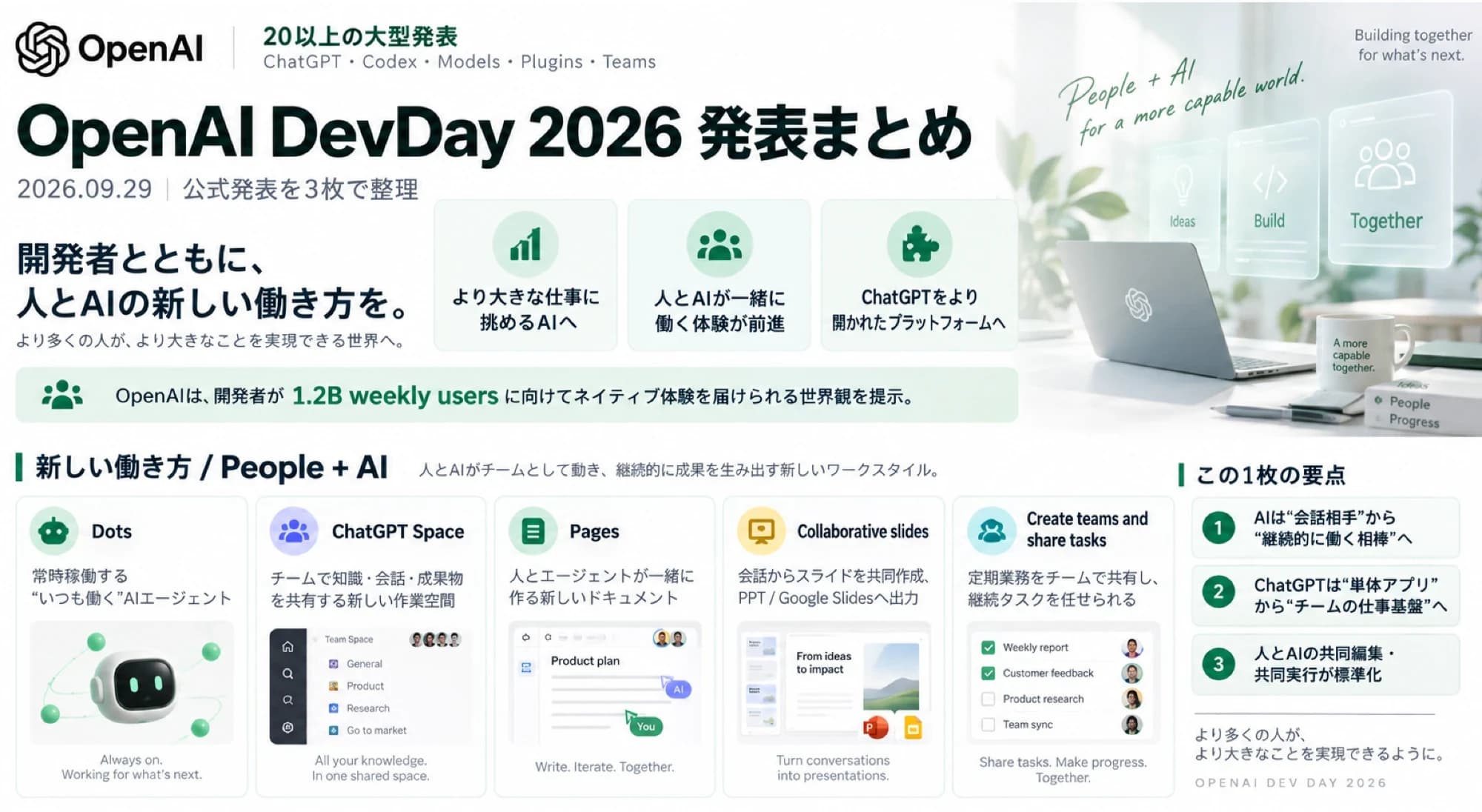
OpenAI DevDay 2026 Summary | Key Points for Implementers
FDX Inc. reviews the GPT-6.1 Sol, Ultrafast, Agents API computer-use capabilities, and dots announced at OpenAI DevDay 2026 against official documentation, and outlines their impact on existing implementations and steps for migration decisions.
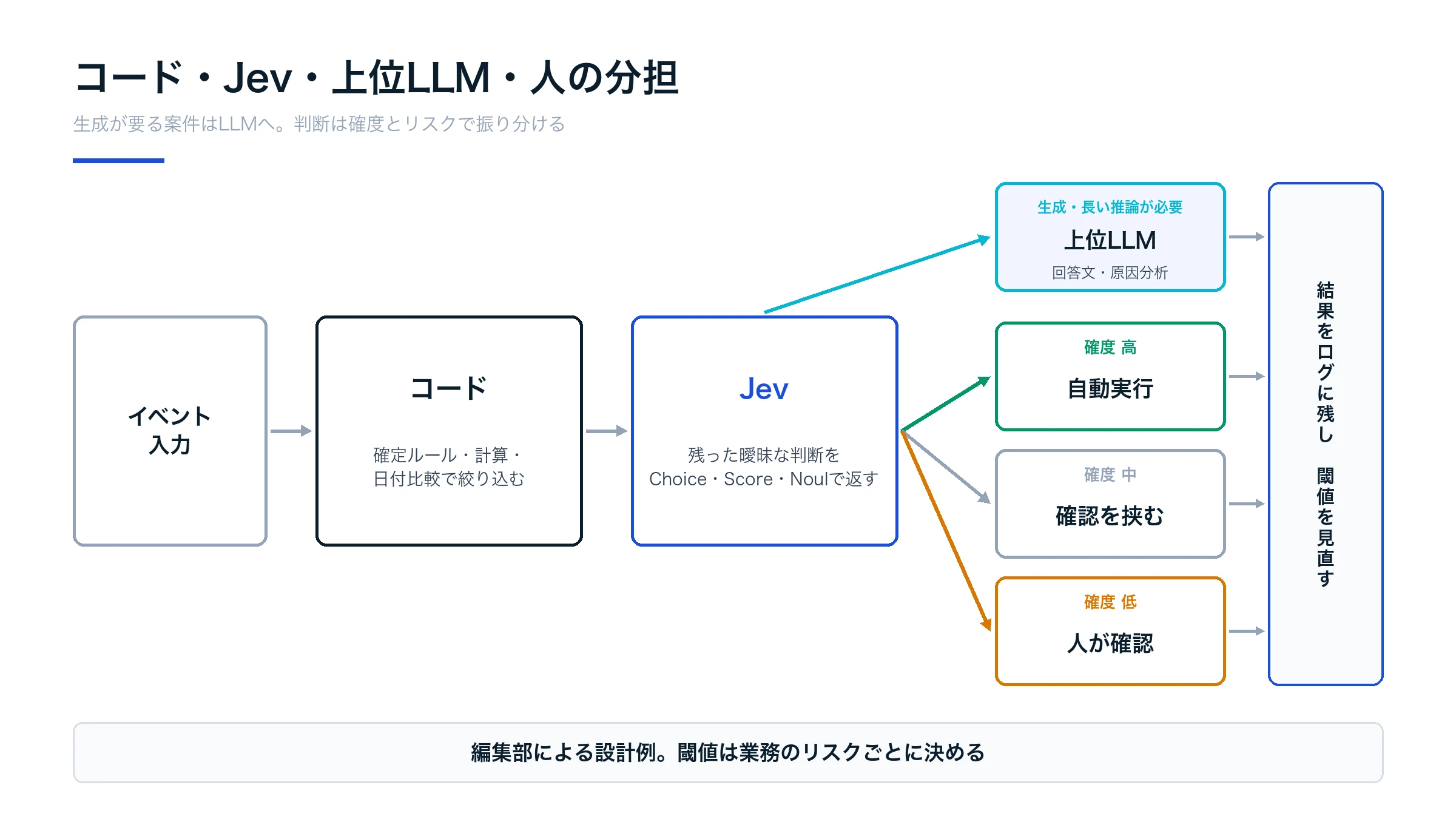
What Is Jev? Features, Pricing, and Use Cases of a Judgment-Specialized AI
We organize the judgment-specialized model "Jev" released by TypeSafe AI in September 2026 using primary sources. We explain how it differs from LLMs, how to read its pricing and published figures, its division-of-labor setup where input is text-only and images/OCR are structured upstream, and its business use cases and verification steps.
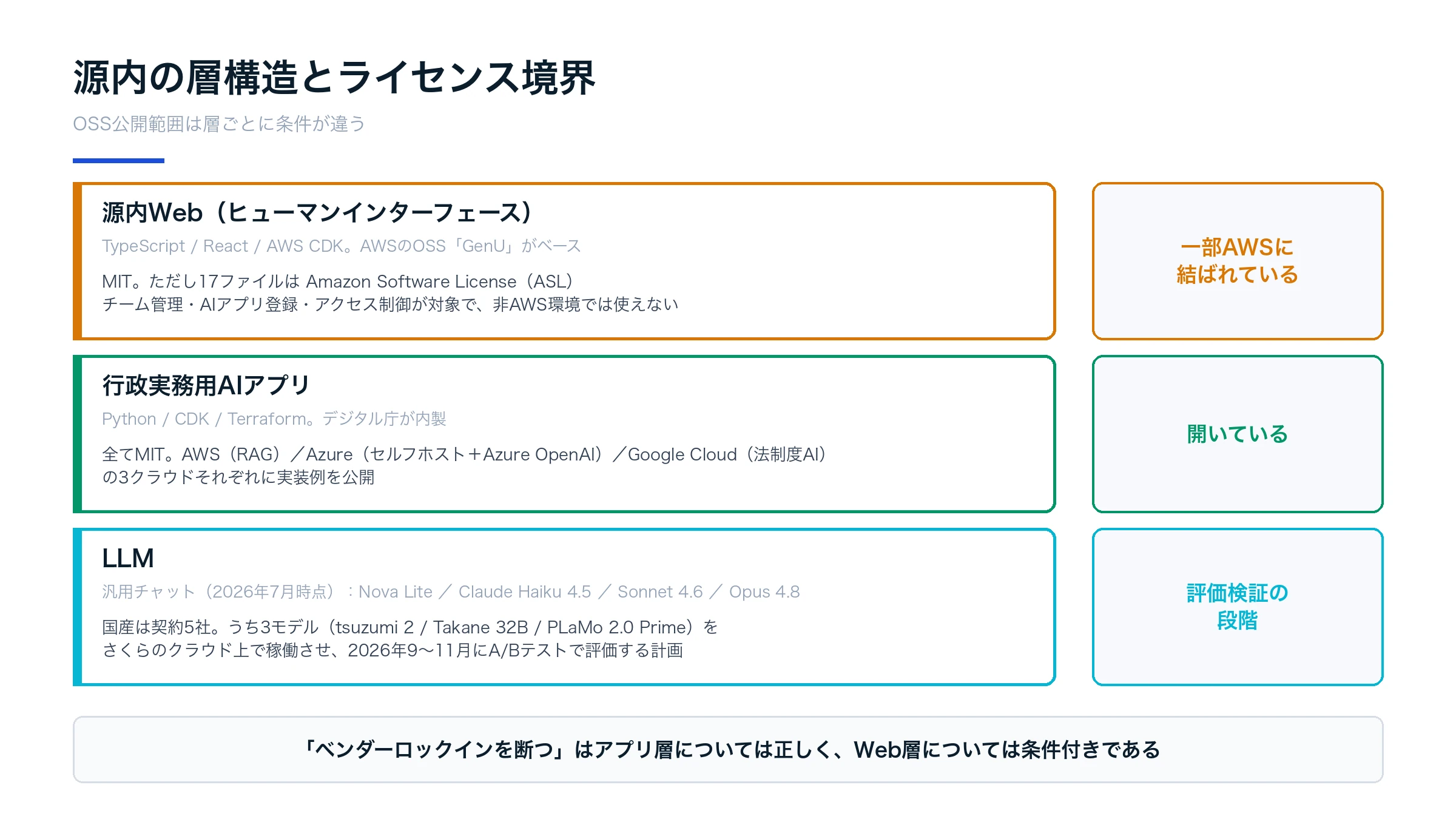
What Is the Government AI "Gennai"? OSS and Domestic LLMs
We analyze the government AI "Gennai," released as OSS by the Digital Agency in April 2026, using primary sources. FDX Inc. organizes its layered architecture and license boundaries, an operational design where 1-2 people support 180,000 users, and the current state of domestic LLMs.
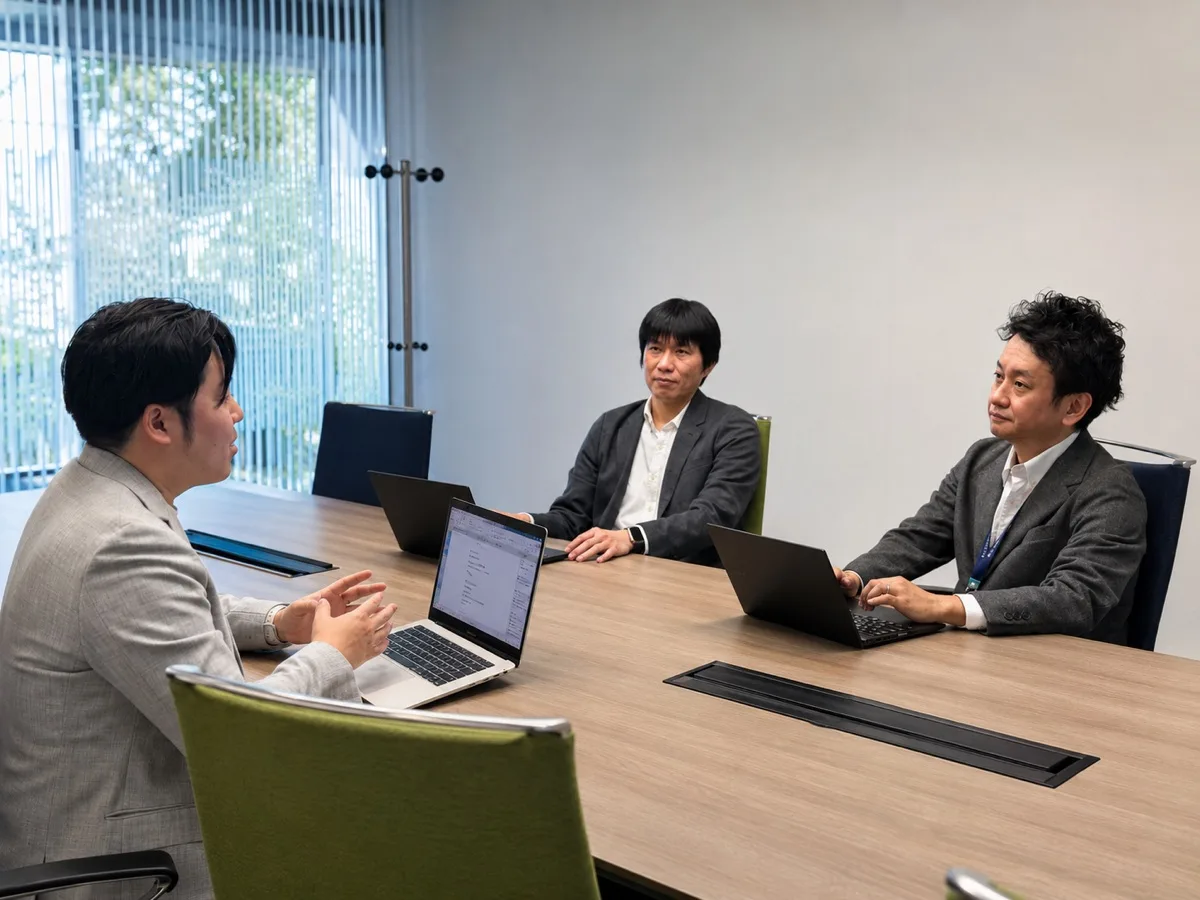
The Full Story of NEC Solution Innovators' Hands-On Generative AI Training
NEC Solution Innovators struggled to respond to generative AI RFPs on their own. Through interviews with those involved, we share how a case-study-style training using Dify and AWS Bedrock transformed the organization into one that can confidently say, "We can do this in-house."
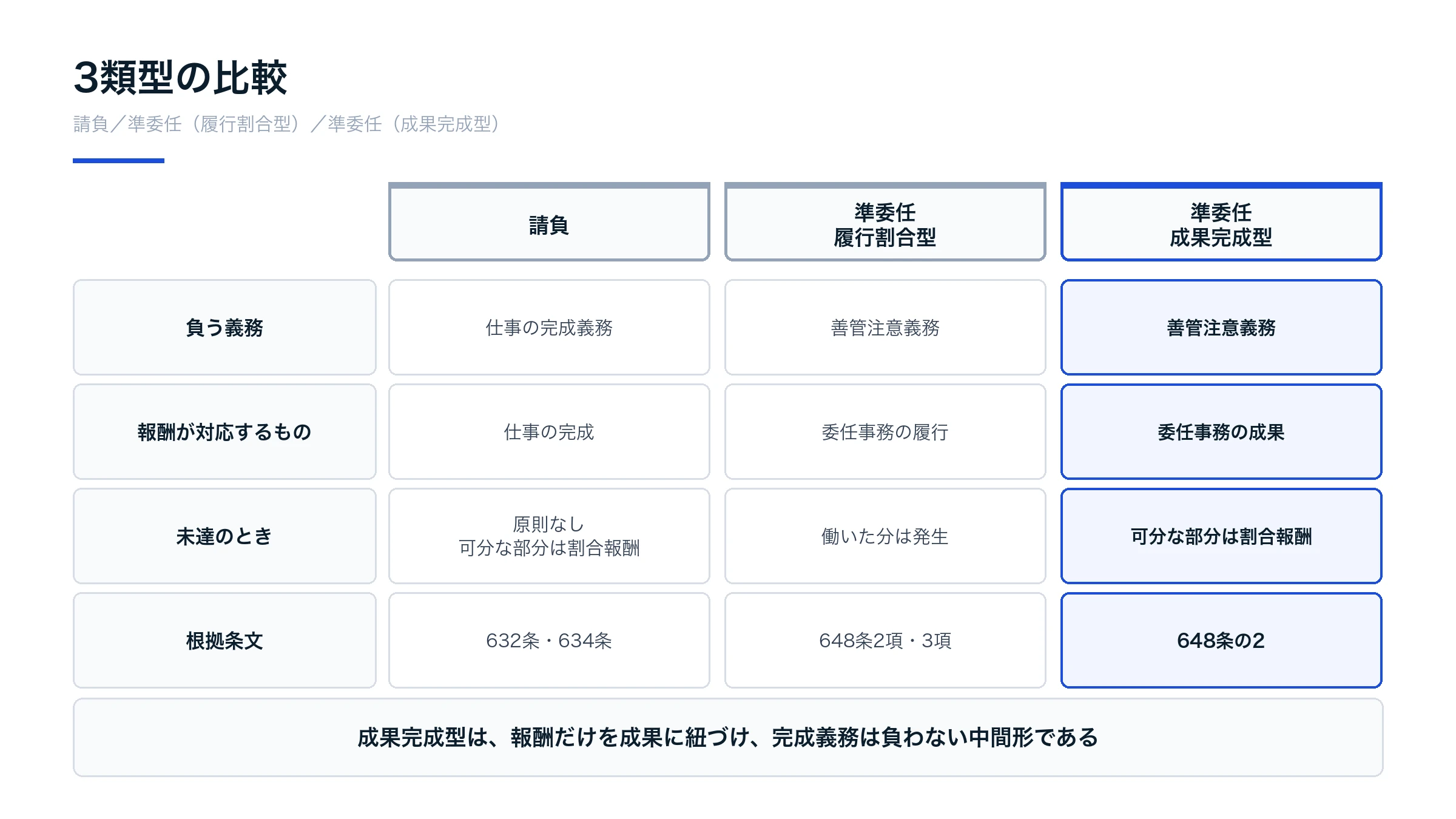
Contract Types in the AI Era | The Option of Quasi-Commission (Completion-Based)
AI development contracts often stall on whether to use a work-for-hire (ukeoi) or quasi-commission (jun'inin) arrangement. FDX Inc. organizes the three contract types under the Civil Code and, drawing on METI's 2025 checklist and actual US FDE contract structures, explains why we recommend the completion-based quasi-commission model.
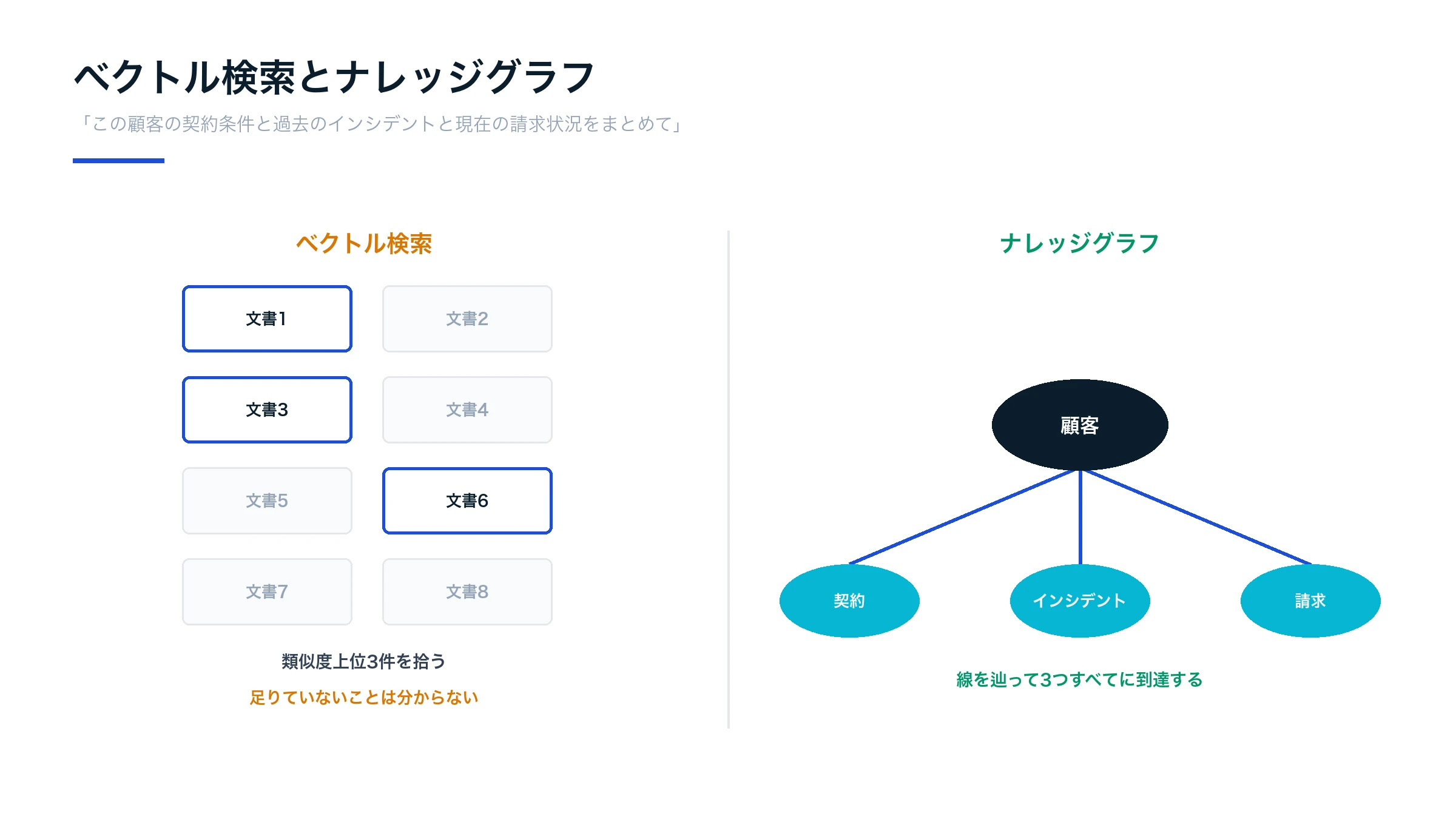
What Is a Knowledge Graph? How to Build One and Design It for AI Use
A knowledge graph is a data structure that preserves relationships between people, documents, and concepts. FDX Inc. organizes the types of questions where vector search falls short, the practicalities of building one, how to use it in AI with GraphRAG, and the reality of operational costs.
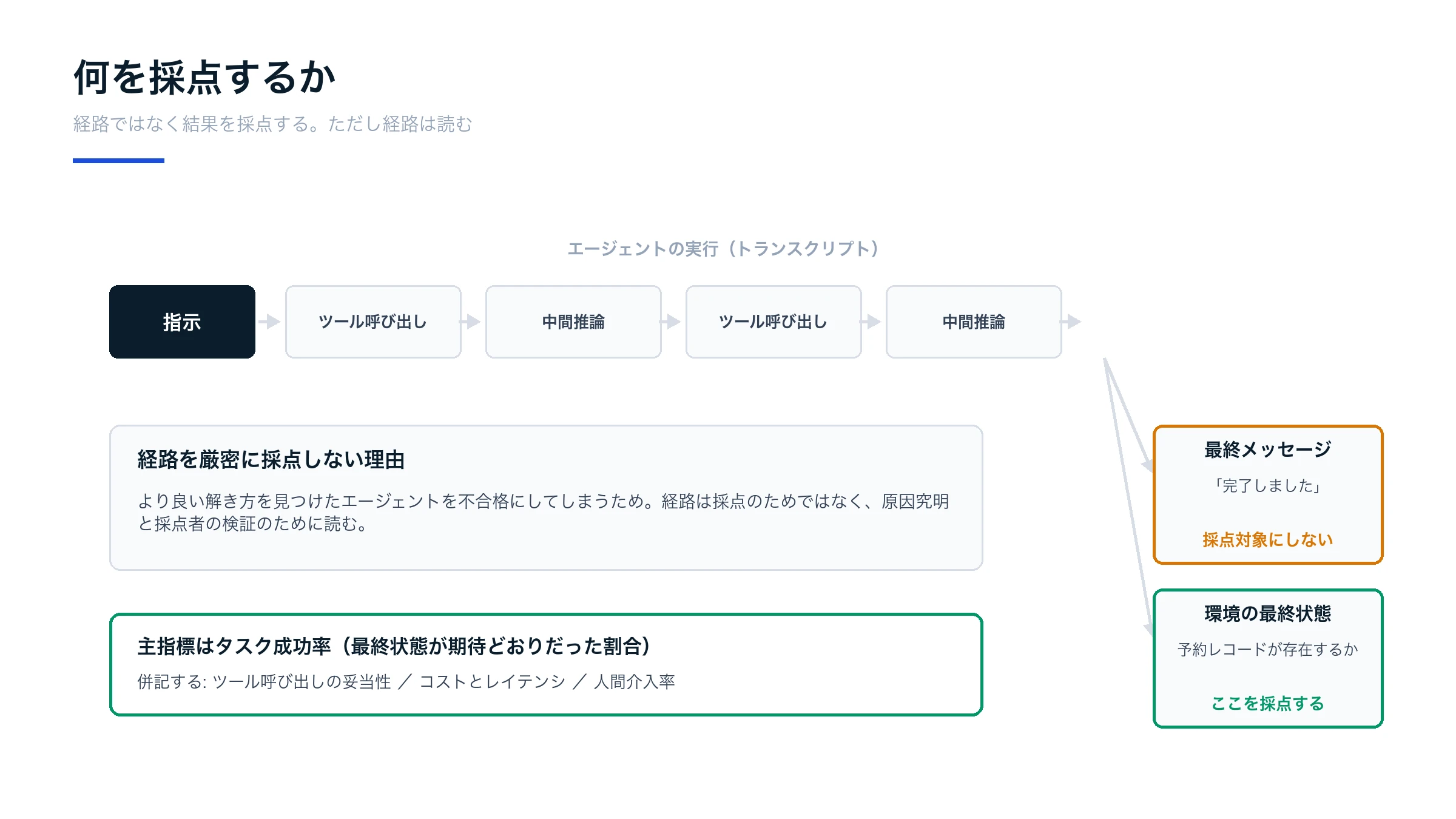
Eval Design for AI Agents | How to Build an Evaluation Set
Evaluating agents is different from evaluating chat. FDX Inc. organizes why you score the final state, how to start with 20-50 cases based on actual failures, the conditions for using LLM graders, and operational pitfalls.
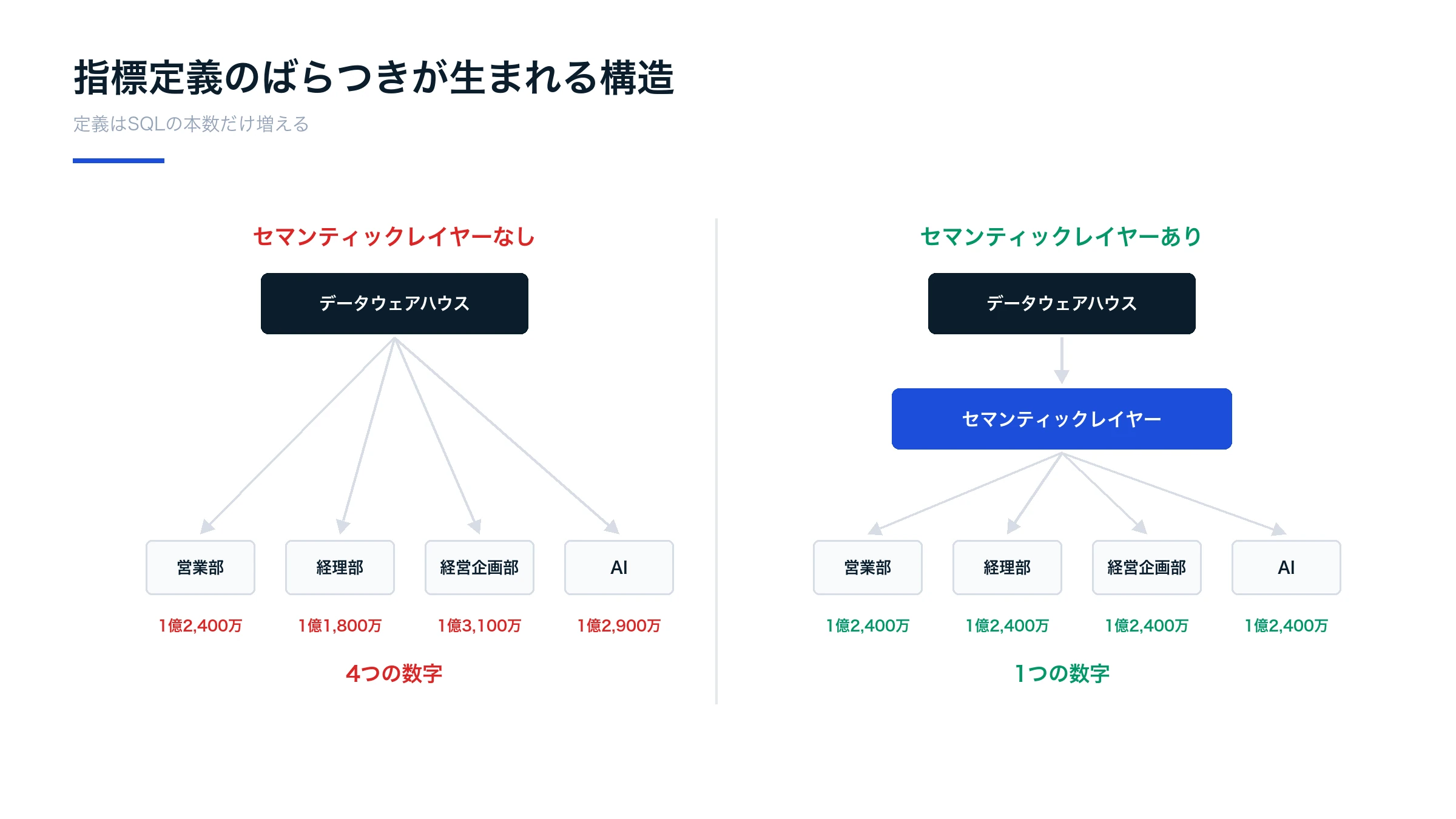
What Is a Semantic Layer? The Layer That Unifies Metric Definitions
A semantic layer is a layer that unifies the definitions of metrics such as revenue and churn rate across the entire company. FDX Inc. organizes what is needed now that the premise of letting AI touch data has changed, along with measured benchmarks and implementation order.
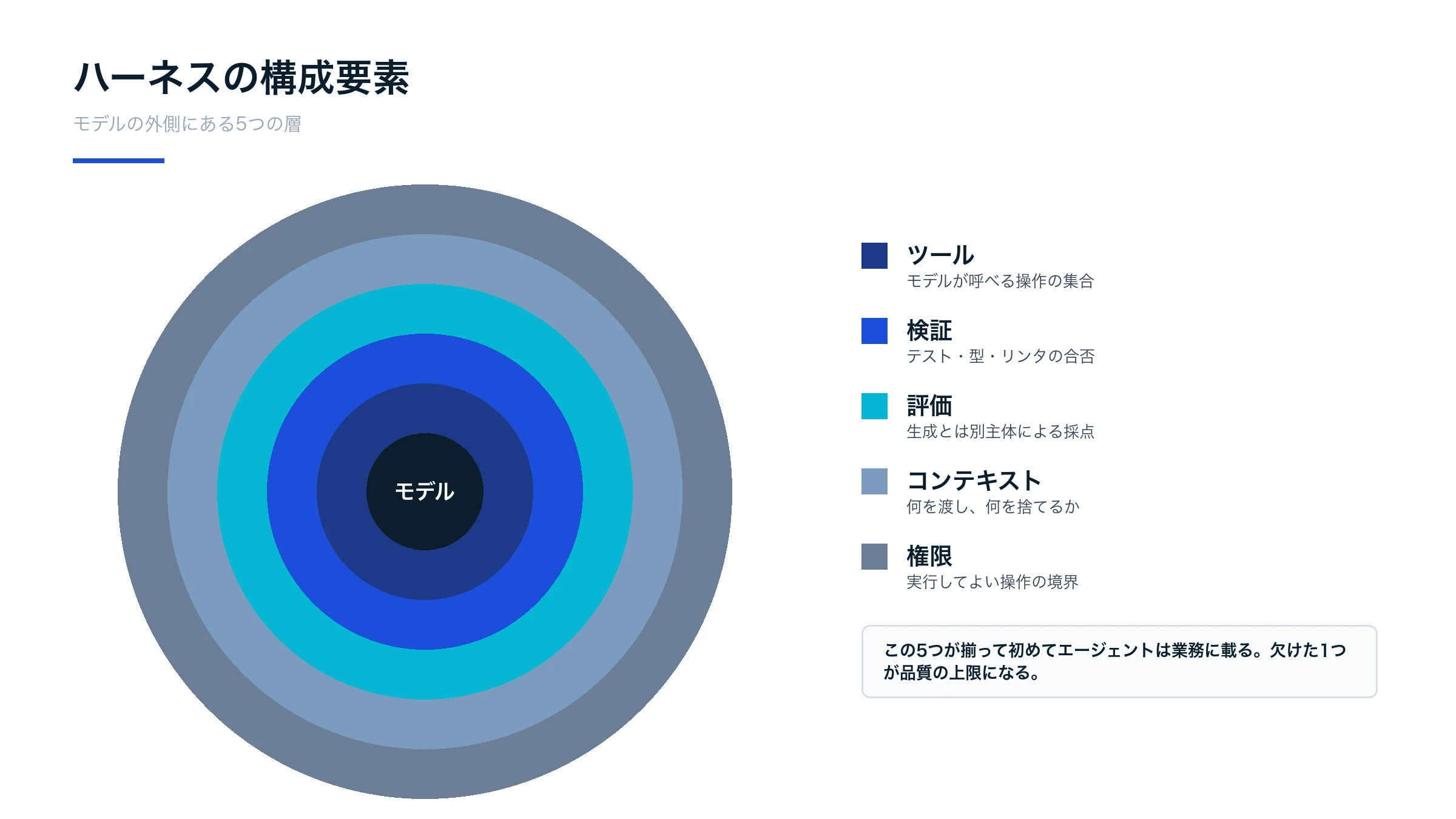
What Is Harness Engineering? The Key to Agent Quality
Harness engineering is the technology of verification, evaluation, and context design that sits outside the AI agent. FDX Inc. explains the separation of generation and evaluation, enforcing quality with deterministic tools, and the principle of "subtract rather than add."
GPUs and VRAM Needed for Local LLMs | Quick Reference Table by Model
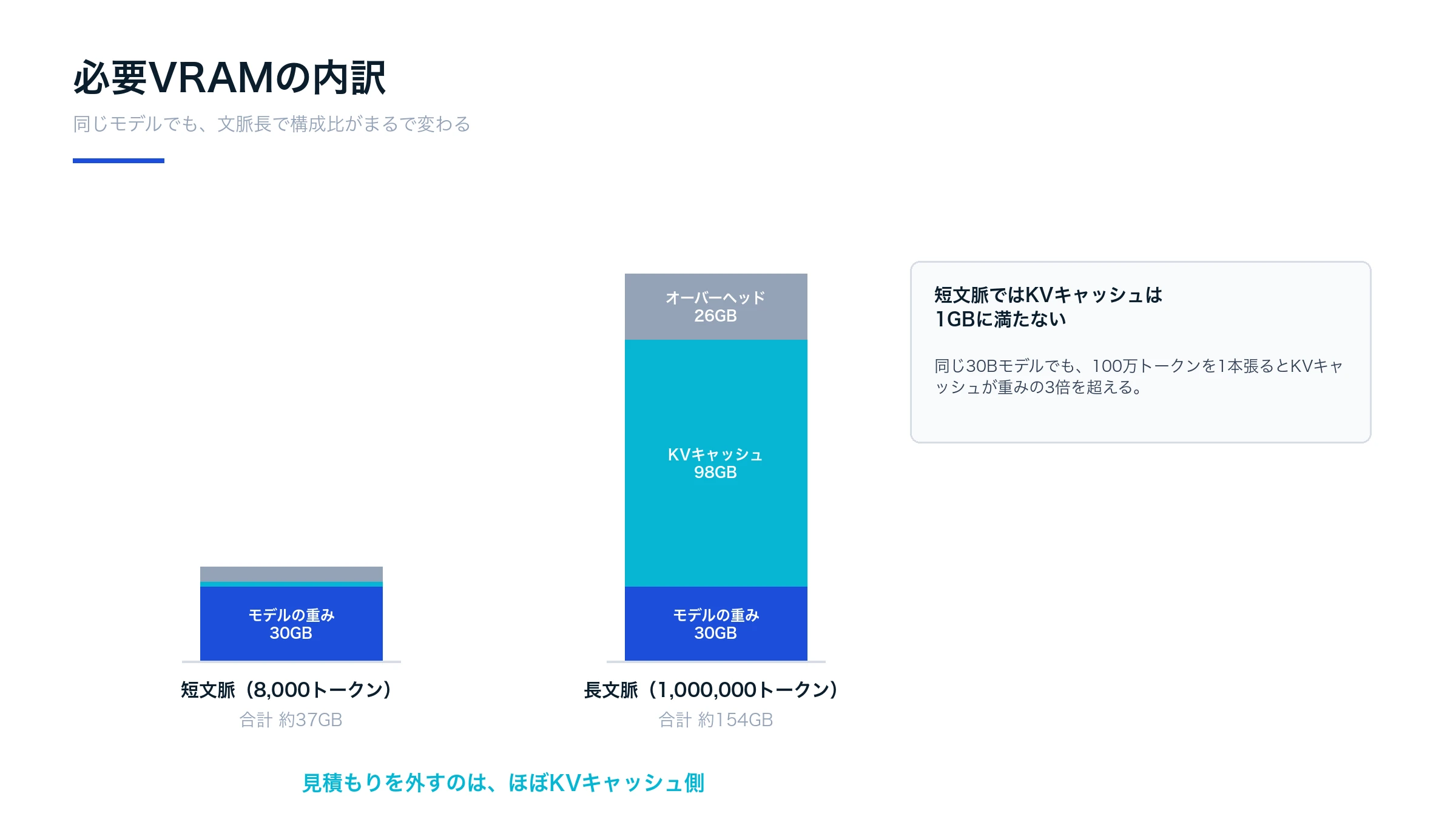
The VRAM required for a local LLM is determined by the sum of weights, KV cache, and overhead. FDX Inc. organizes why MoE models are estimated by total parameters, the calculation showing KV cache exceeding weights at long context lengths, and a quick reference table by model.
Cross-Analysis of AX Case Studies | Reduction Results by Work Type
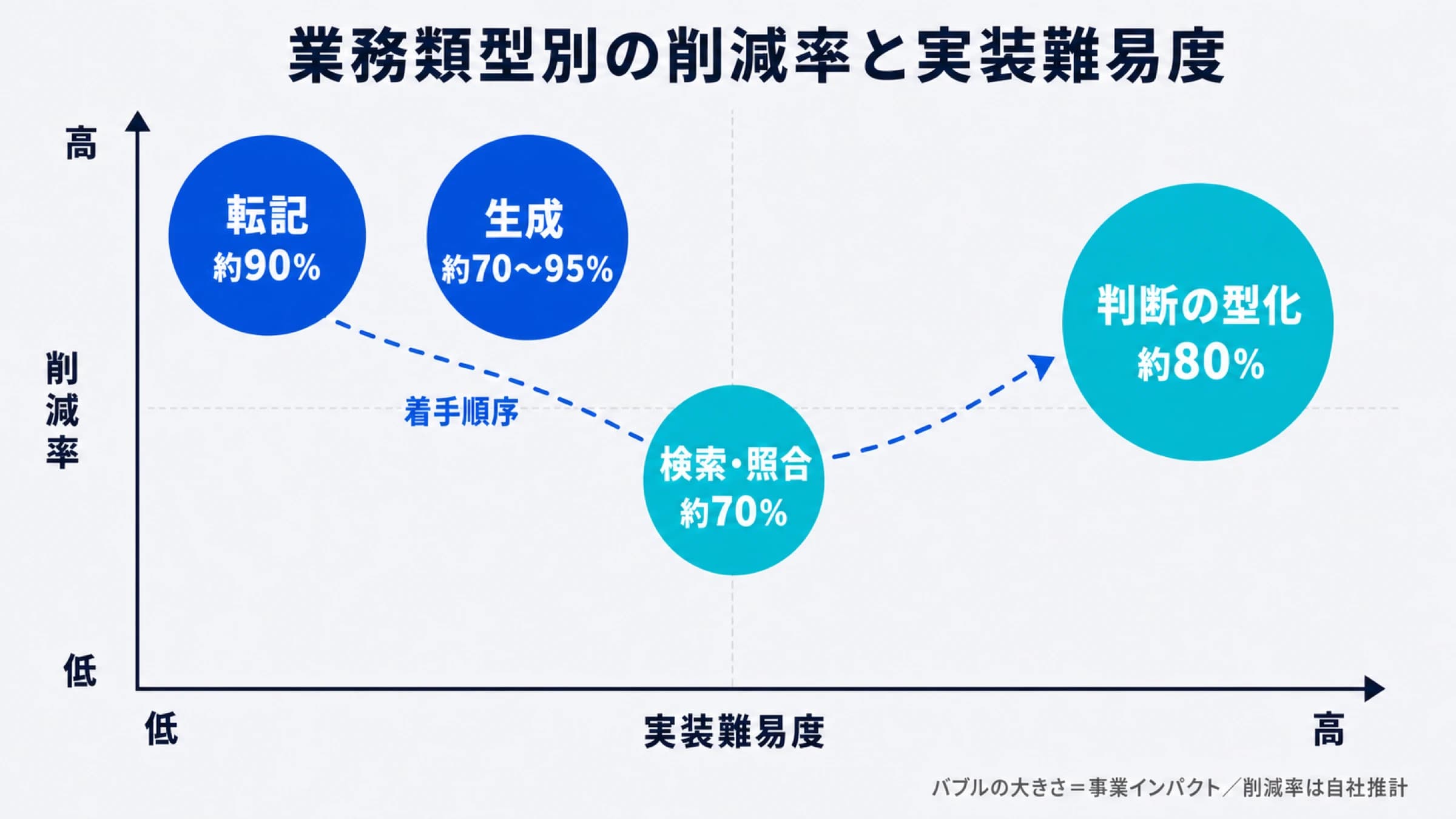
Over 20 AX cases implemented by FDX are cross-analyzed across four work types: generation, transcription, search, and judgment. FDX Inc. explains the reduction rate standards for each type, an application map by industry, and principles for implementation order based on actual performance data.
AI Governance and Implementation Security | Six Control Points
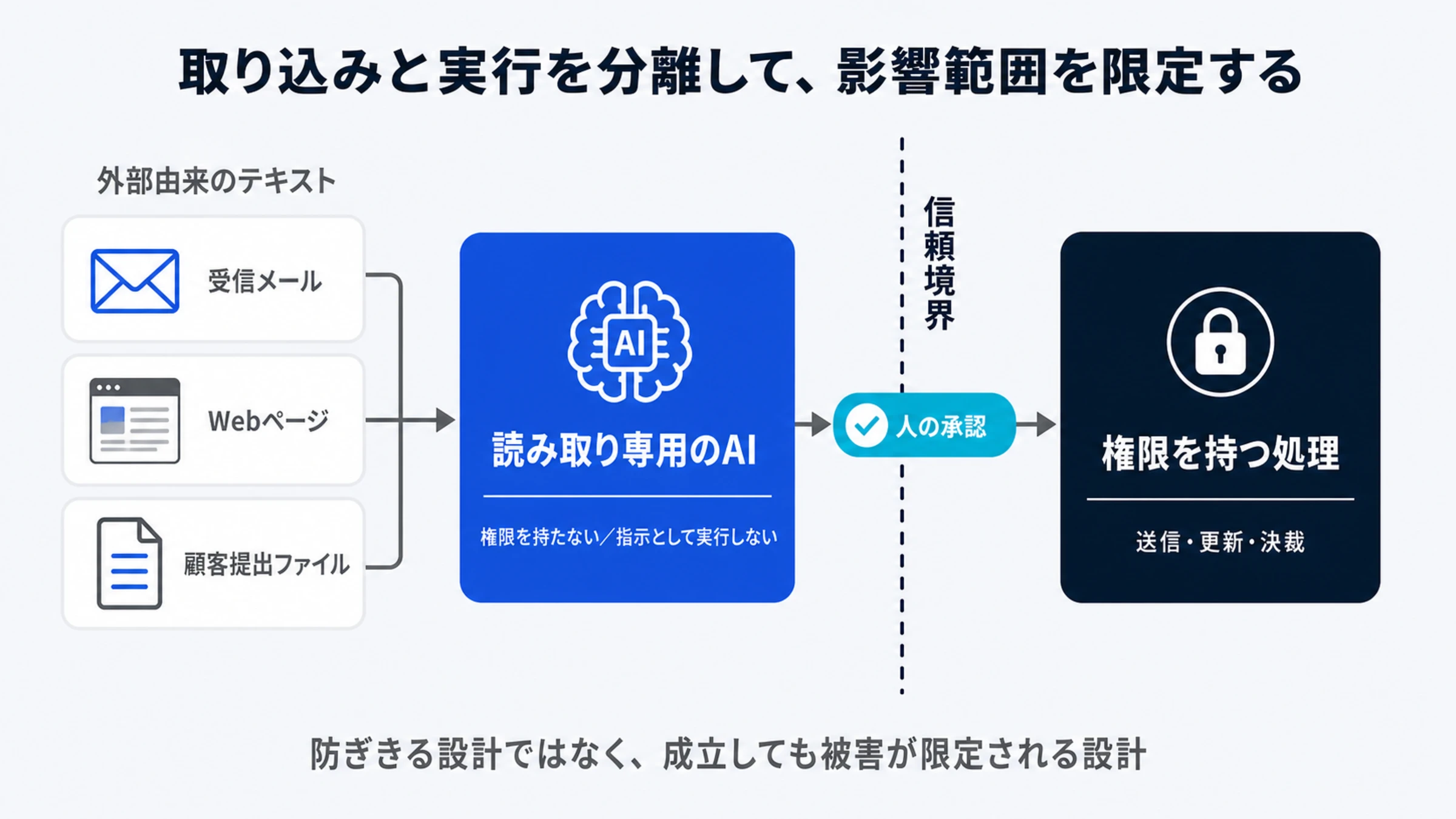
AI governance is determined by implementation, not documents. FDX Inc. explains six control points-data boundaries, permission design, input trust boundaries, output validation, audit logs, and model updates-as design decisions when connecting AI to business systems.
FDE vs. Pre-Sales Engineer | Comparison Across 8 Axes
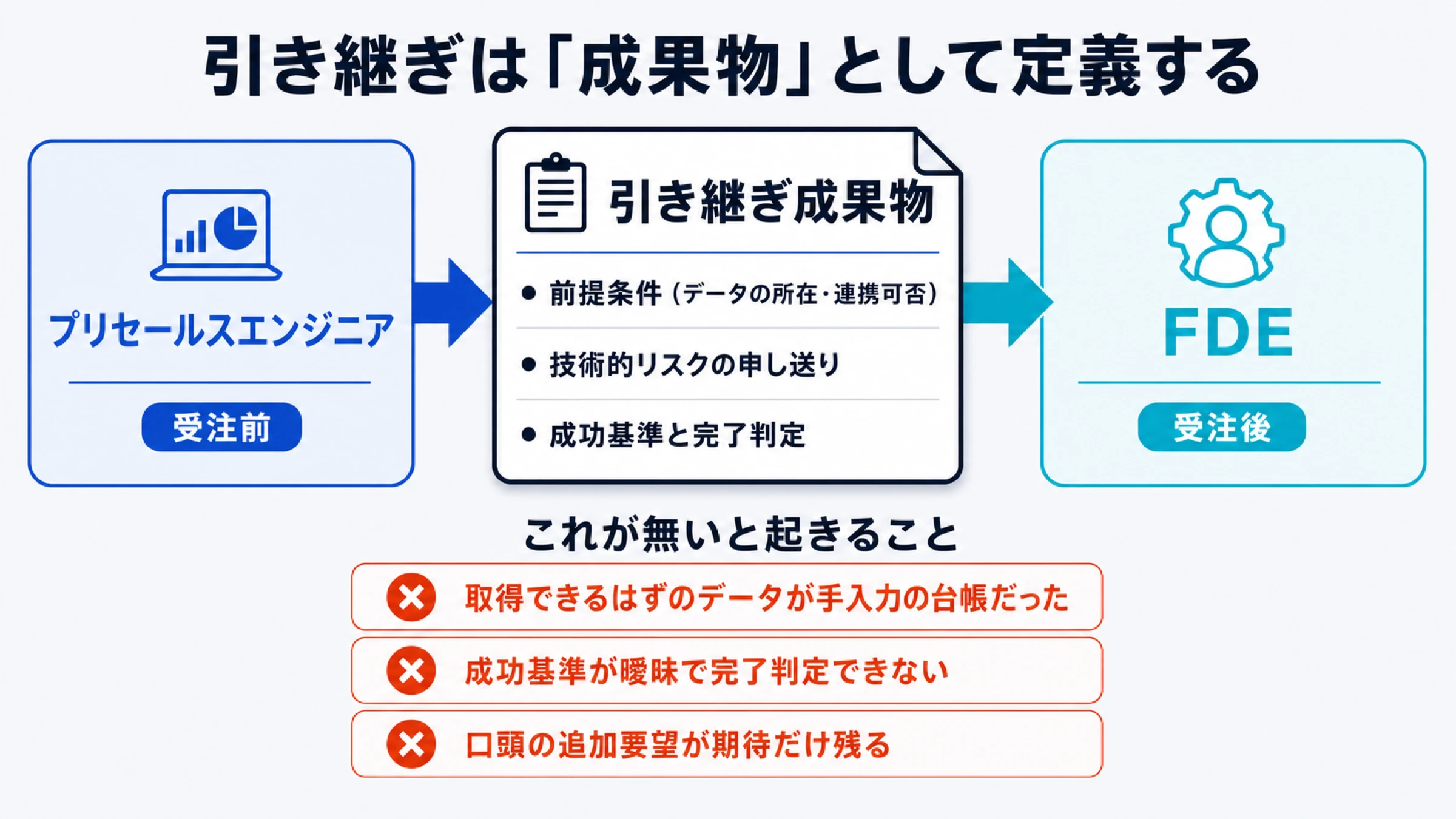
FDEs and pre-sales engineers differ in that one handles post-order implementation and the other pre-order technical judgment. FDX Inc. compares them across 8 axes-scope of responsibility, performance metrics, required experience, and career growth-and explains which one suits you.
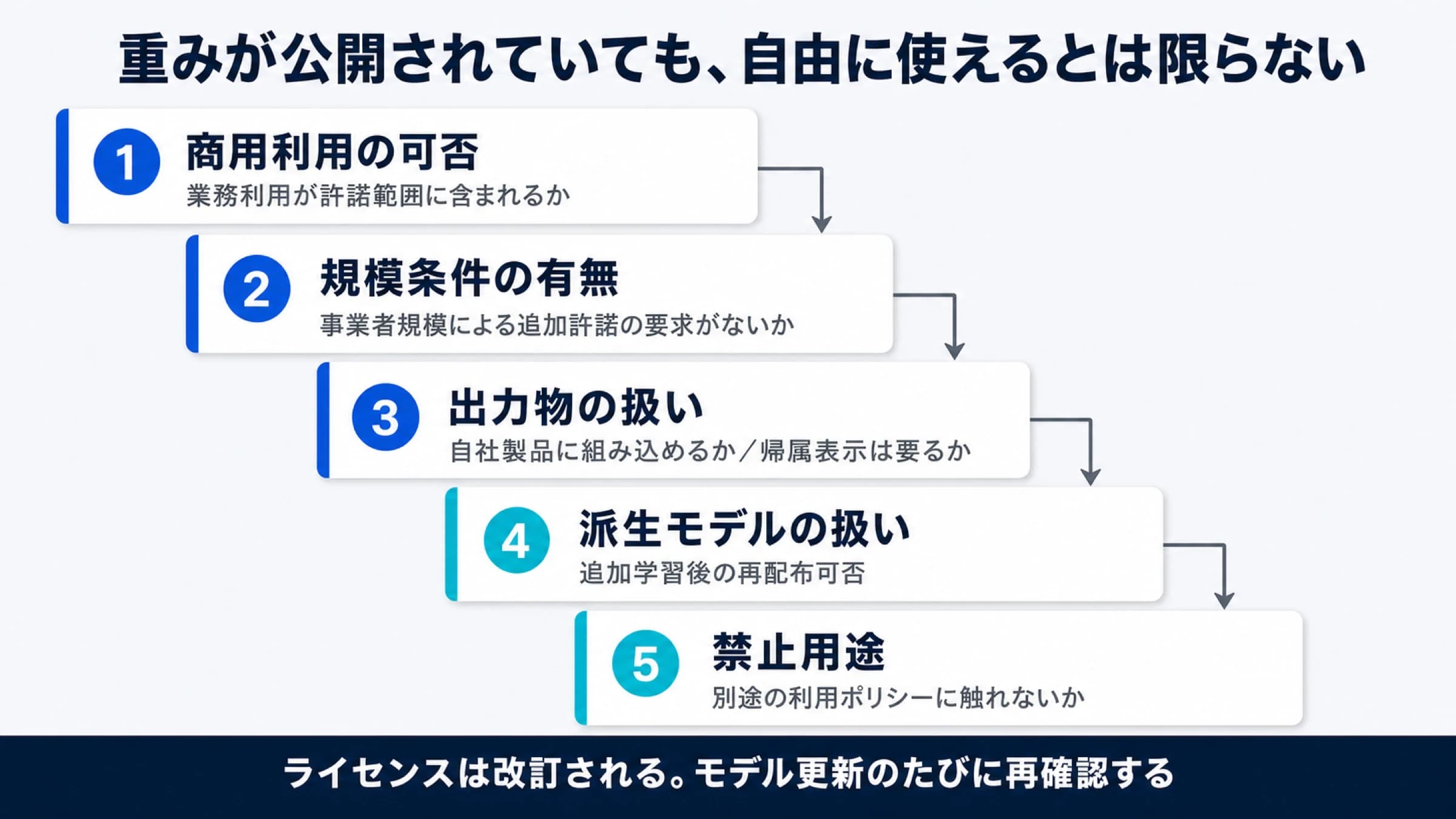
What Are Open-Weight Models? Differences from Open Source and Commercial Use
An open-weight model is an LLM whose trained weights are published and can be run in your own environment. This article organizes the differences from closed APIs and open source in a table, and provides a checklist of 5 license items to confirm with legal before commercial use. A comparison of models is available in a separate article.
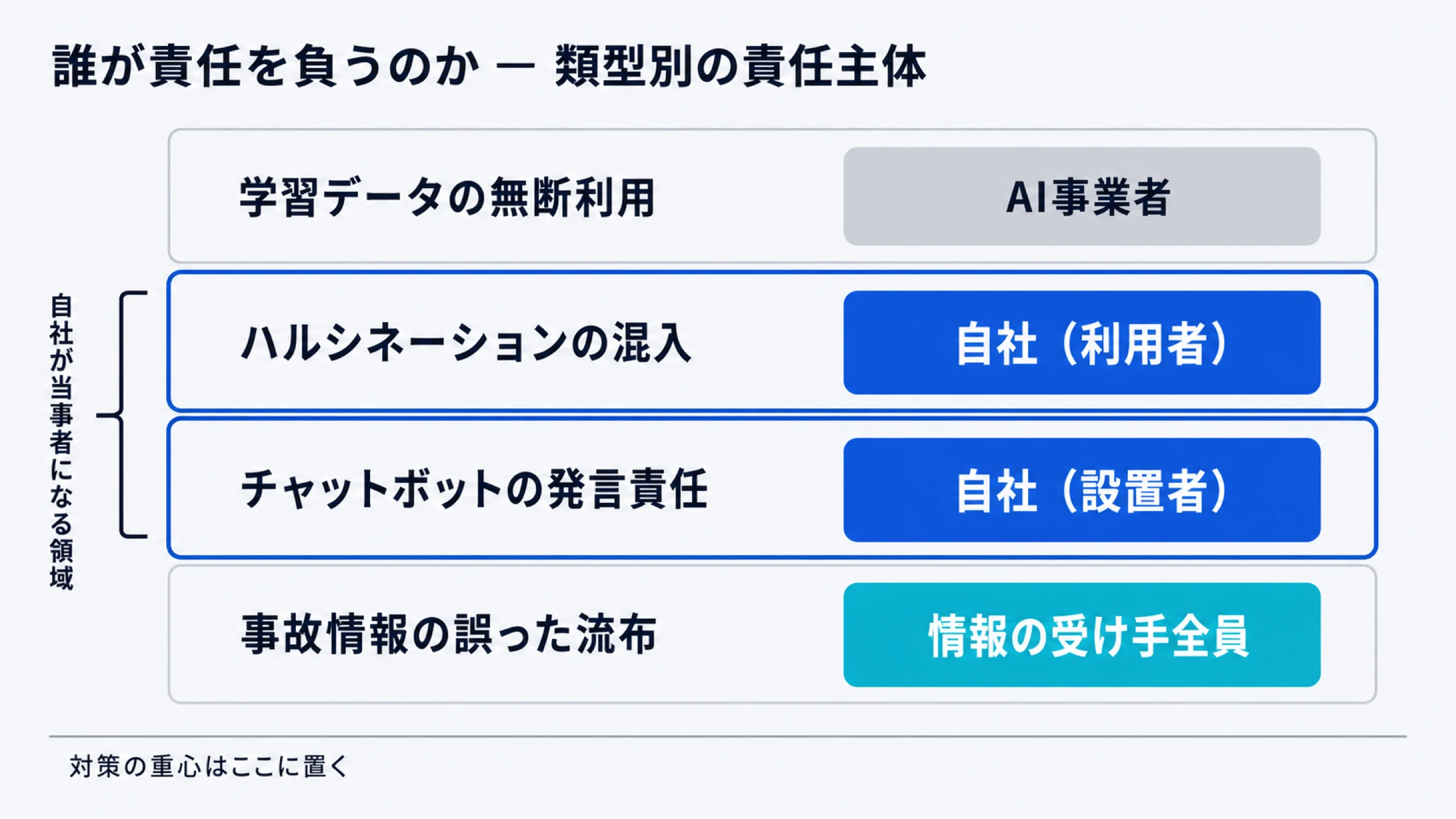
Generative AI Incident Cases 2025-2026 | 4 Categories and Practical Countermeasures
FDX Inc. organizes generative AI incidents that actually occurred from 2025 onward into four categories-lawsuits over training data, hallucination contamination, chatbot statement liability, and accidental spread of false information-and explains the facts confirmed from primary sources and companies' practical countermeasures.
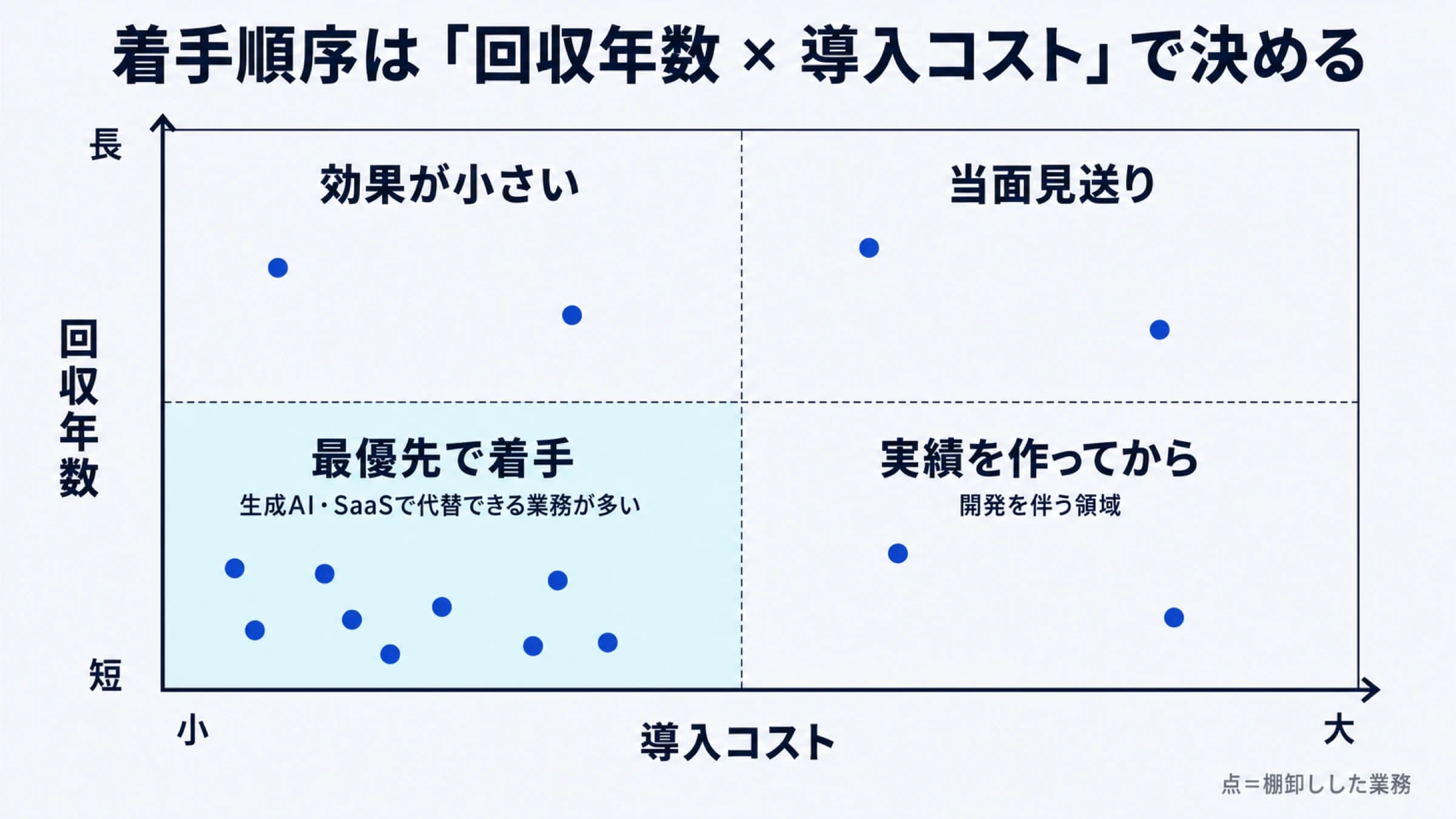
What Is AI Assessment? Designing Work Inventories and ROI
An AI assessment is a method of inventorying work processes, quantifying labor hours, and determining which tasks can be replaced by which AI, including return on investment. FDX Inc. explains the three-layer structure of a 12-item work inventory, AI suitability judgment, and payback period estimation, along with a one-day implementation format.
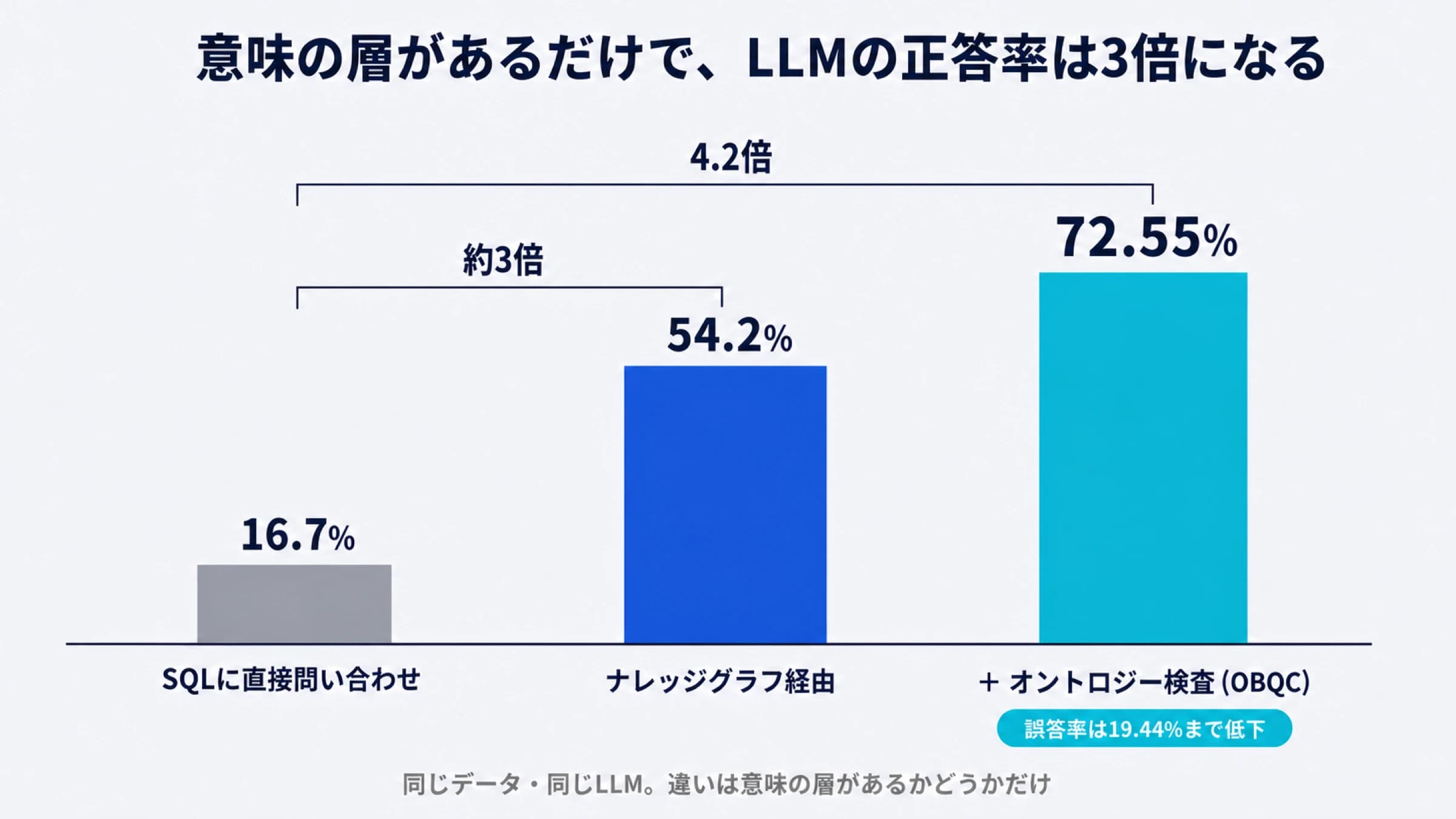
What Is an Ontology? Meaning, Differences from Knowledge Graphs, and How to Build One for AI
An ontology is a "map of meaning" that defines the semantics and relationships of data in a form both humans and AI can understand. This article organizes the differences from knowledge graphs, semantic layers, and data catalogs in a single table, presents evidence that knowledge graph conversion tripled LLM accuracy, and explains the 5 steps of construction.
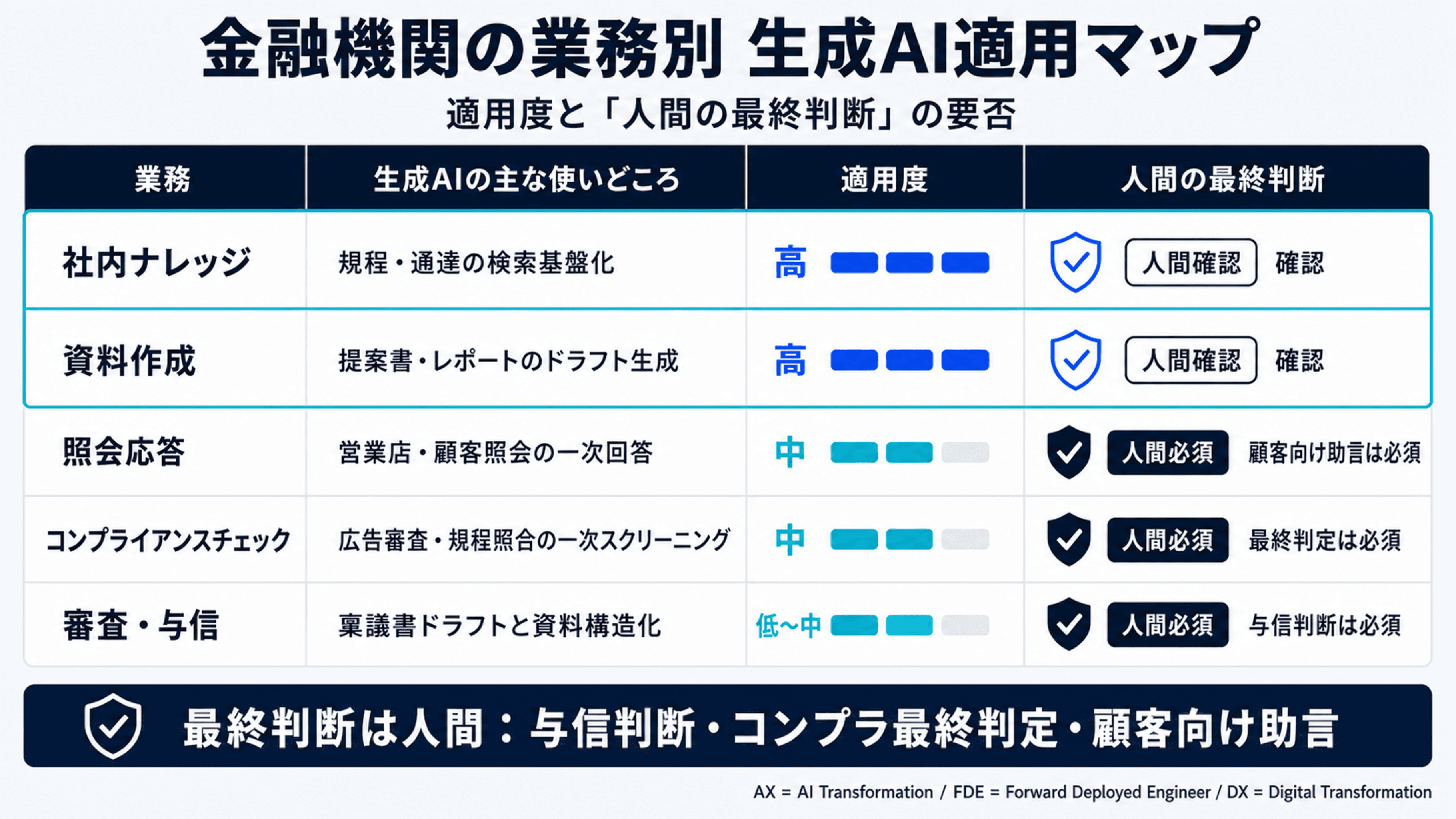
Generative AI in Financial Institutions | Application Map by Task and Key Points of Regulatory Compliance
Generative AI adoption in financial institutions starts with breaking down tasks such as credit review, inquiry responses, document creation, compliance checks, and internal knowledge. This article organizes, for executives, an AI application map by process, regulatory compliance based on the FSA's AI Discussion Paper, and phased rollout from internal to customer-facing use.
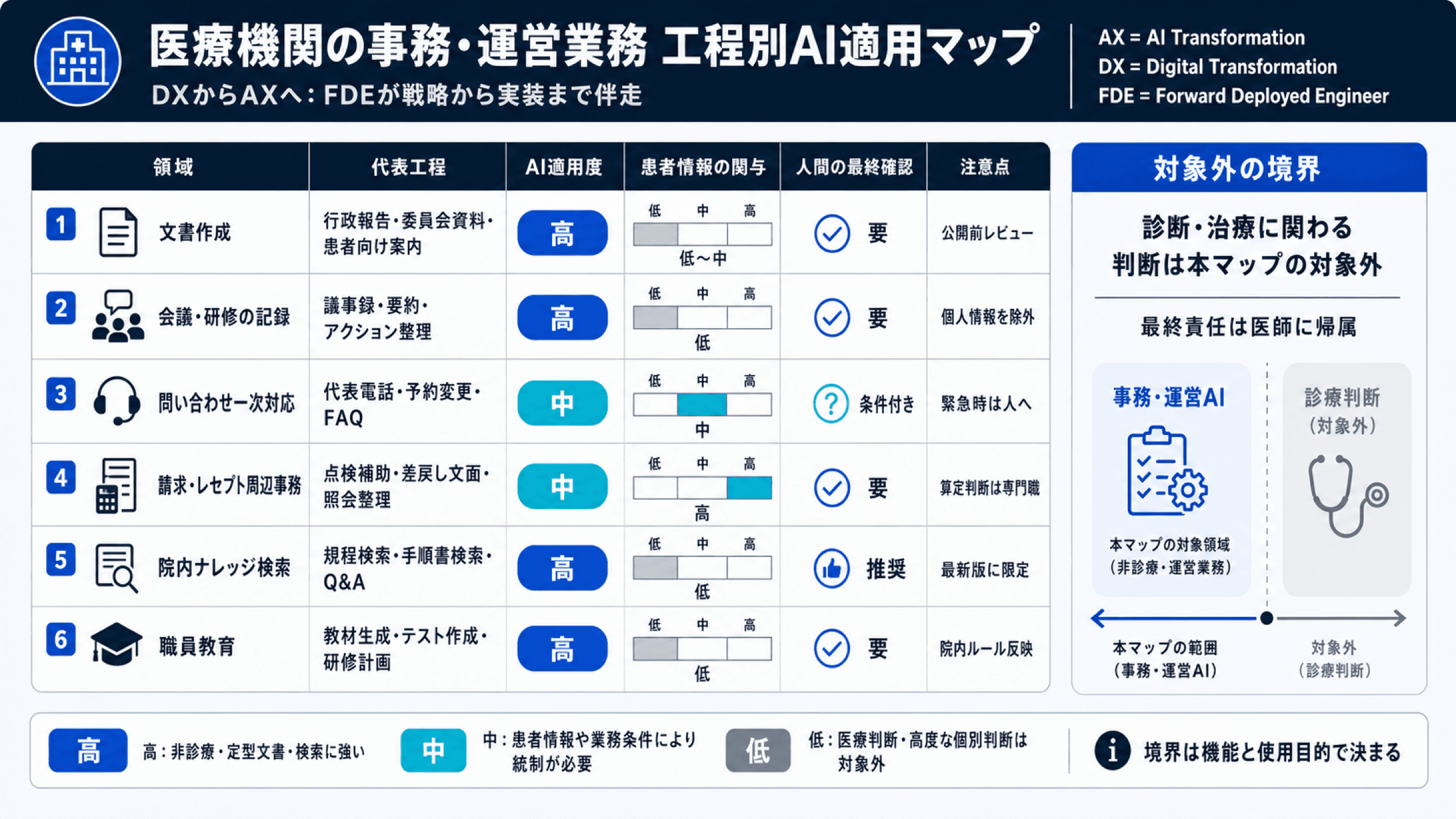
Generative AI in Healthcare | Application Map for Administrative and Operational Tasks and Regulatory Overview
Generative AI adoption in medical institutions should start with administrative and operational tasks such as document creation, inquiries, billing, and internal knowledge, not diagnosis. This article explains, for executives and administrative departments, an AI application map by process, the regulatory framework of the Medical Practitioners Act and program medical devices, compliance with three ministries and two guidelines, and implementation order.
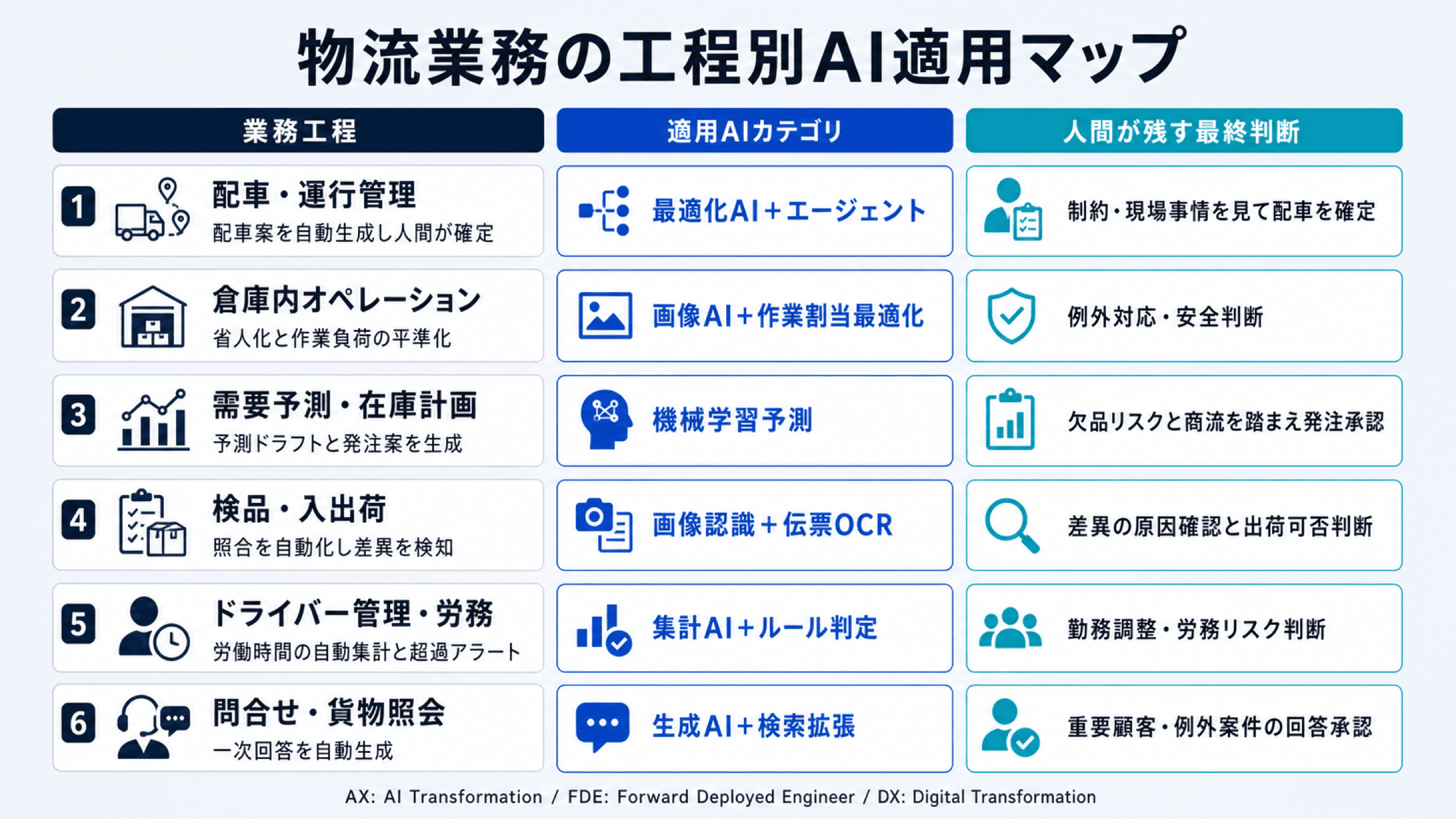
How to Adopt AI in Logistics | Application Map by Task in the Era of the 2024 Problem
AI adoption in logistics means breaking down operations into six tasks-dispatching, warehousing, demand forecasting, inspection, driver management, and inquiries-and applying the optimal AI to each process. This article organizes, for executives, regulatory trends around the 2024 problem, an AI application map by process, prerequisites for data integration, and implementation order.
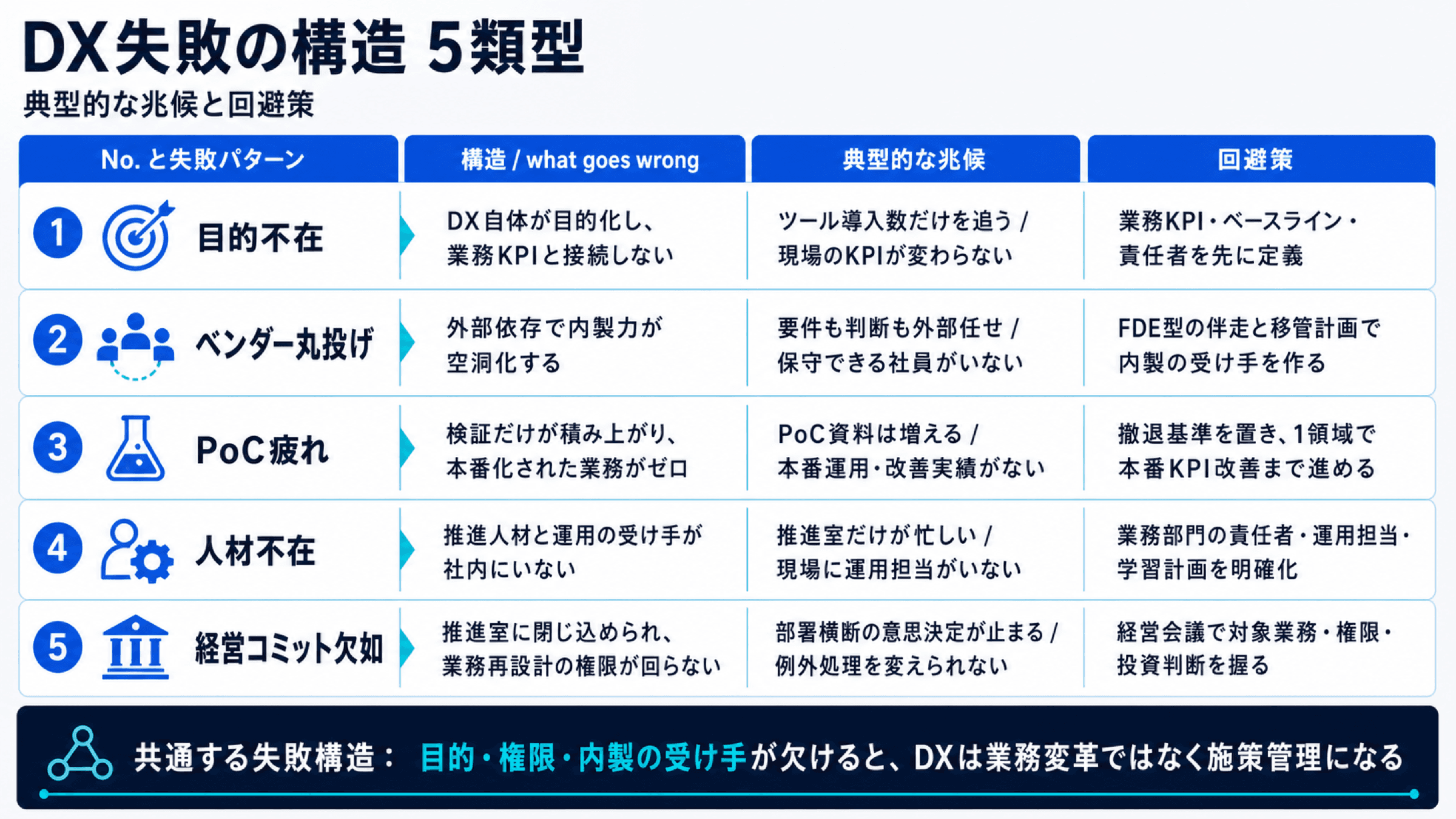
5 Common Causes of DX Failure and How to Avoid Them | A Recovery Roadmap
The causes of DX failure lie in organizational structure, not technology. This article organizes, for executives, five categories-lack of purpose, complete outsourcing to vendors, PoC fatigue, talent shortage, and lack of executive commitment-their warning signs and countermeasures, lessons from METI's "Cliff of 2025," and a roadmap for recovering from stagnation.
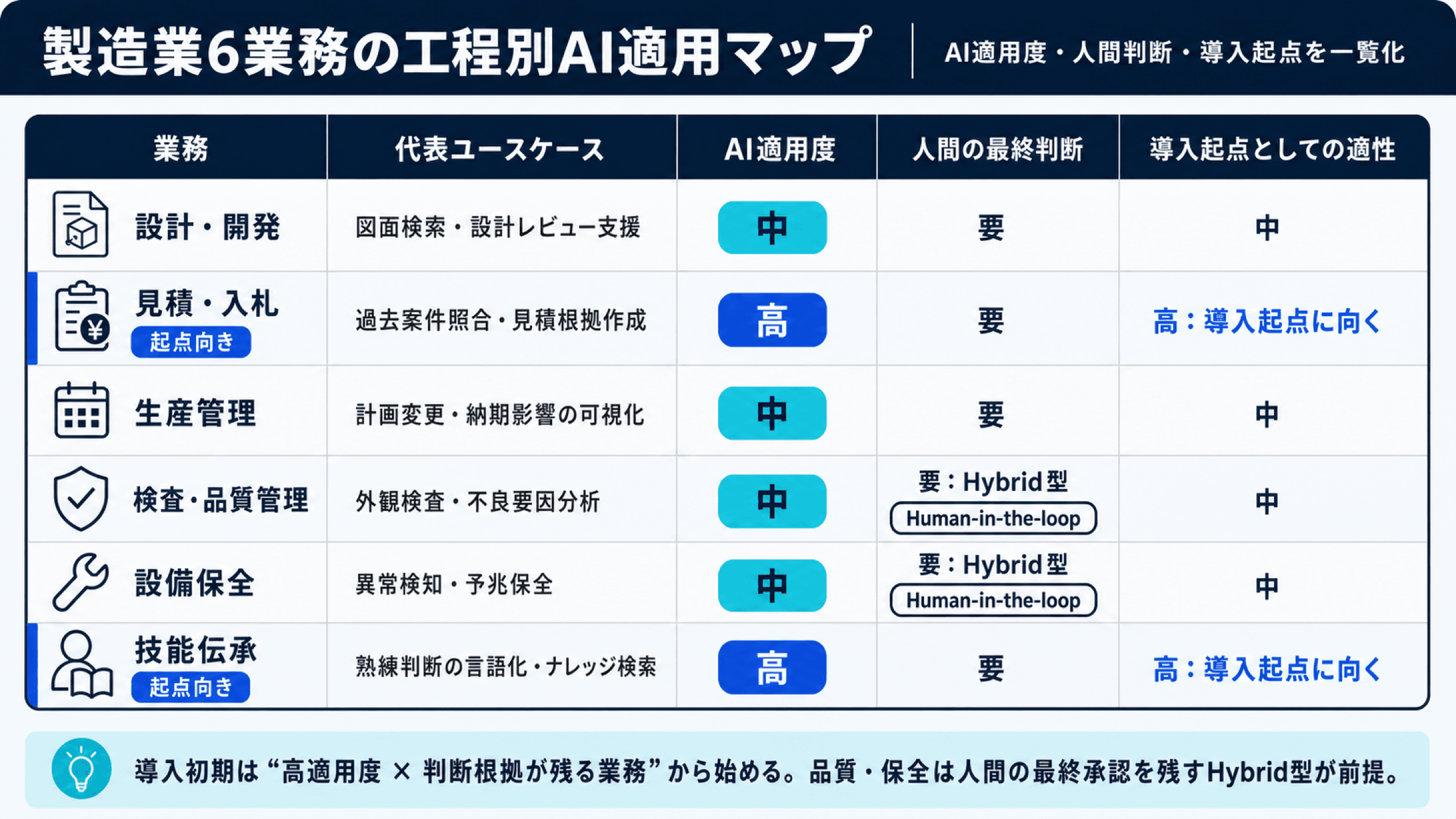
AI in Manufacturing | 6 Tasks Transformed by Generative AI and Implementation Order
This article breaks down AI adoption in manufacturing into six tasks-design, estimation, production management, inspection, maintenance, and skill transfer-and explains an AI application map by process and implementation order. Drawing on support cases such as an approximately 80% reduction in metal appraisal time (internal estimate), it shows why structuring drawings, images, and documents determines results.
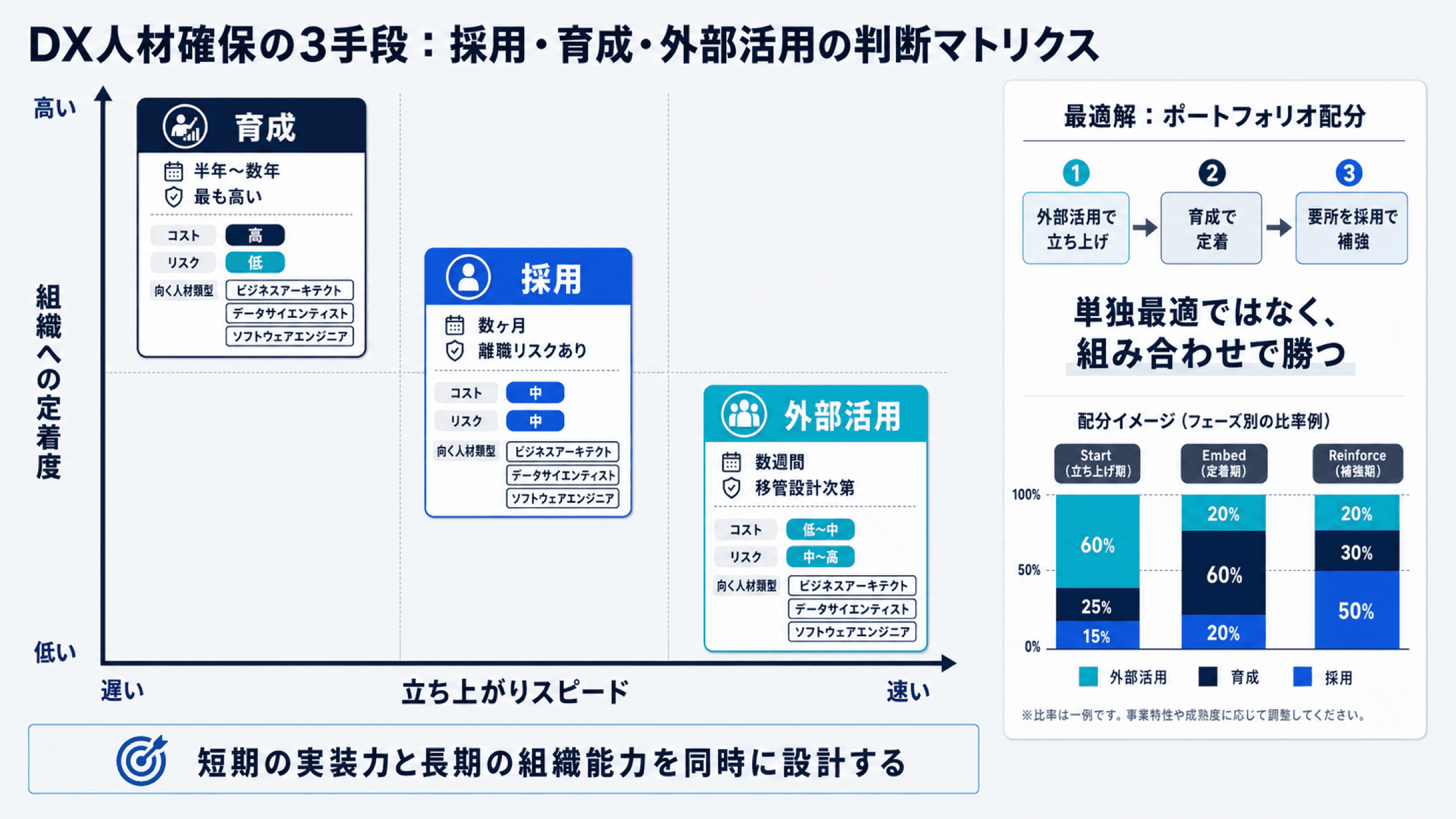
What Is DX Talent? 5 Types and Criteria for Hiring, Training, and External Utilization
DX talent is a general term for professionals who drive business transformation using digital technology and data. This article, aimed at executives, covers the five categories of the IPA Digital Skill Standard, criteria for deciding between hiring, training, and external utilization, and the redefinition of DX talent as AX talent in the era of generative AI.
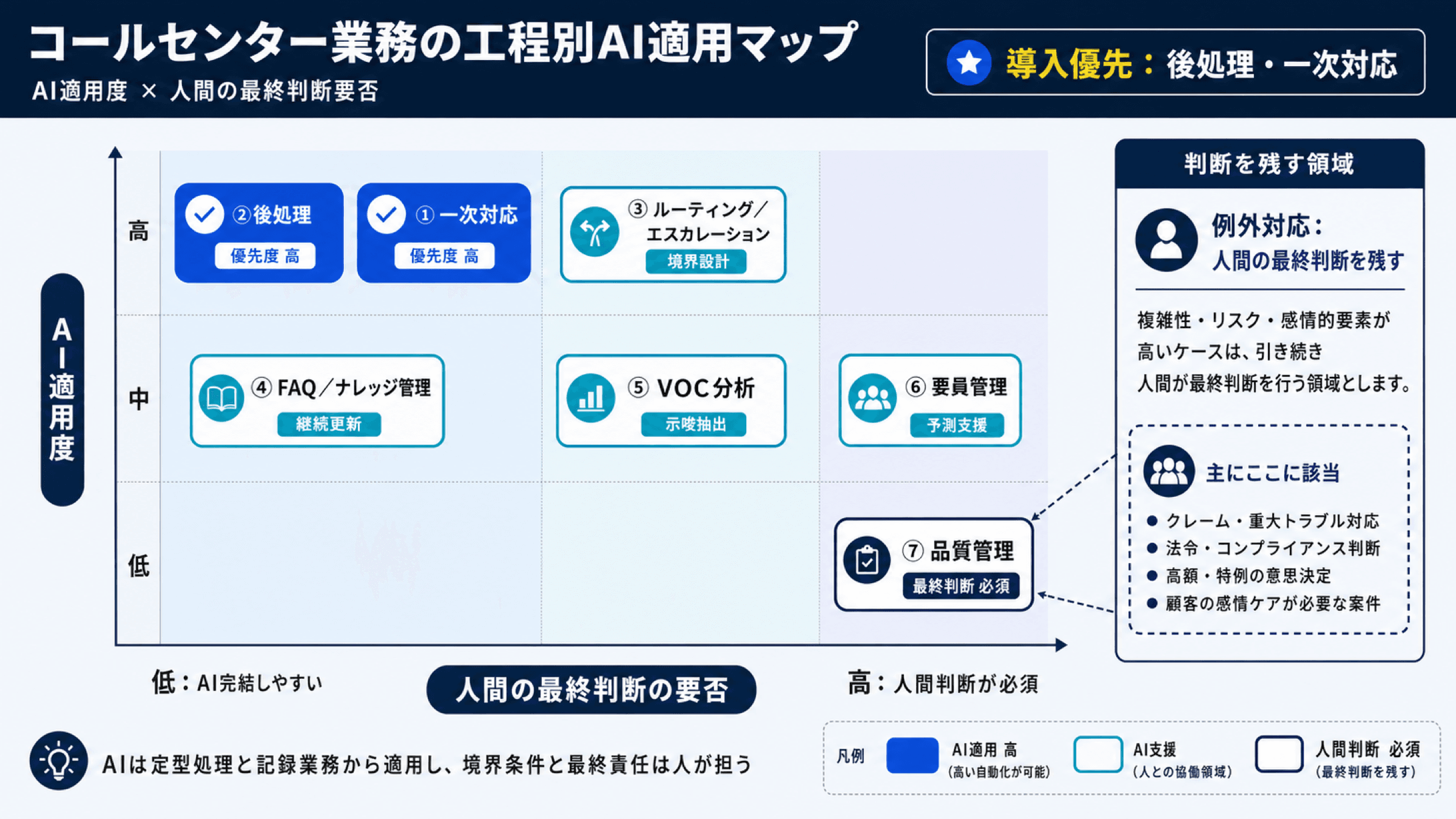
Call Center AI Implementation Guide | Advancing with Task Decomposition and an Application Map
Call center AI implementation does not deliver results through automation of first-line responses alone. This article explains a design procedure that decomposes operations into seven steps and sets priorities based on AI applicability and the need for human final judgment, together with a real-world example where AI automatically answered about 83% of 1,200 monthly inquiries.
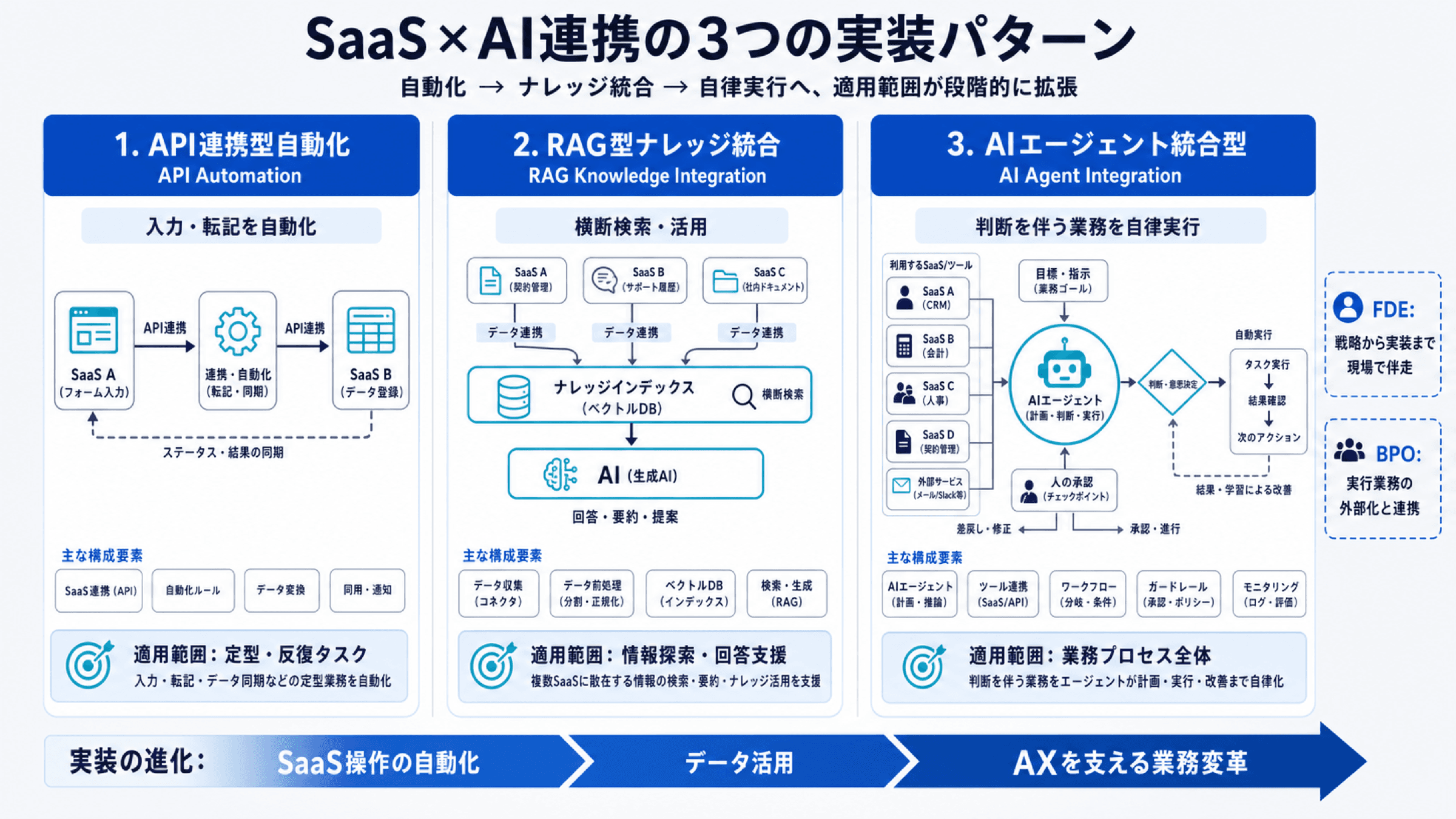
SaaS Integration × AI Implementation | Integrated Design That Turns Underused SaaS into Results
SaaS integration × AI implementation is a method that resolves adoption failure by rebuilding already-deployed SaaS into business processes through API integration, RAG, and AI agent integration. This article explains three integration patterns, a real-world example of reducing CRM input workload by about 90%, and a design checklist with selection criteria.
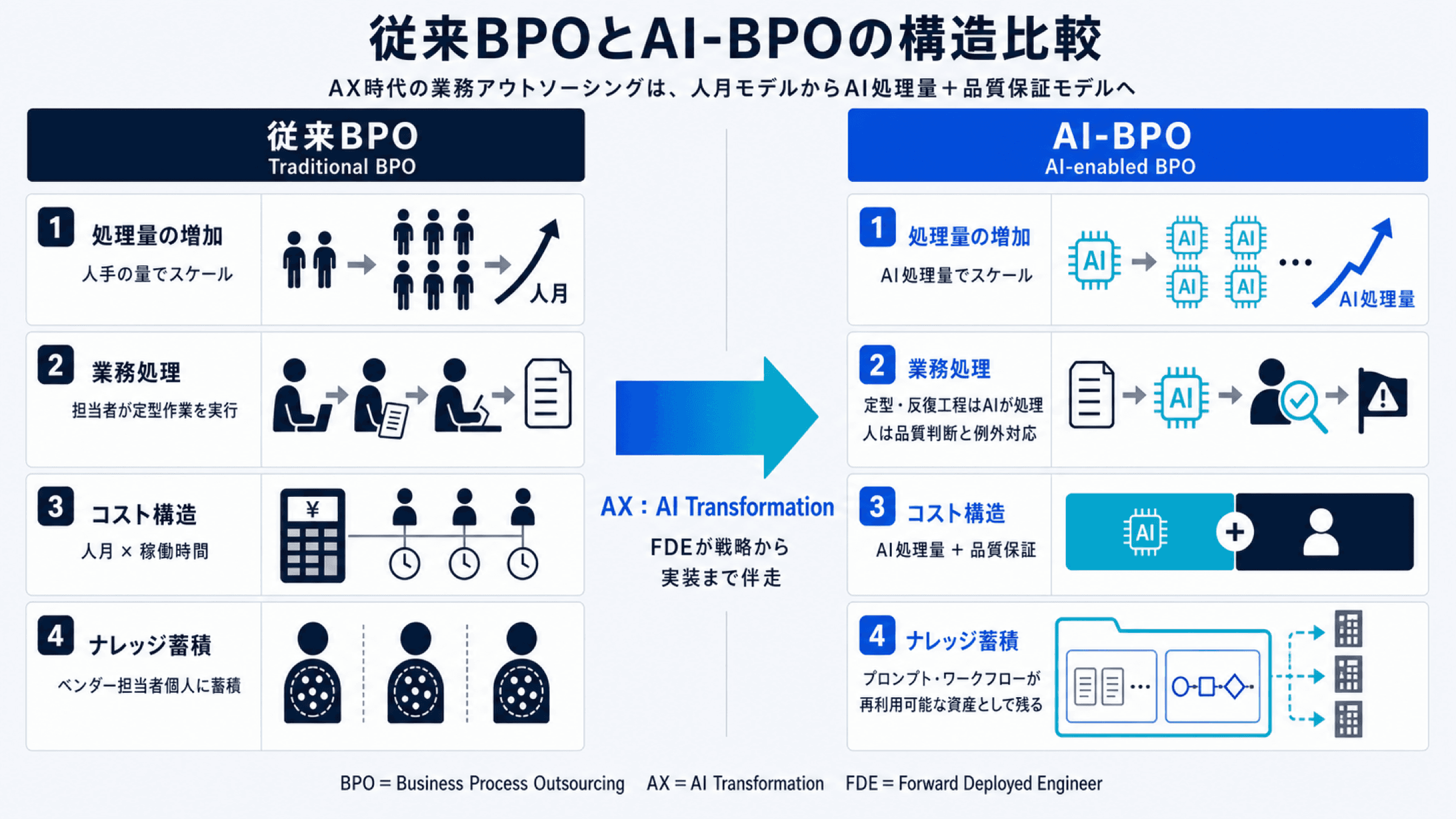
What Is AI-BPO? Differences from Traditional BPO and Criteria for Selecting Business Process Outsourcing
AI-BPO refers to hybrid business process outsourcing in which AI handles routine tasks while humans guarantee quality. Aimed at executives, this article covers structural differences from traditional BPO, a real-world example where AI answered 83% of 1,200 monthly e-commerce inquiries, and selection criteria with an eye toward eventual insourcing.
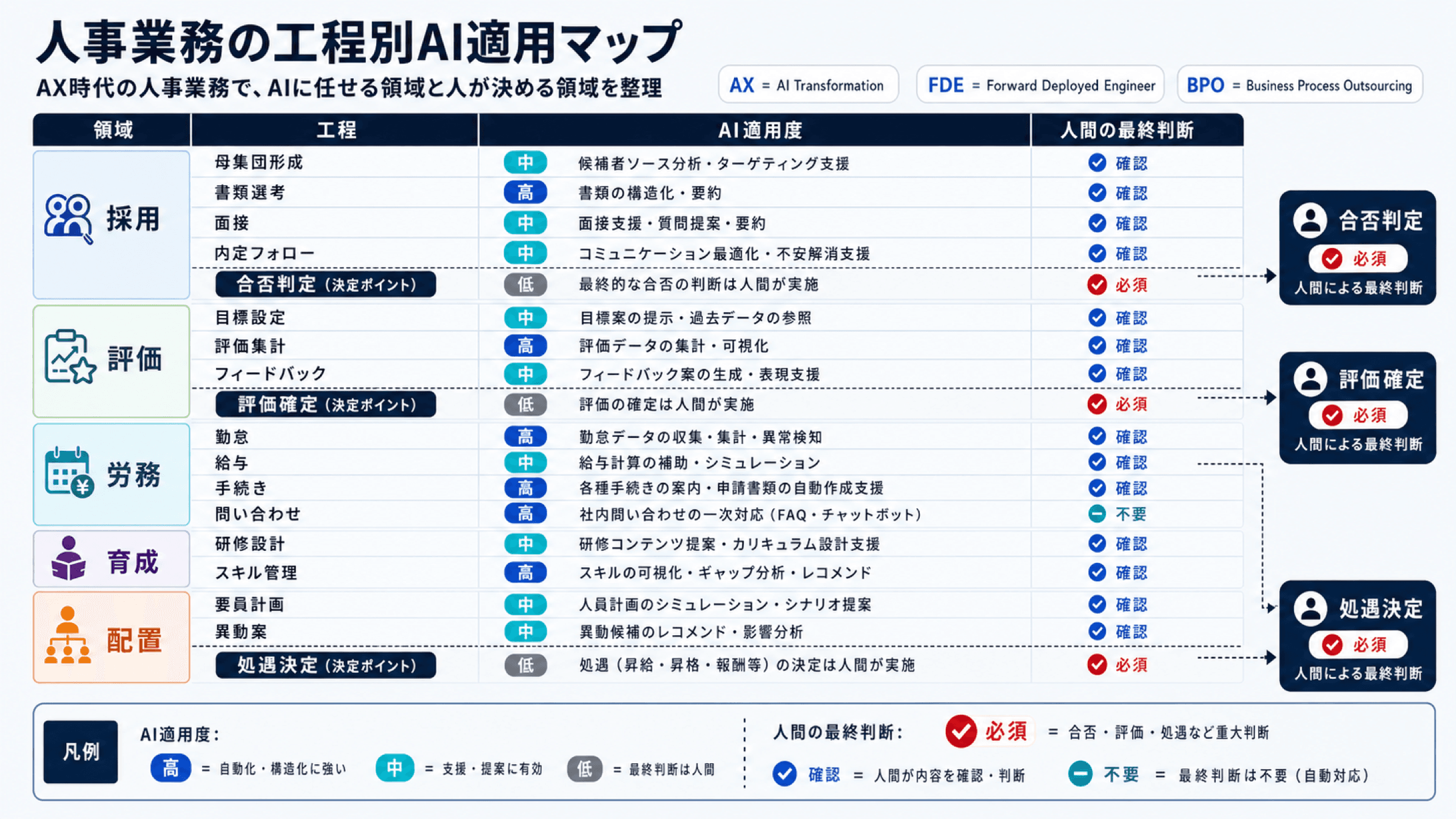
AI in HR | Task-Specific Application Maps for Recruiting, Evaluation, and Labor Management, with Legal Considerations
Applying AI in HR starts with decomposing operations into recruiting, evaluation, labor management, training, and staffing. This article, aimed at HR leaders and executives, covers a task-specific AI application map, real-world examples of AI analysis of résumés, legal considerations around fairness and personal data protection required of recruiting AI, and implementation order.
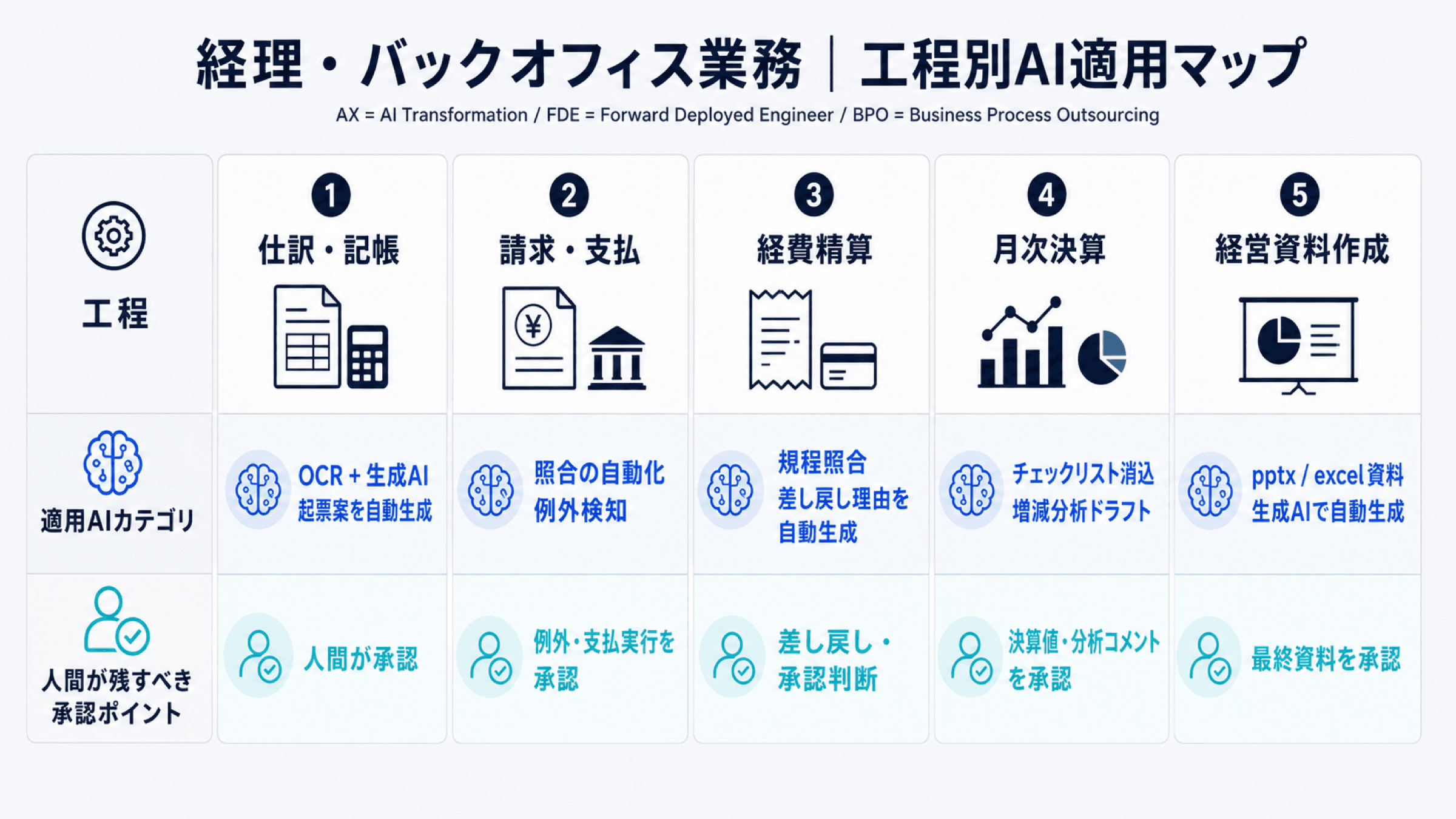
How to Advance Accounting AI Automation | Back-Office AI Application Map and Implementation Order
Accounting AI automation is an initiative that decomposes operations into journal entries, invoicing, expenses, monthly closing, and document creation, and applies the optimal AI to each task. Aimed at executives, this article covers a task-specific application map for back-office AI, an in-house example of reducing document creation by 75%, compatibility with internal controls, and implementation order.
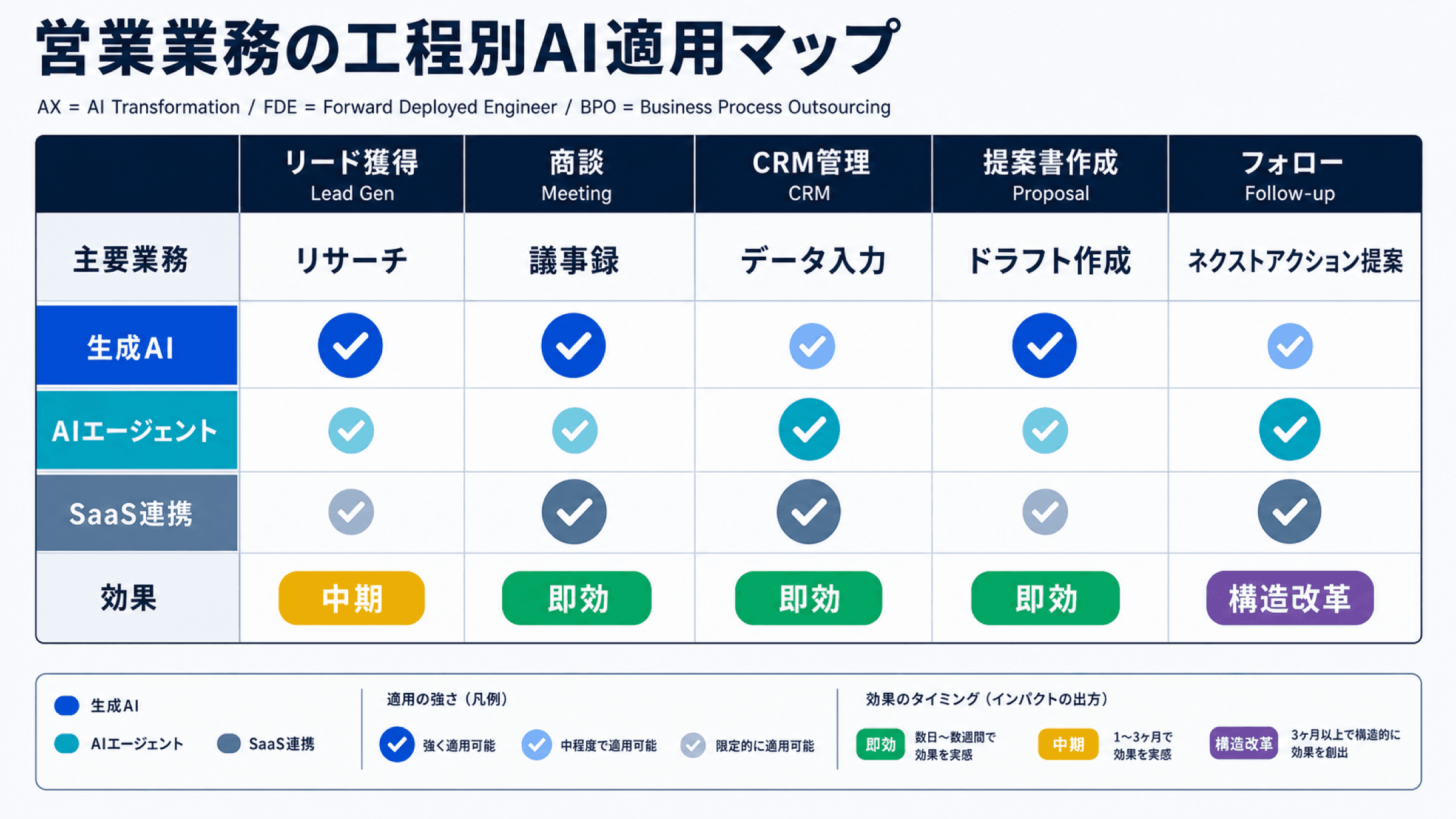
AI-Driven Business Process Reform in Sales | Task-Specific Application Map and CRM Automation in Practice
AI-driven business process reform in sales should start not with the sales meetings themselves but with surrounding tasks. Aimed at executives, this article decomposes operations into five steps—lead acquisition, sales meetings, CRM management, proposals, and follow-up—and covers a task-specific AI application map, a real-world example of reducing CRM input workload by about 90%, and an implementation roadmap with adoption design.
How to Choose Corporate AI Training | Reliable Comparison Criteria and Adoption Design
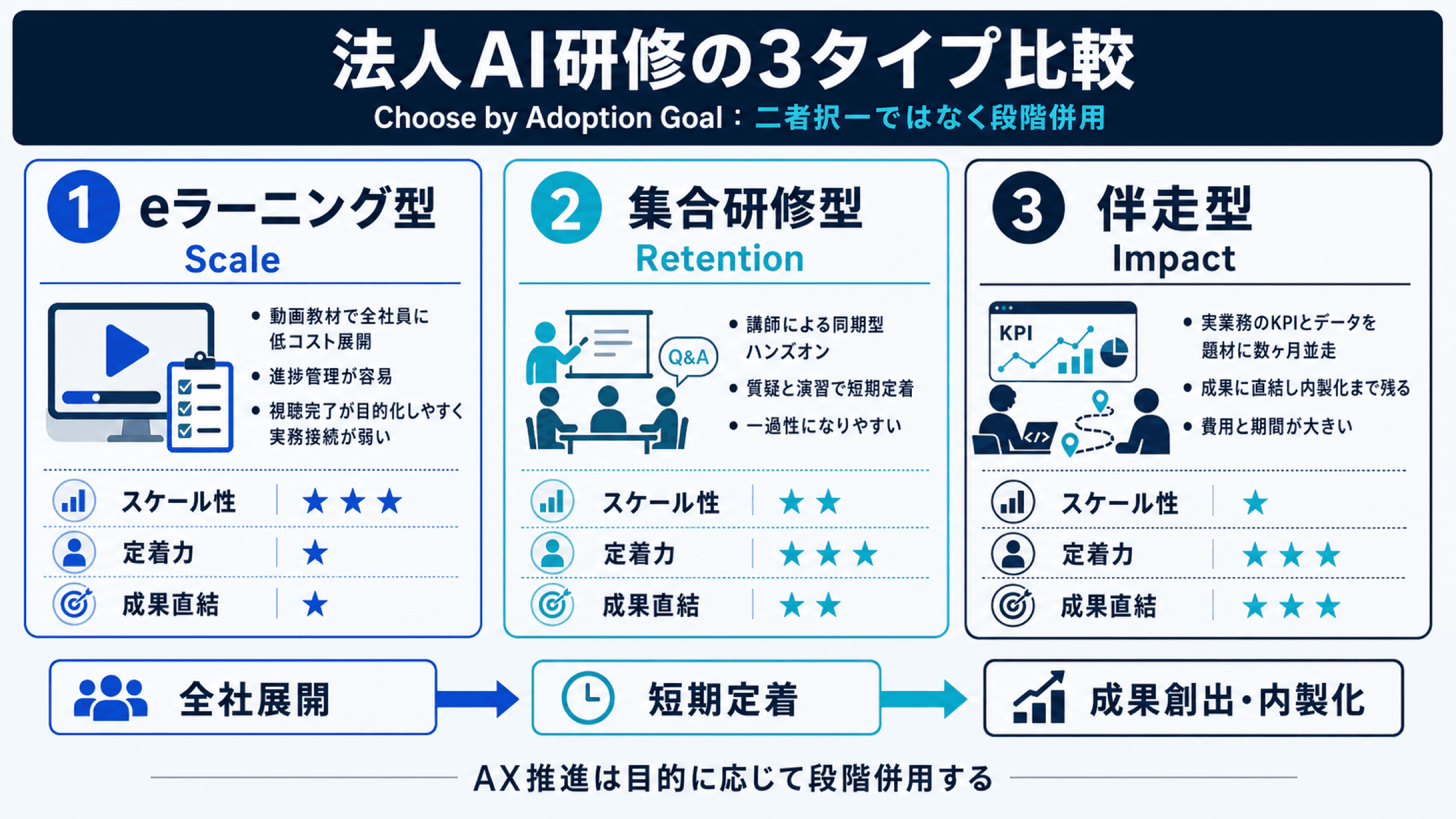
Corporate AI training is a company-oriented development program designed to help employees use generative AI effectively in their work and turn it into results. Aimed at executives, this article explains how to choose training that sticks in daily practice, covering failure patterns, a training type comparison table, selection criteria × verification methods, and adoption KPI design.
7 Generative AI Adoption Case Studies from Large and Mid-Sized Enterprises | Results and Turning Points by Industry
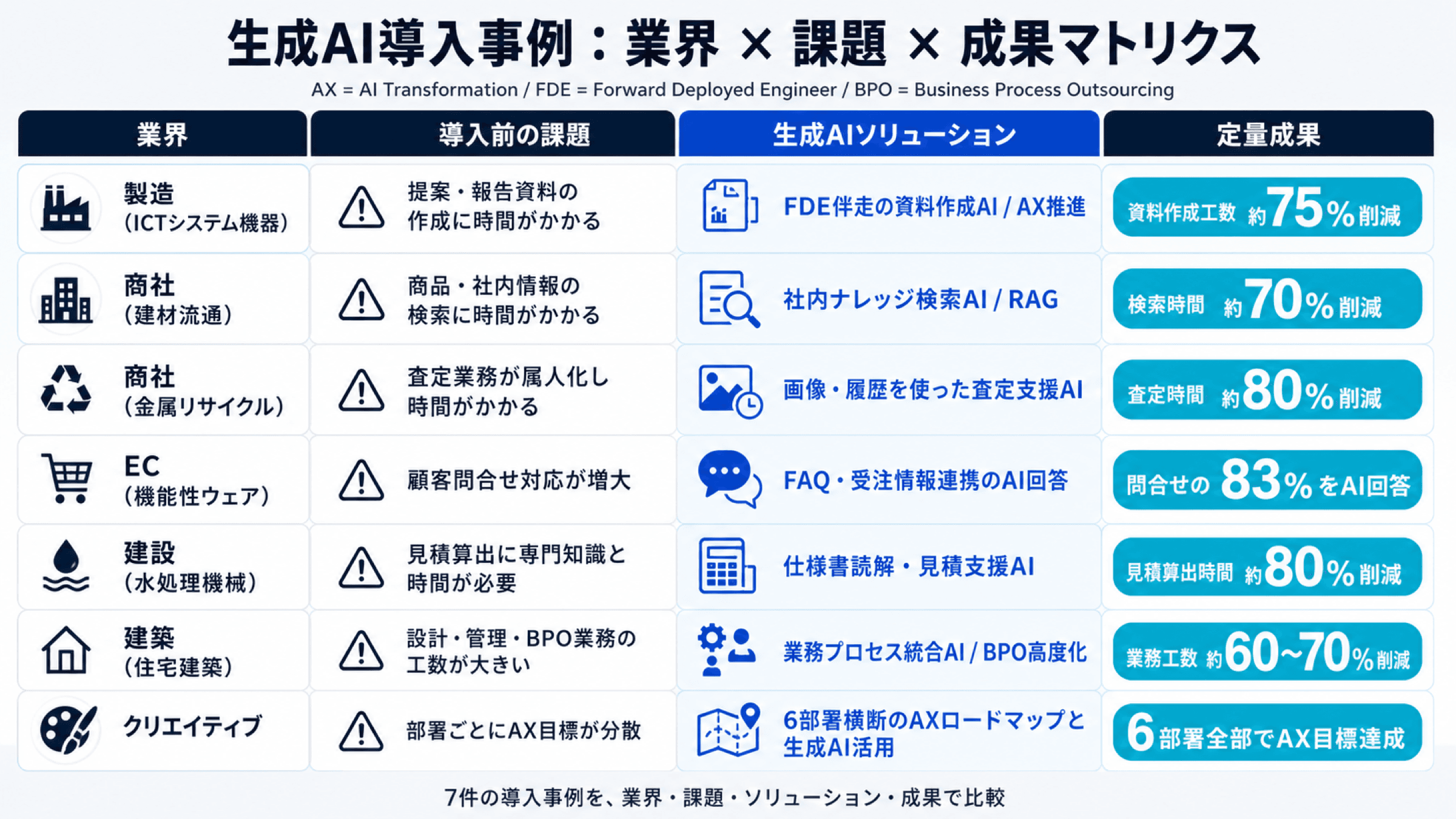
A collection of real-world examples of generative AI adoption at large and mid-sized enterprises, organized by industry × challenge × results. Based on actual figures from seven cases—including about 75% reduction in document creation and AI answering 83% of inquiries—this article explains the common factors and reproducible steps that separate companies stuck at the PoC stage from those achieving production adoption.
What Is AX Consulting? Comparison of 4 Types, How to Choose, and Contract Design
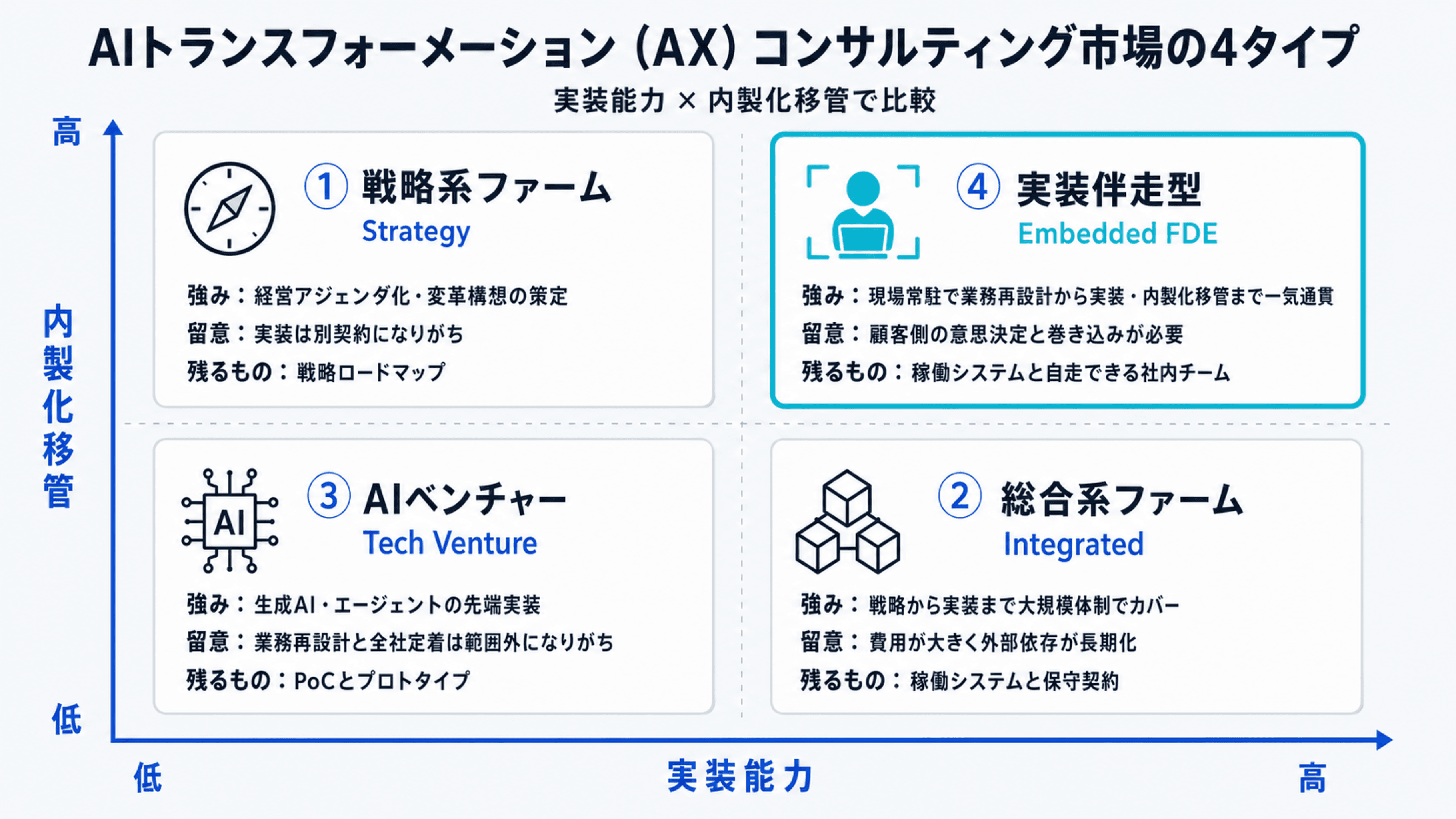
AX consulting (AI transformation consulting) is a service that supports rebuilding business processes and organizations with AI as the premise. This article compares the four types—strategy-focused, generalist, AI venture, and implementation-support—based on what remains in-house after the contract ends, and outlines contract design that avoids ending with mere recommendations, plus a selection checklist.
FDE Costs and Pricing | Appropriate Budgets Based on Role-Level Rates and TCO
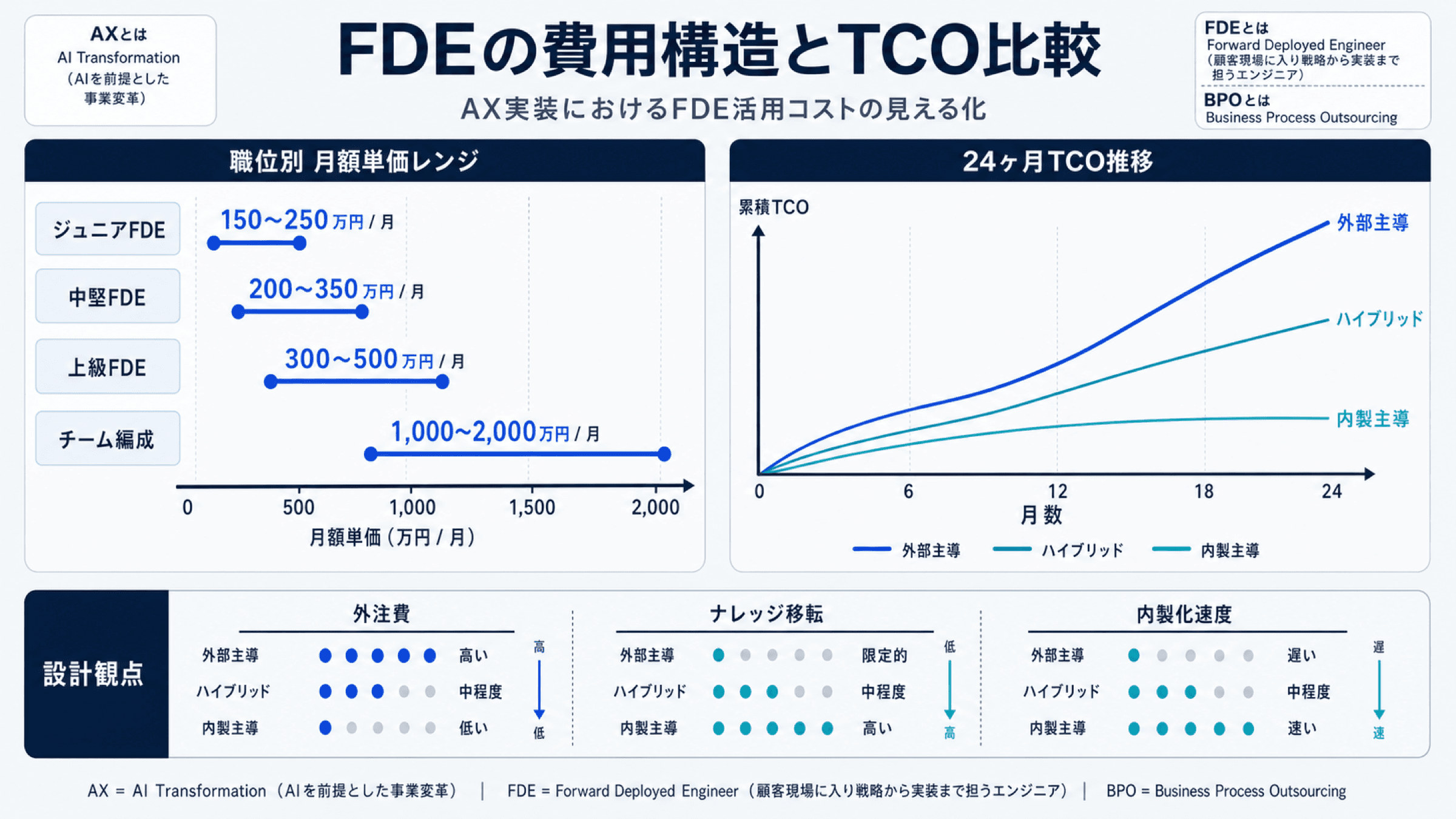
This article, aimed at executives, covers FDE (Forward Deployed Engineer) costs and market rates by role-level pricing, cost comparisons with SES, SI, and consulting, an 18–24 month TCO view, how to measure cost-effectiveness, and how to build a budget.
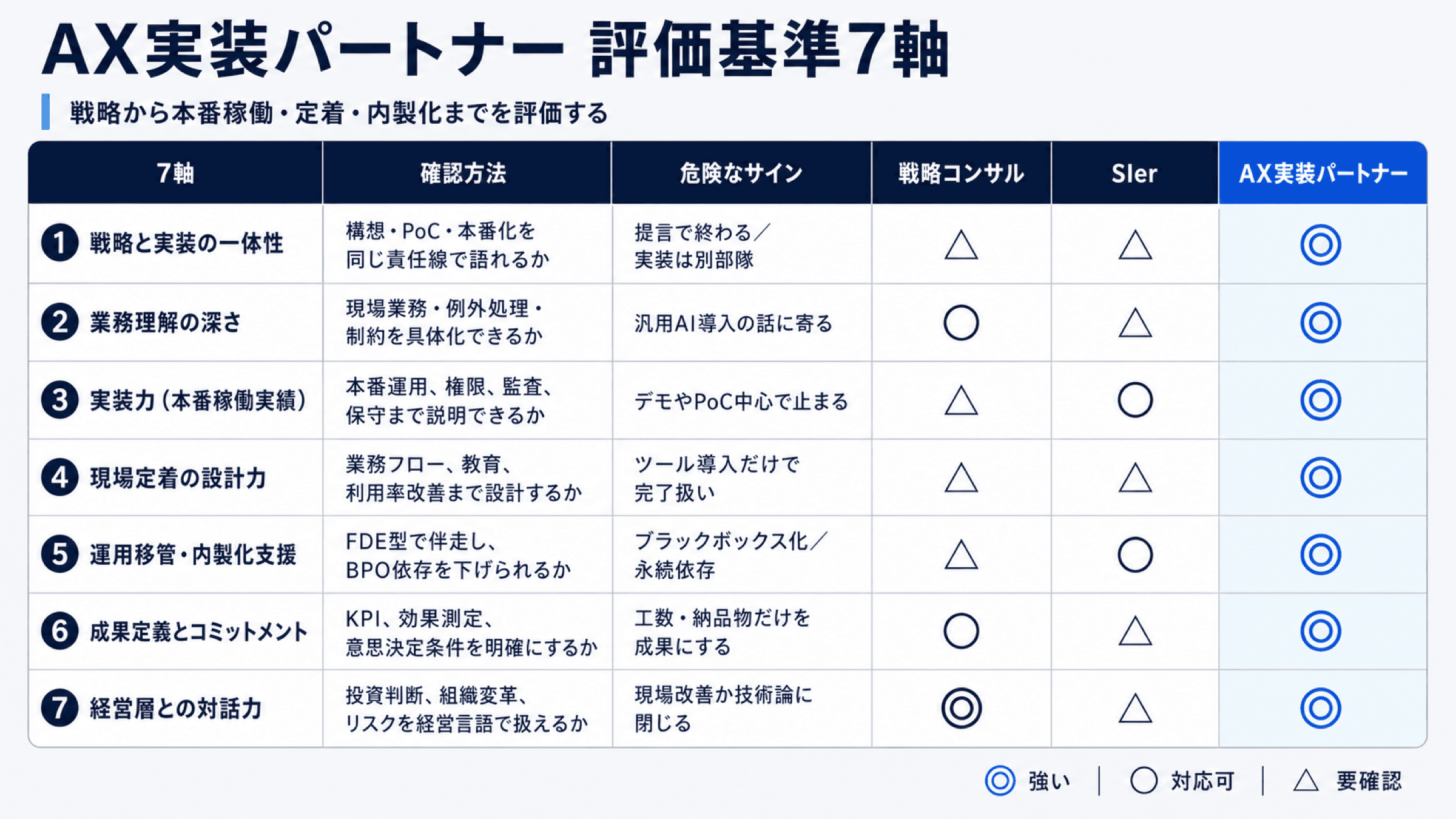
What Is an AX Implementation Partner? 7 Evaluation Criteria, How to Choose, and Avoiding Failure
An AX implementation partner is an external partner that handles the entire chain from AI strategy planning through implementation, on-the-ground adoption, and operational handover. Aimed at executives, this article explains differences from consultants and SIers, a comparison table of 7 evaluation criteria, a 5-step selection process, and failure patterns.
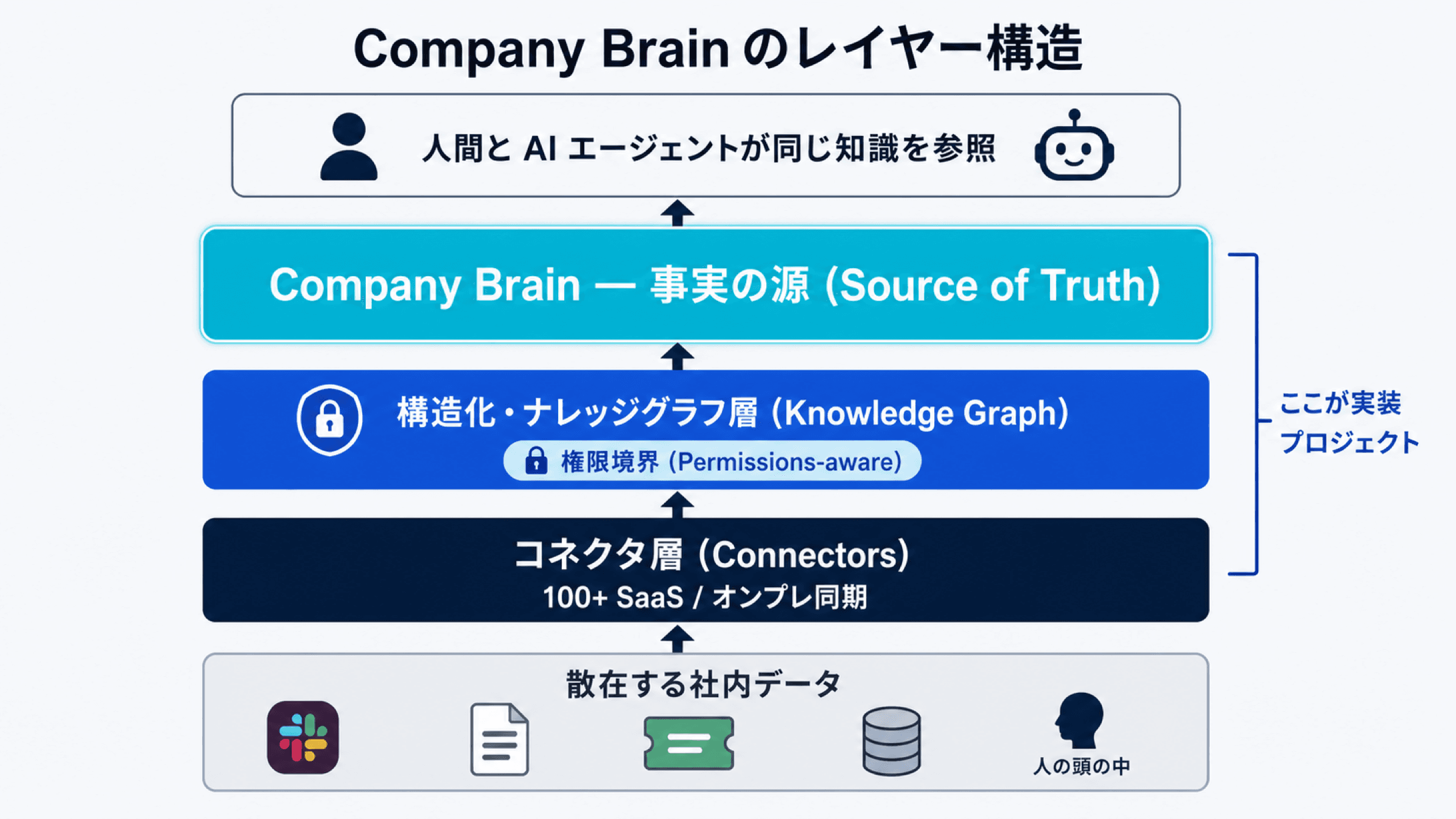
What Is Company Brain? An AI Knowledge Foundation for Enterprises
Company Brain is an enterprise AI knowledge foundation that structures knowledge scattered across the organization so that humans and AI agents can reference the same source of truth. This article explains key implementation points and differences among three major products.
Open-Weight Model List | Local LLM Comparison 2026 and GPU Quick Reference Table
We compiled a list of 21 open-weight models (LLMs with publicly available weights that can run in your own environment) by license, context length, and required GPU. Verified against official model cards and license texts as of November 16, 2026. We also provide a GPU quick reference table and an "on-prem LLM adoption decision sheet" you can use for internal approvals.
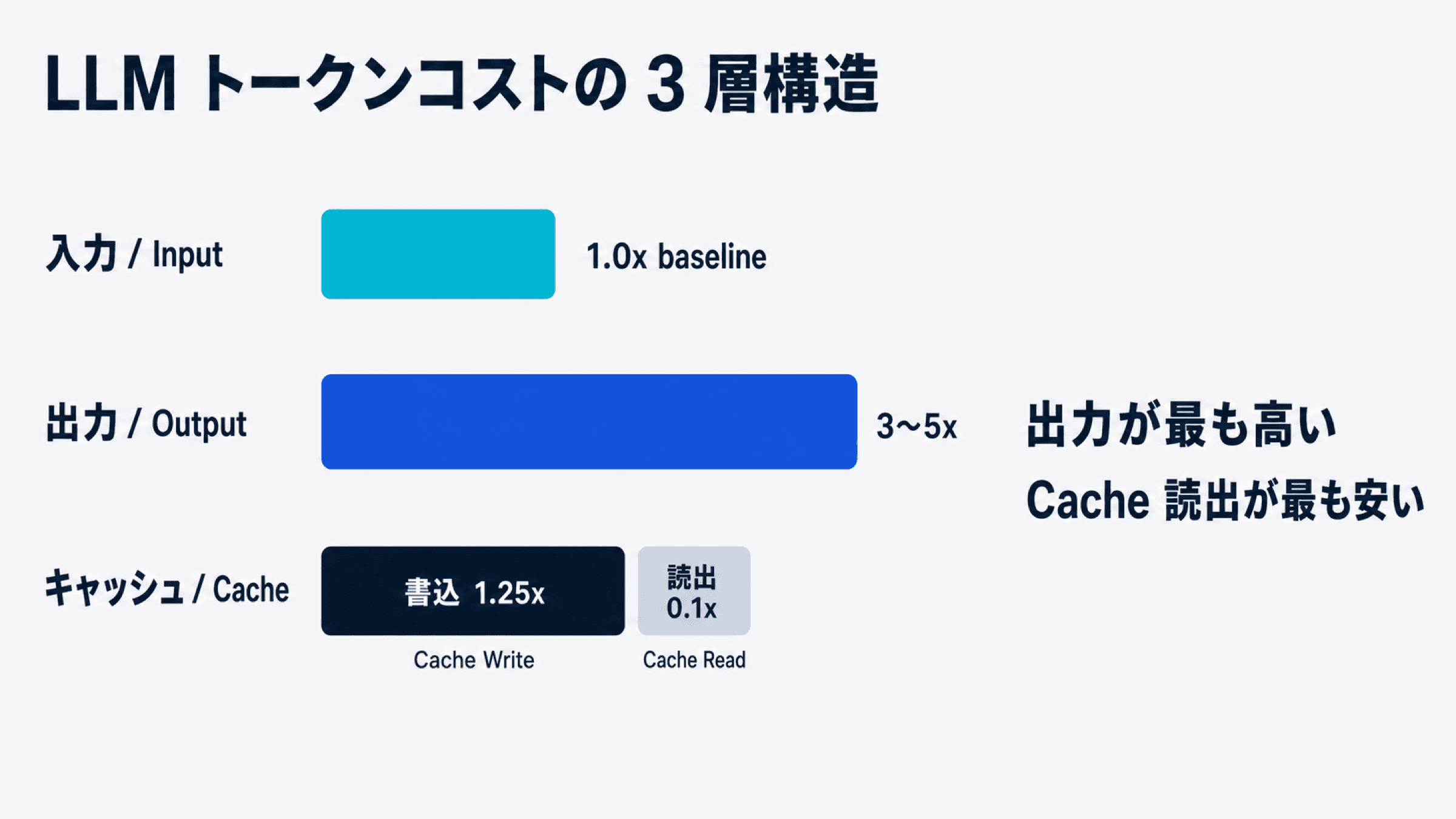
5 Patterns for Saving AI Tokens | Production Design That Cuts LLM Costs by 50–80%
This article organizes five patterns for reducing generative AI/LLM token usage and costs (prompt caching, context compression, model selection, batch APIs, and in-house extraction) in a quick reference table of effectiveness and implementation difficulty. It also covers how to set budget caps and a monthly improvement loop.
Introduction to Loop Engineering | A Systematic Approach to Harness Design for Keeping Autonomous Agents Running
Loop engineering is the technology of harness design for safely running autonomous AI agents through repeated observe → judge → act cycles. This article systematically explains the three-layer structure, four stop-condition patterns, layered design of verification harnesses, and anti-patterns.
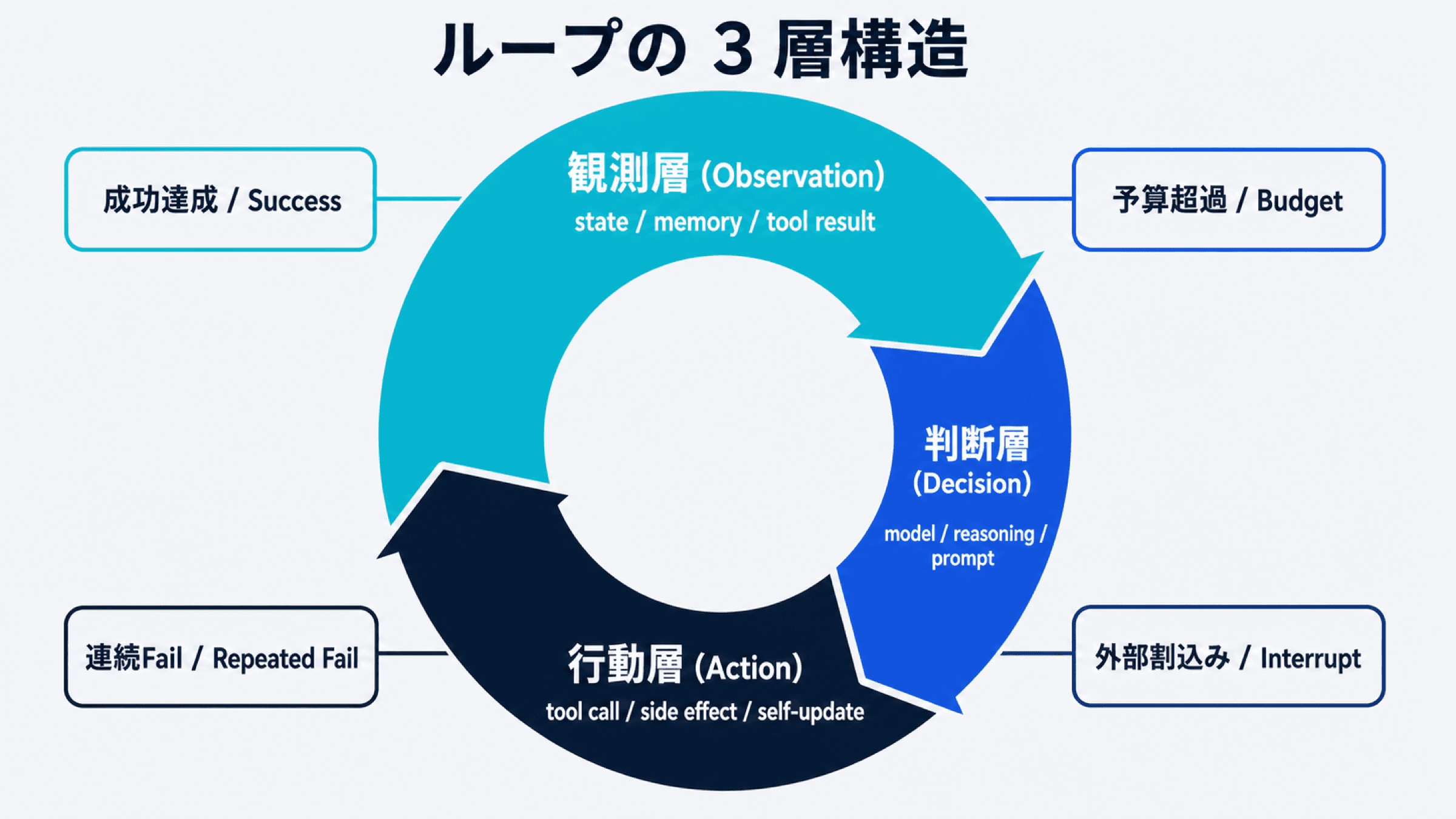
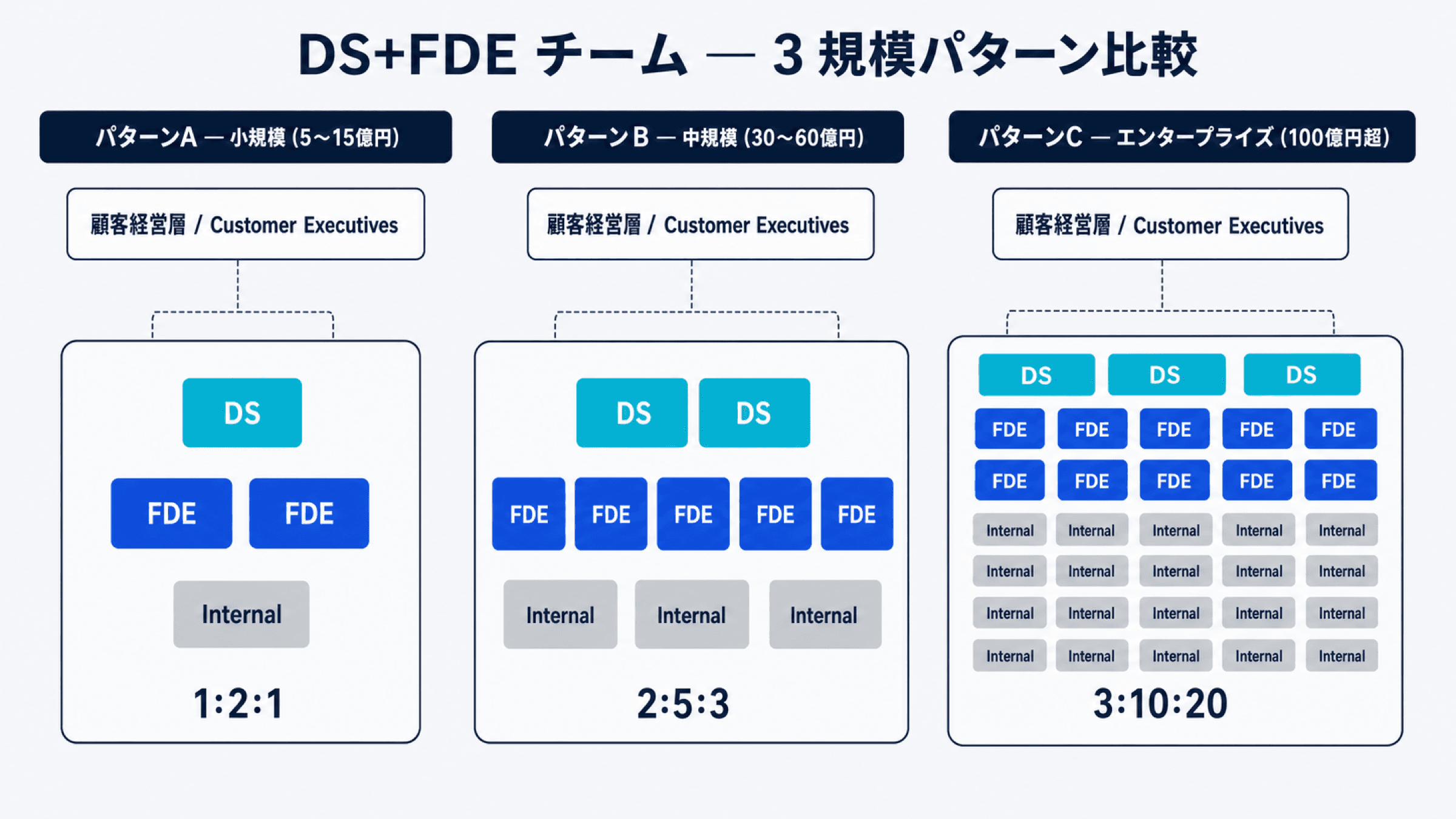
DS+FDE Hybrid Team Design | Organizational Theory for AI Implementation in Japanese Companies
Design practice for DS+FDE hybrid teams. We organize the rationale for a 1:2-3 ratio, three organizational chart patterns by scale, a four-stage adoption roadmap for Japanese companies, and anti-patterns to avoid, as organizational theory for AI implementation.
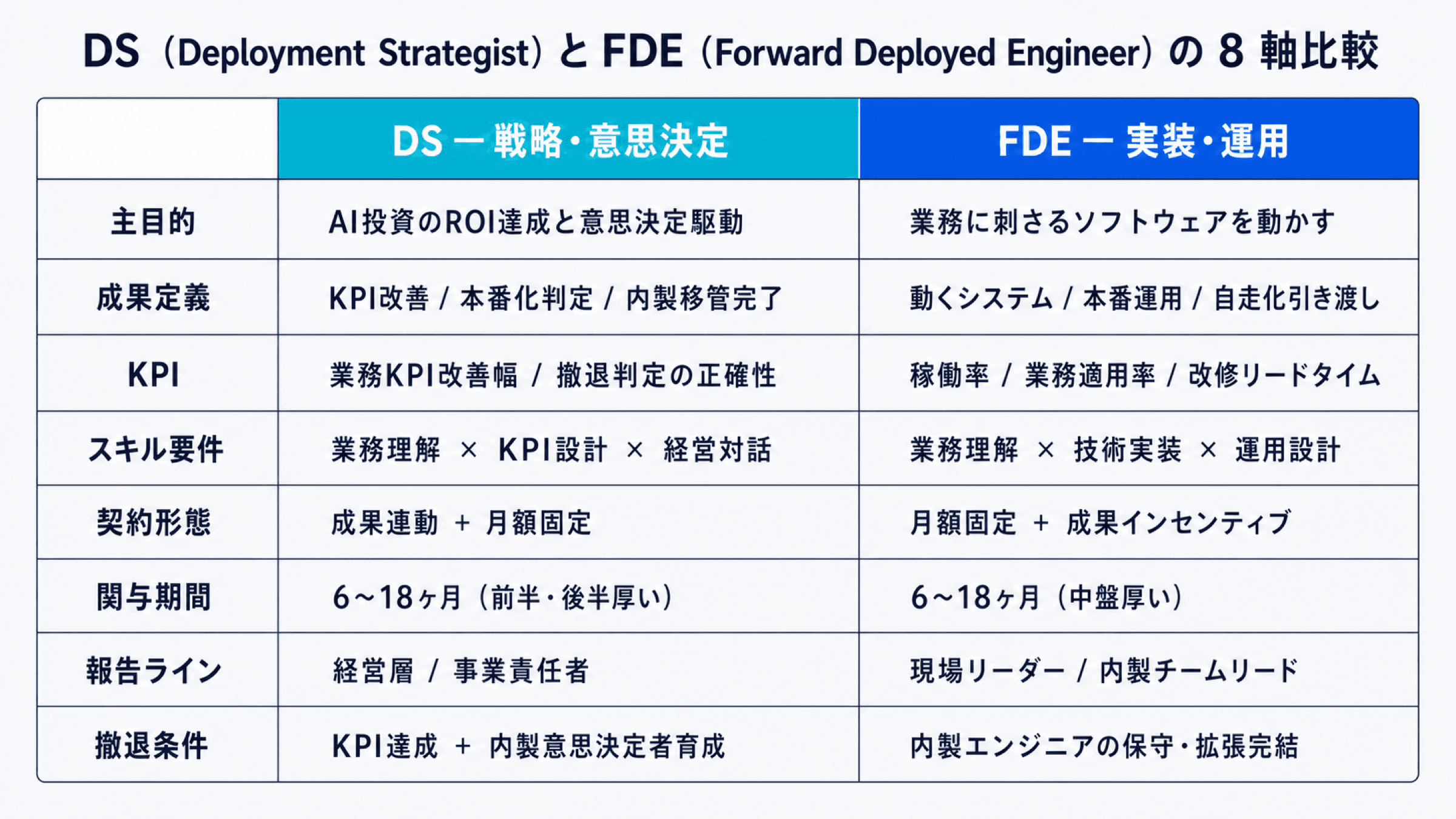
DS vs FDE | An 8-axis comparison of roles, responsibilities, and outcome definitions, and why they should be used together
A thorough 8-axis comparison (primary purpose, outcome definition, contract type, exit conditions, etc.) of DS (Deployment Strategist) and FDE. We organize why the two should be combined and the hiring order by phase, for executives and hiring managers.
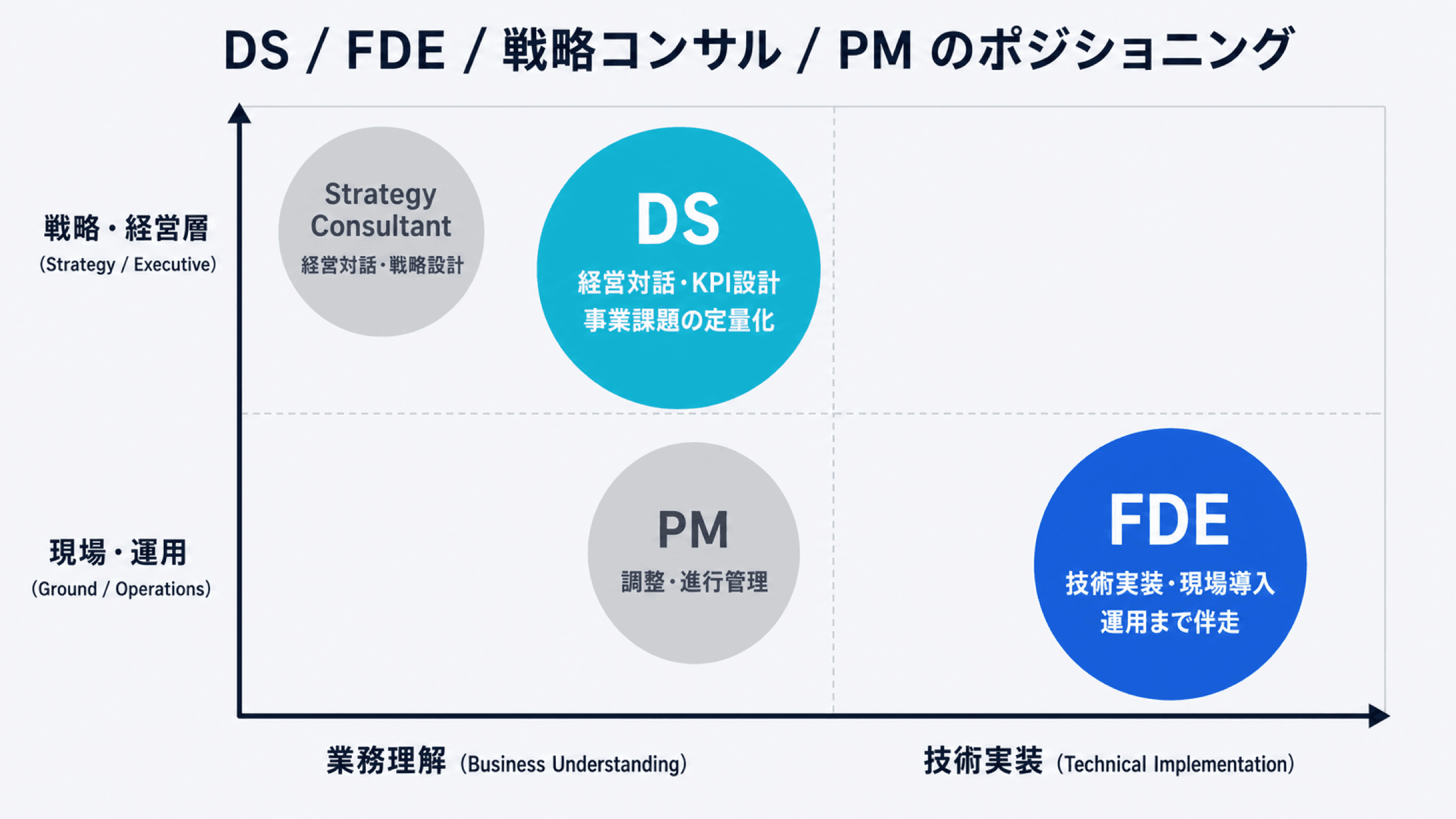
What is a Deployment Strategist (DS)? The strategic role in AI implementation
A DS (Deployment Strategist) is a strategic role originating at Palantir that works alongside executives, handling everything from defining AI implementation outcomes to exit decisions. We explain the differences from FDEs, five key characteristics, and how Japanese companies can leverage DSs, for executives.
What is AI consulting? Differences among 4 types, how to choose, and pre-engagement checks
AI consulting is a specialized service that supports everything from AI adoption strategy planning through implementation and operational establishment. We compare the 4 types of providers in a table, and explain the questions and checklist to verify before engagement in large enterprises, and how to choose with in-house capability building as the goal.
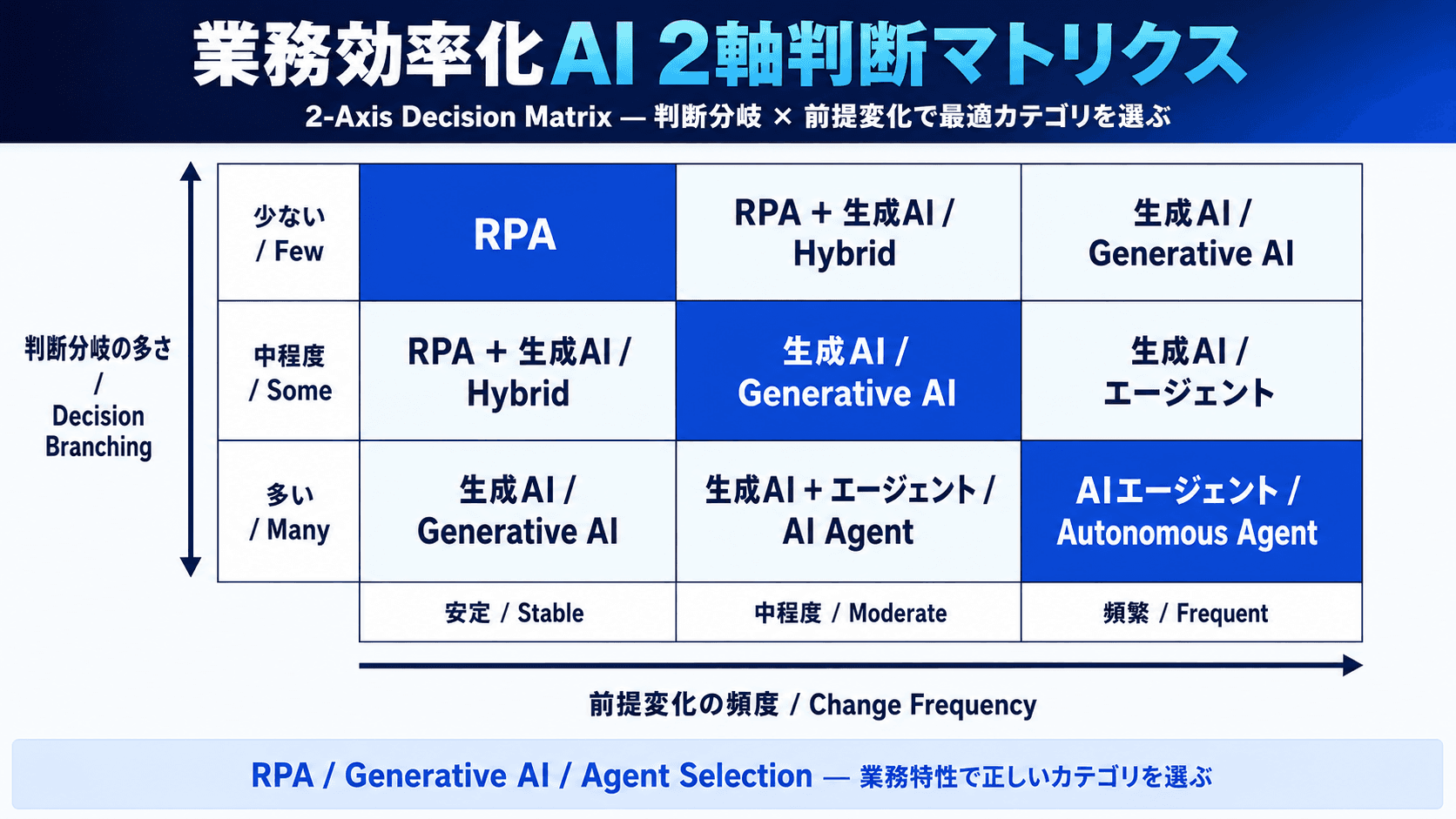
How to choose AI for business efficiency | When to use RPA, generative AI, and AI agents
There are three categories of AI for business efficiency: RPA (automation of routine tasks), generative AI (content generation and summarization), and AI agents (autonomous goal achievement). This article organizes the strengths and weaknesses of each, decision criteria for choosing by business characteristics, mapping across six typical business processes, common selection failure patterns, and the business infrastructure needed to combine them, for executives and DX/AX promotion leads.
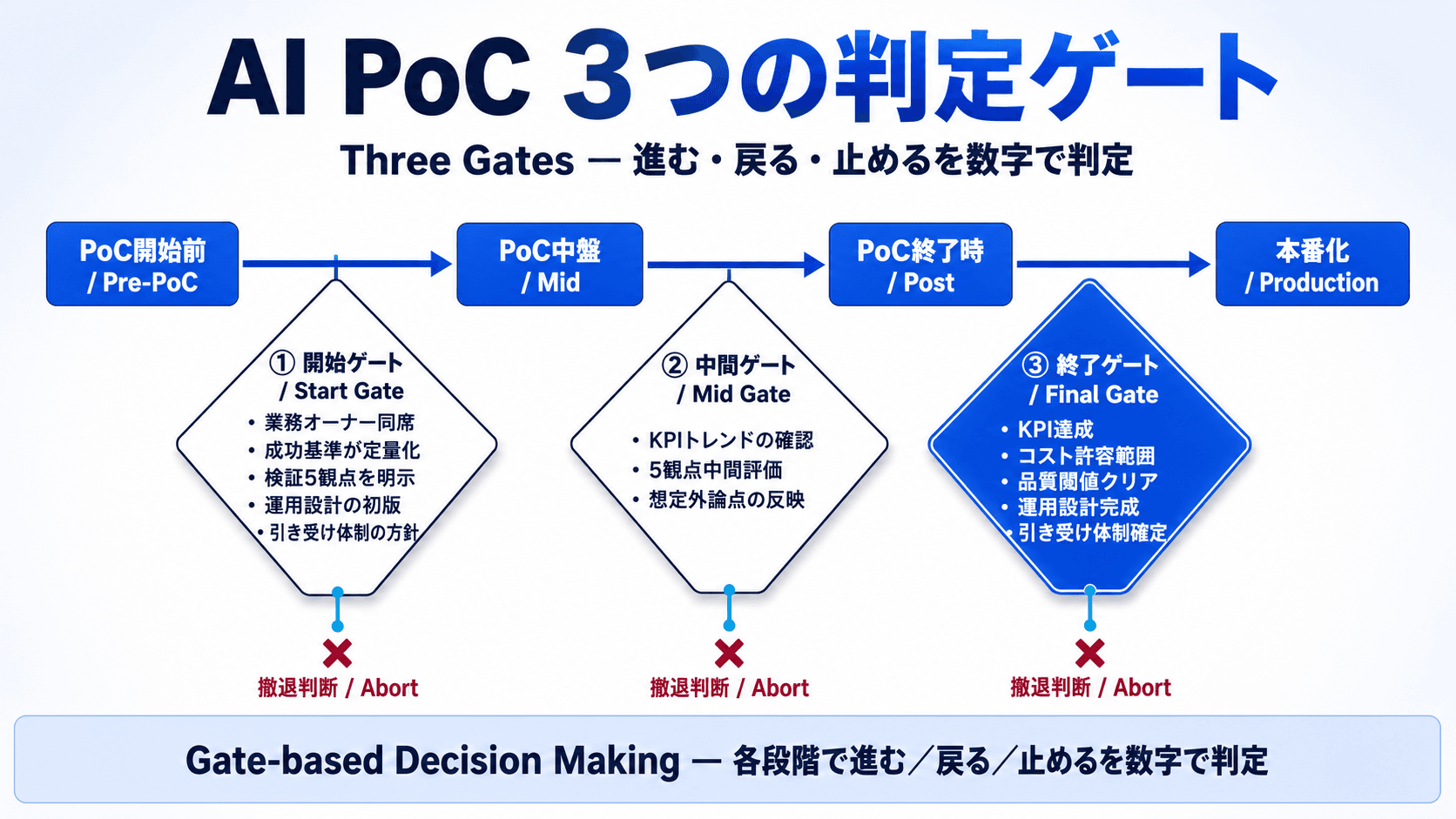
5 structural reasons AI PoCs fail and how to avoid them | Designing PoCs that can move to production
Most AI PoCs never reach production. The cause of failure is not technology but structural gaps in PoC design. This article organizes the five failure patterns (lack of business understanding, success criteria set after the fact, trivialized validation purpose, missing production operations design, no in-house team to take over operations) and the design methods and decision gates for PoCs that can move to production, for executives and DX/AX promotion leads.
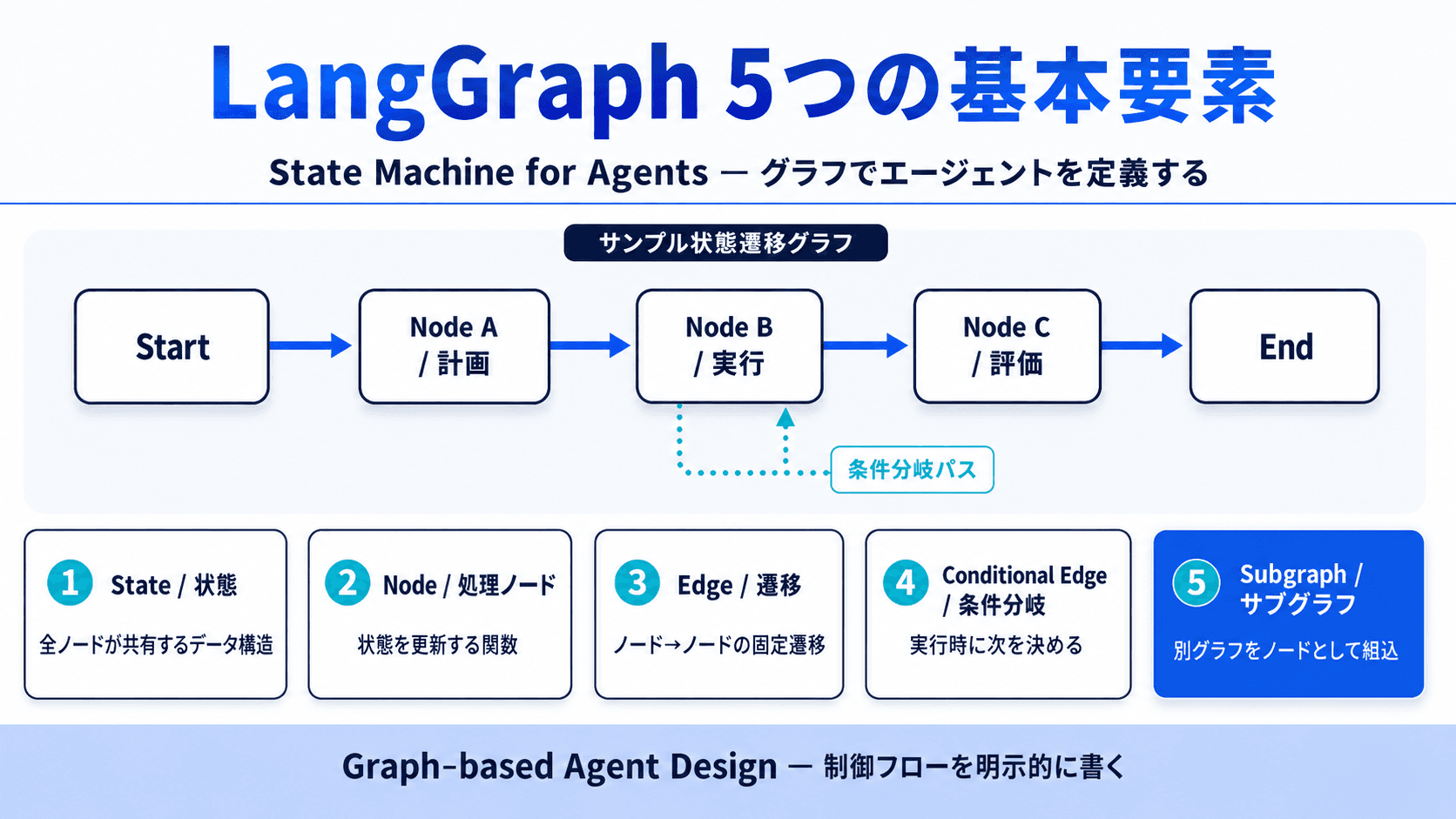
Introduction to LangGraph implementation | A framework for building enterprise AI agents
LangGraph is a LangChain-family framework that defines AI agent state transitions as graphs. It enables explicit design of observability, human intervention, and state management, making it strong for enterprise production use. We organize its five elements and implementation steps as of 2026.
Multi-agent implementation guide | Design patterns for collaboration and division of labor, and operations design
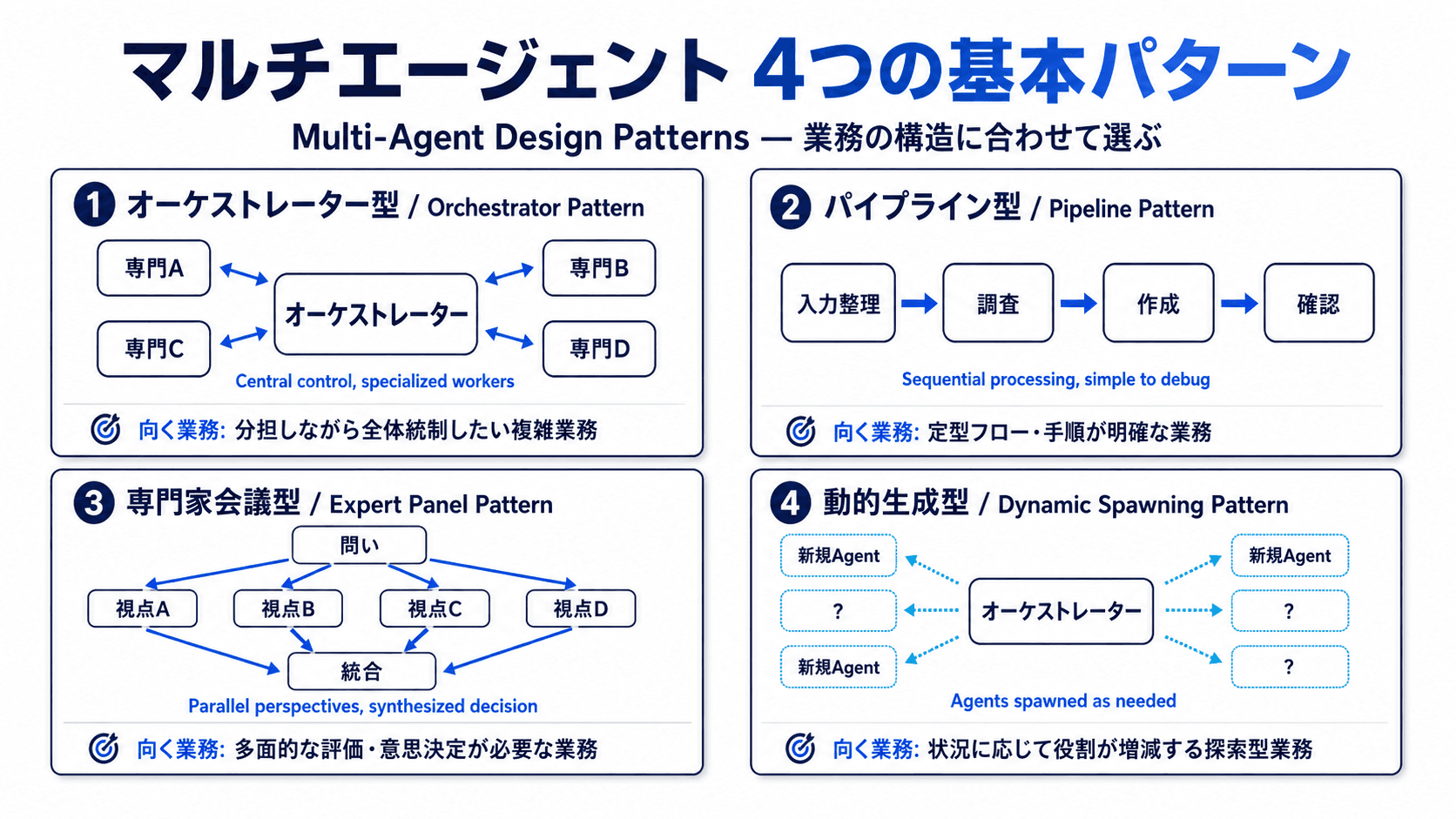
The essence of multi-agent systems is division-of-labor design. Instead of having a single LLM do everything, specialized agents work together to improve quality, scalability, and maintainability. This article organizes the four basic patterns (orchestrator, pipeline, expert panel, dynamic generation), five design considerations, a comparison of implementation frameworks, five business application patterns, five failure patterns, and successful migration steps, as of 2026.
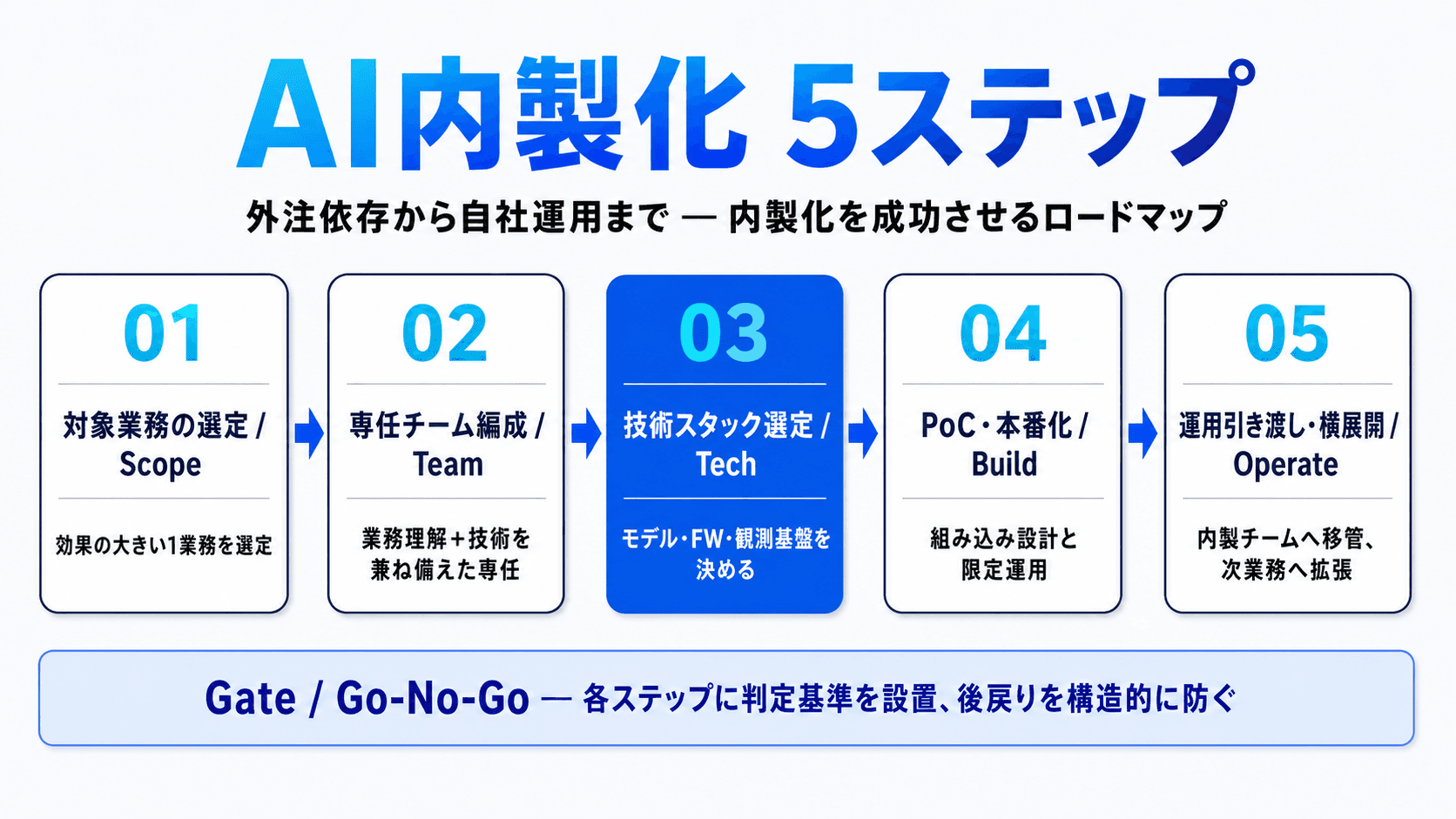
How to build in-house AI capability | 5 steps to break free from outsourcing dependence and decision criteria
We organize the five steps to successful AI in-housing (selecting target processes, forming a dedicated team, choosing the tech stack, moving from PoC to production, and operational handover and horizontal rollout) for executives. We provide end-to-end coverage of the outsourcing vs. in-house decision criteria, three common failure patterns, how to leverage implementation partners to accelerate in-housing, and the AX Factory model for in-housing support.
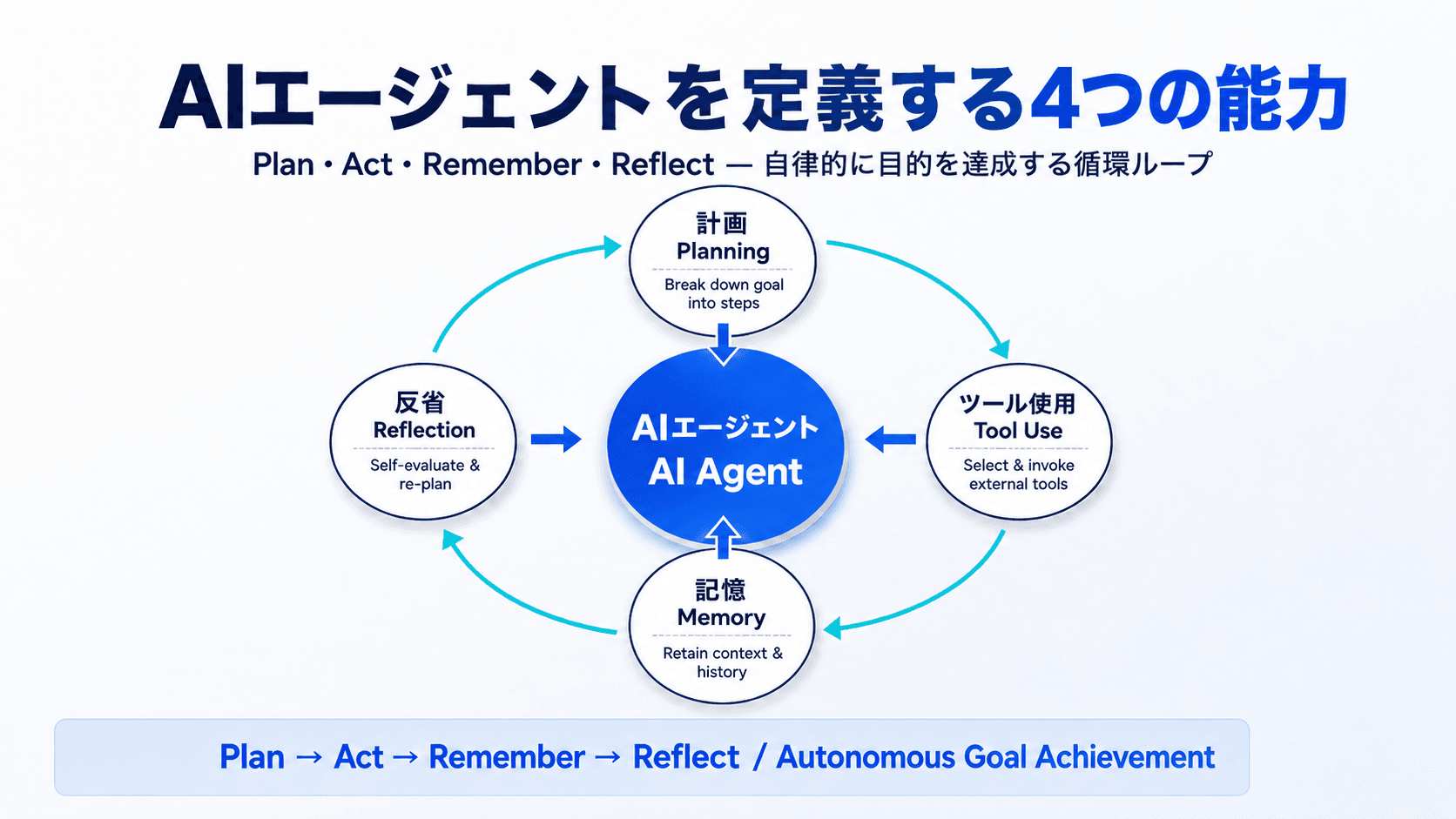
What are AI agents? Development methods and 5 steps for enterprise adoption
An AI agent is an AI mechanism that, when given a goal, assembles its own procedures and acts according to the situation. We organize the differences from chatbots and RPA, when to use single vs. multi-agent approaches, how to proceed with development, and the five failure patterns and five success steps in enterprise adoption.
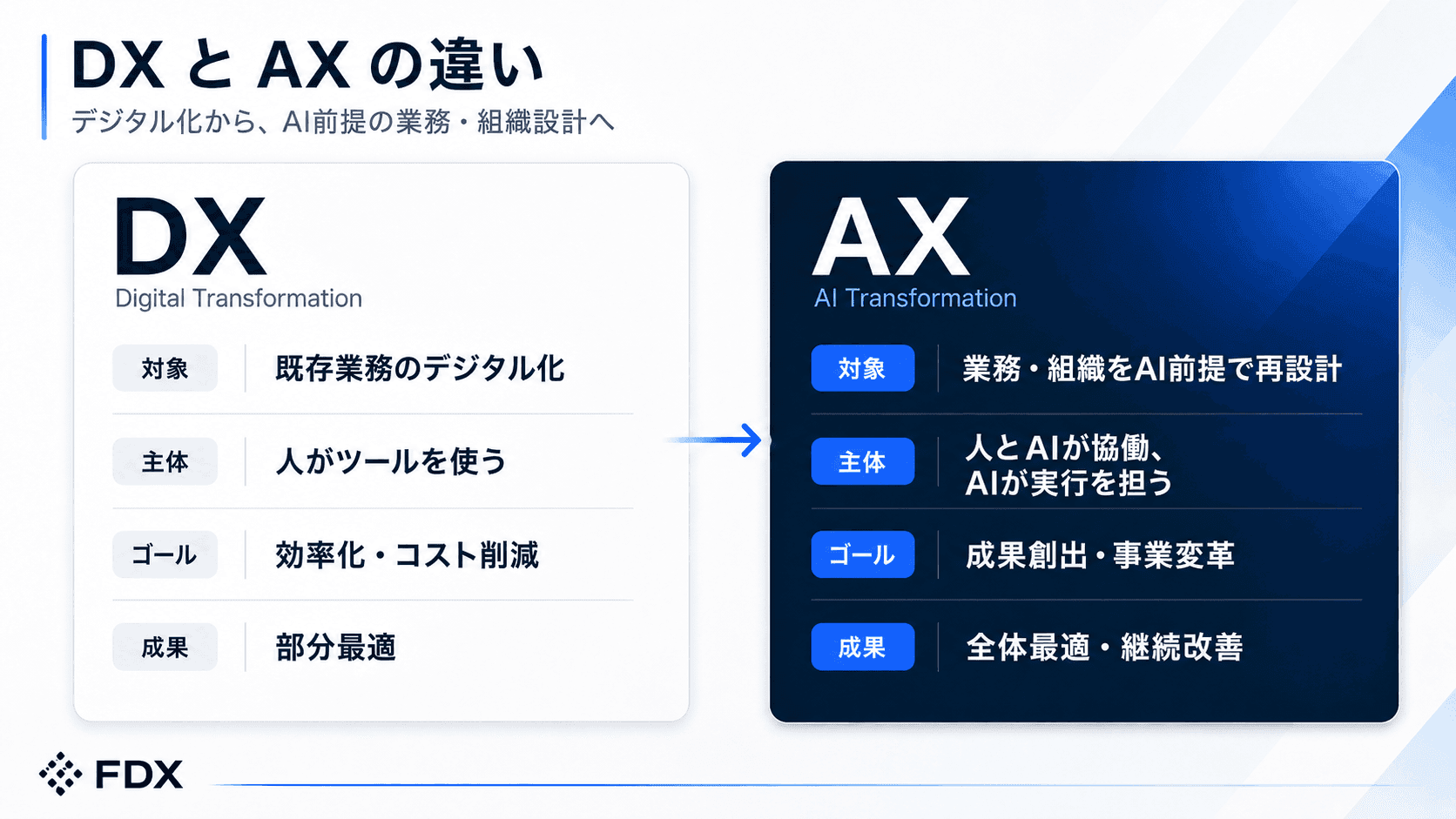
What is AX? The meaning of AI transformation, how it differs from DX, and how to proceed
AX (AI transformation) is transformation that redesigns processes, organizations, and decision-making with AI as the premise. We organize the differences from DX in a comparison table, and explain the five maturity stages, how to proceed with AX Factory's five phases, and common failures and how to avoid them.
How to implement generative AI | 5 steps to get past stalled PoCs and the right order to avoid failure
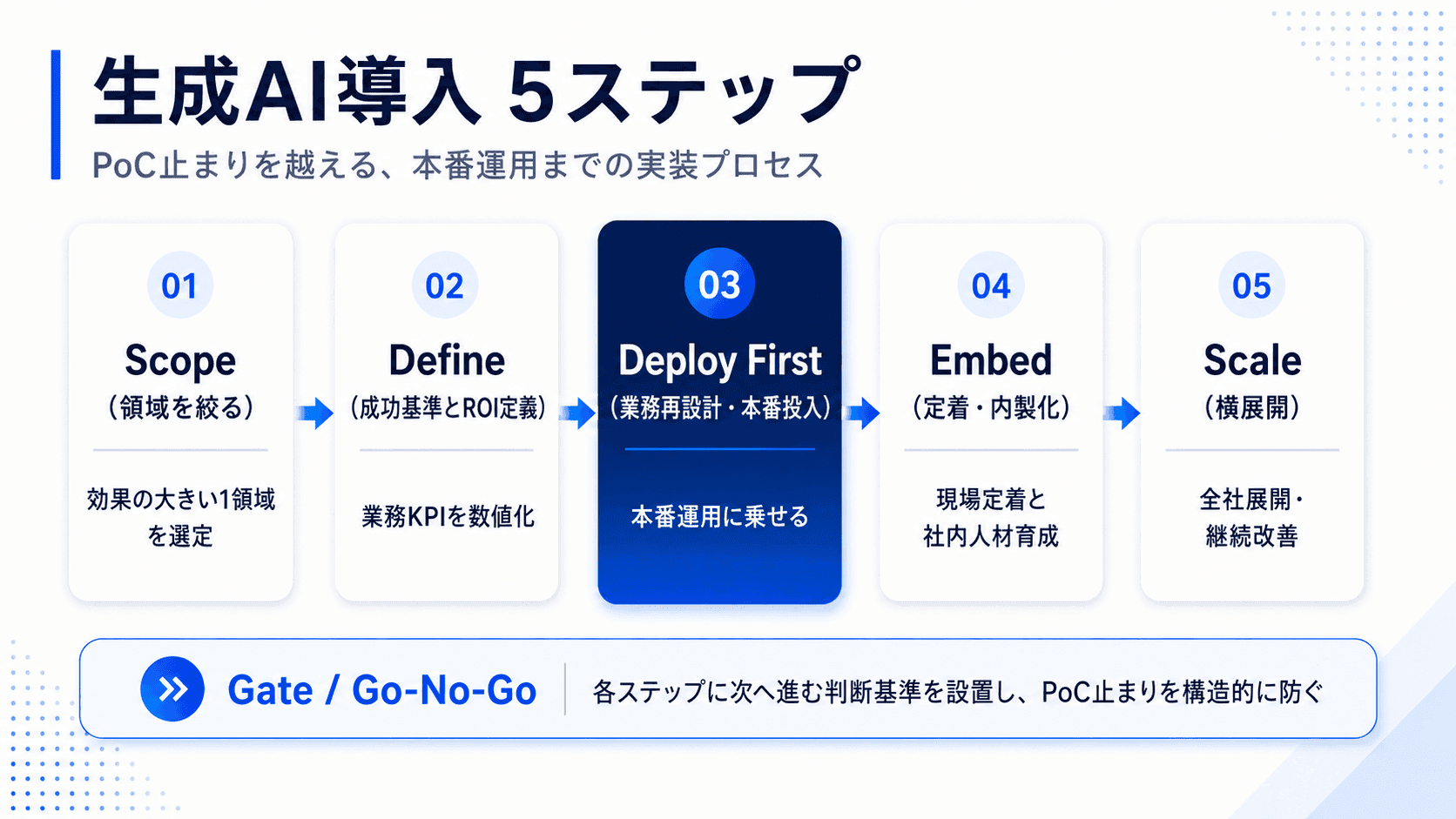
We explain the five steps to turn generative AI adoption into results and the criteria for deciding to move to the next stage at each phase. For executives, we organize how to follow the order of narrowing scope, defining success criteria, production deployment, establishing operations in-house, and horizontal rollout, to get past the PoC-to-production barrier and make business use stick.
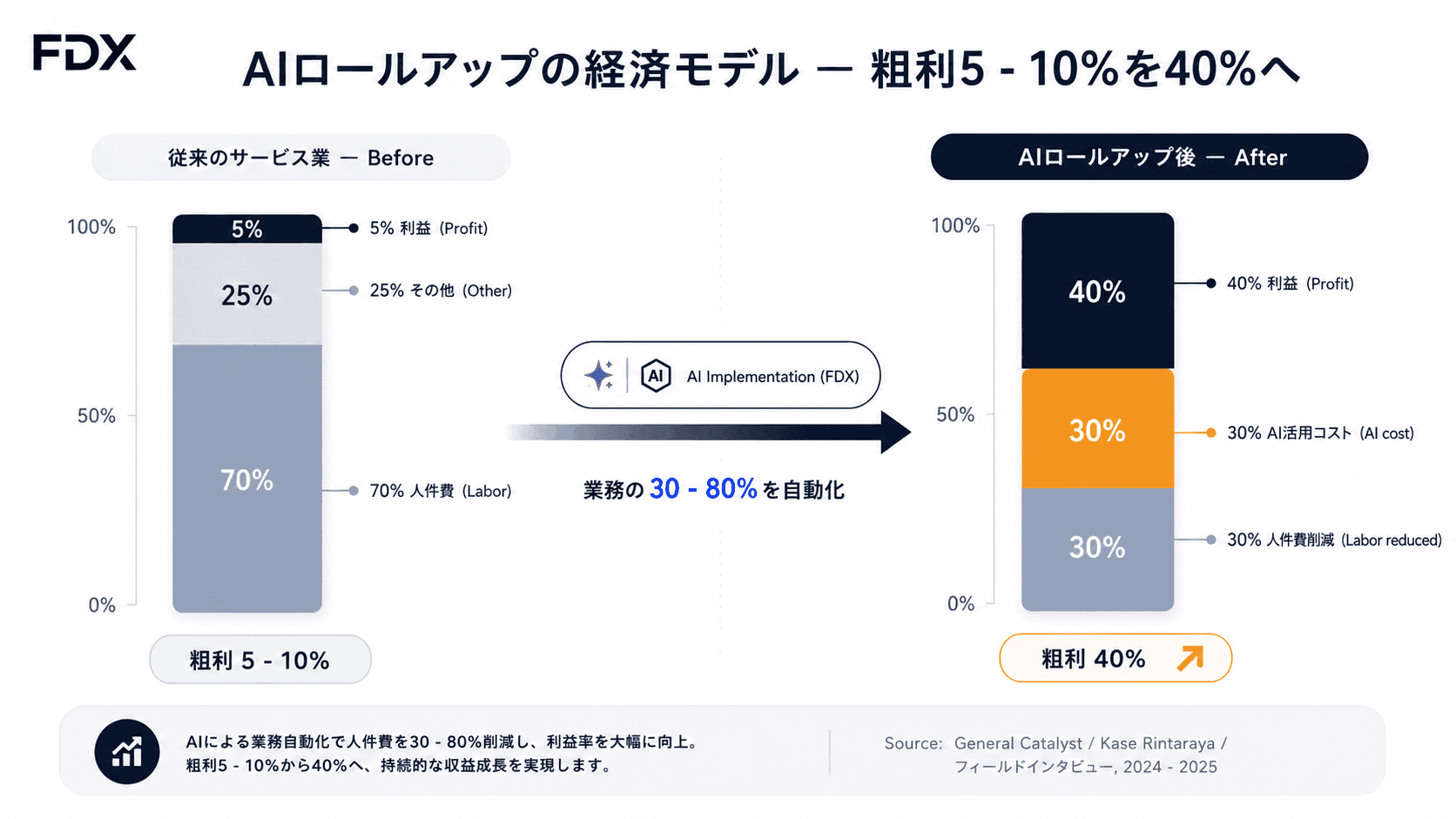
What is an AI rollup? A thorough explanation of the new AI x M&A model
We explain the structure of the AI rollup, said to "rebuild the $16 trillion market," for executives based on primary source verification: General Catalyst-affiliated cases, movements in the Japanese market (the GROWTH VERSE model), four regulatory fronts, KPIs, and connections to FDEs.
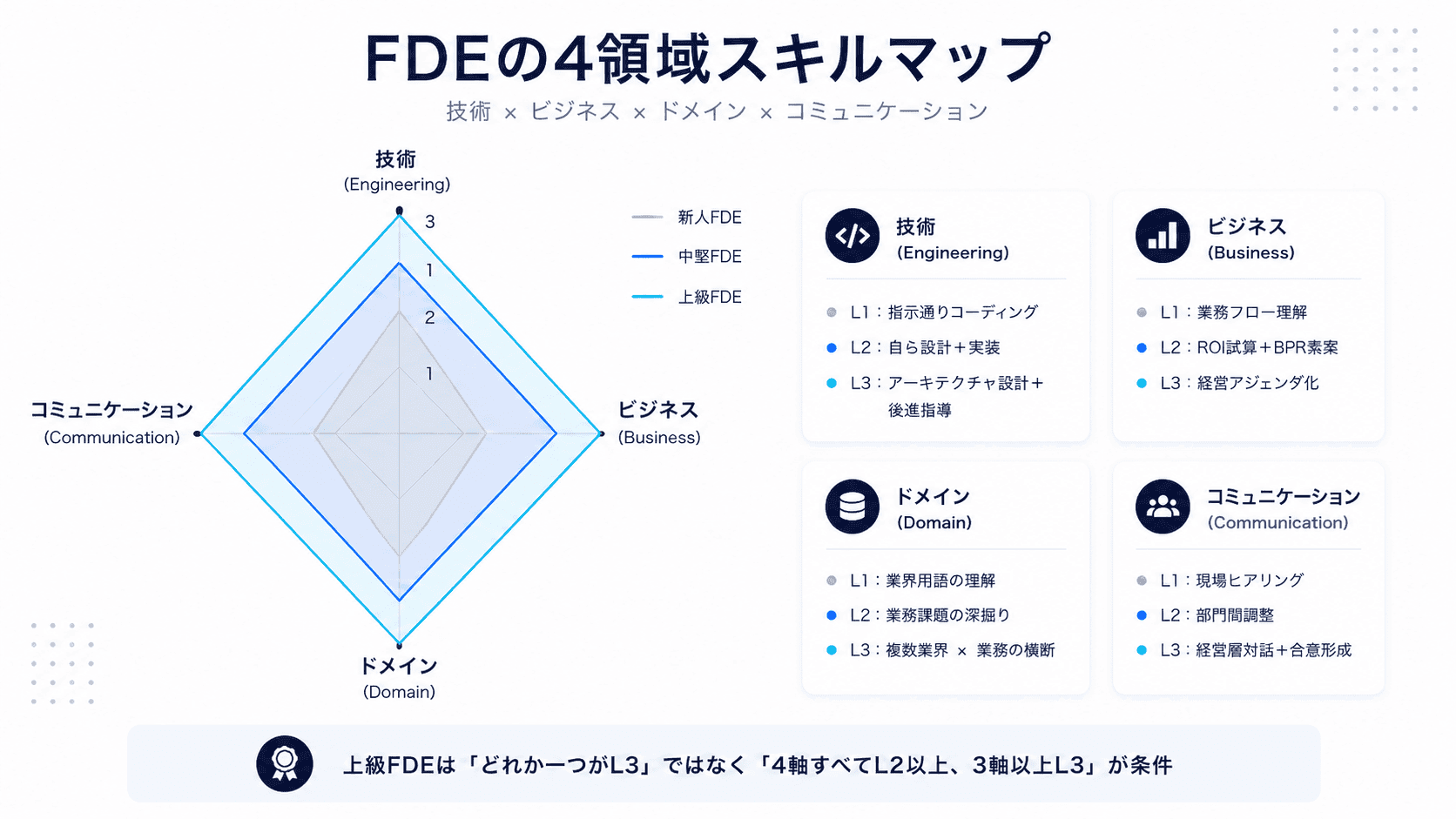
Integrating FDEs into your organization | Skill maps, evaluation criteria, and development roadmap
A practical guide for integrating FDEs (Forward Deployed Engineers) into your company. We thoroughly explain the four-domain skill map (technical, business, domain, communication), customer-outcome-based evaluation criteria, an 18-month development roadmap, and transition paths from existing roles.
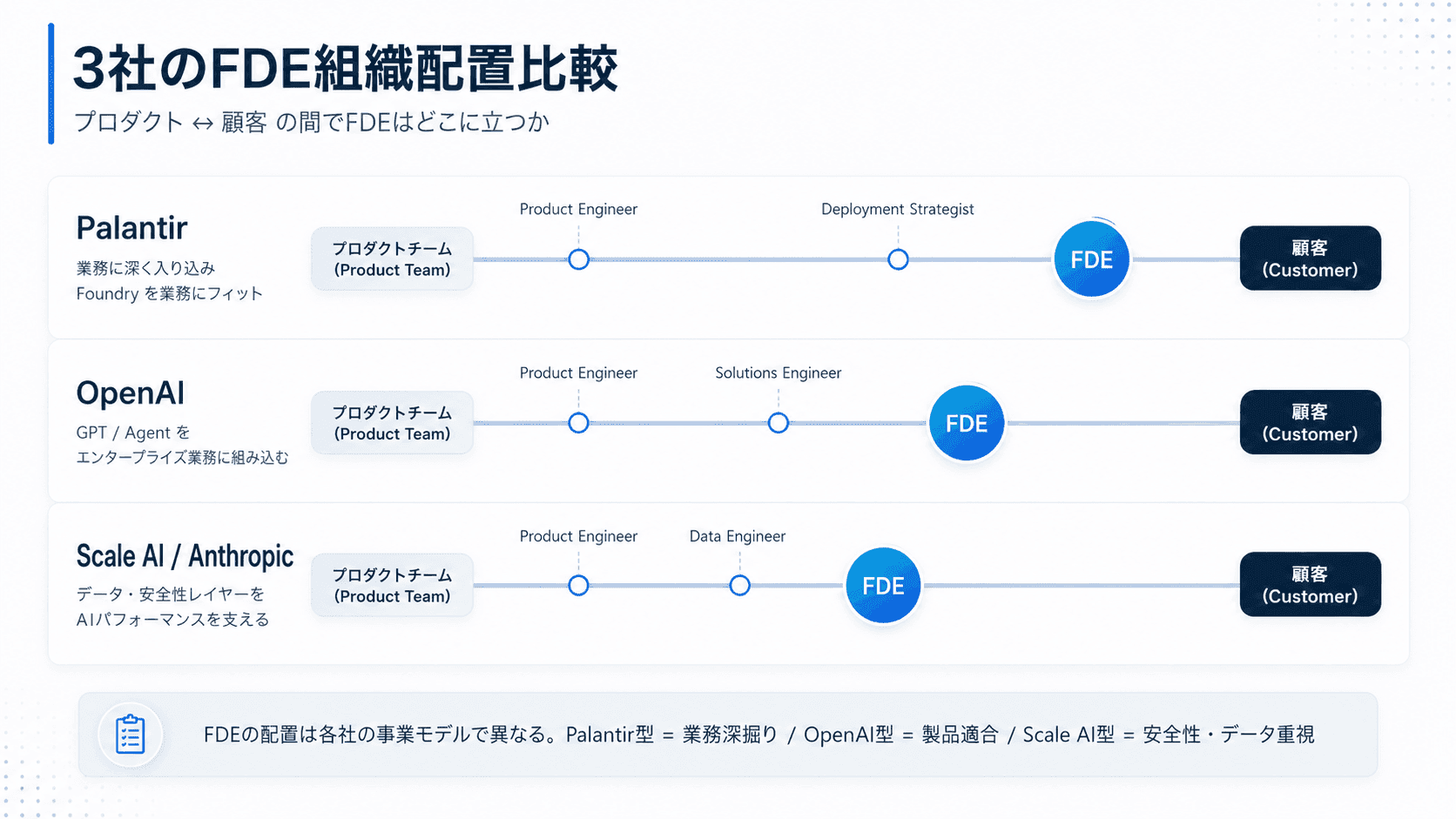
Comparing FDE cases at Palantir, OpenAI, Anthropic, and Scale AI
FDEs (Forward Deployed Engineers) originated at Palantir (Foundry) in 2003 and spread to AI companies such as OpenAI, Anthropic, and Scale AI. From the FDE organizational design of leading AI companies, we explain the five success factors Japanese companies should learn and the pitfalls to avoid when imitating them.
Leveraging external FDEs vs. developing them in-house | 5 criteria for the executive decision
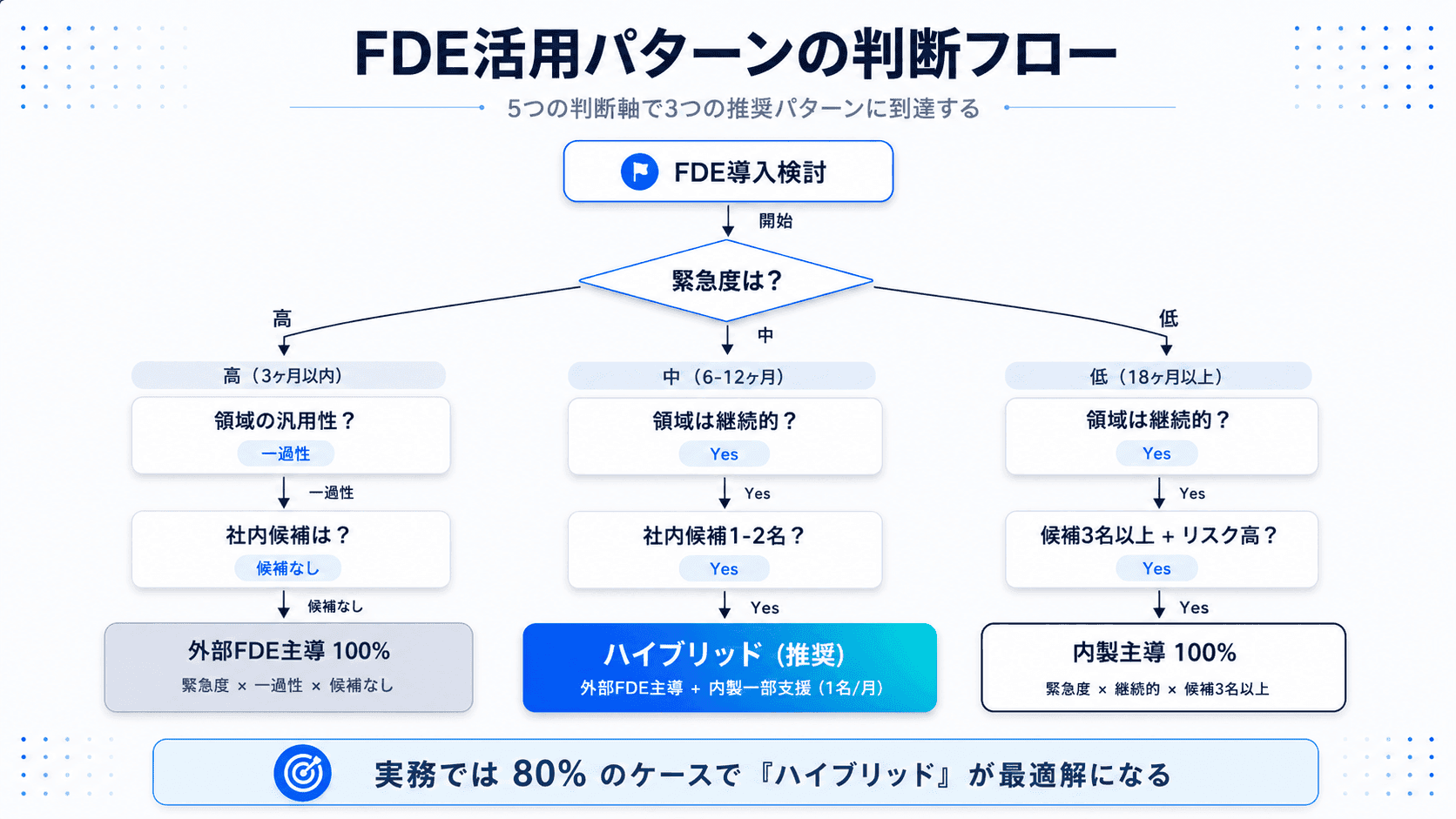
Should you hire FDEs (Forward Deployed Engineers) externally, develop them in-house, or take a hybrid approach? This article presents five criteria for executive decision-making (urgency, domain generality, talent market, transfer risk, and TCO) and provides an in-depth explanation of the three-phase hybrid model recommended by FDX.
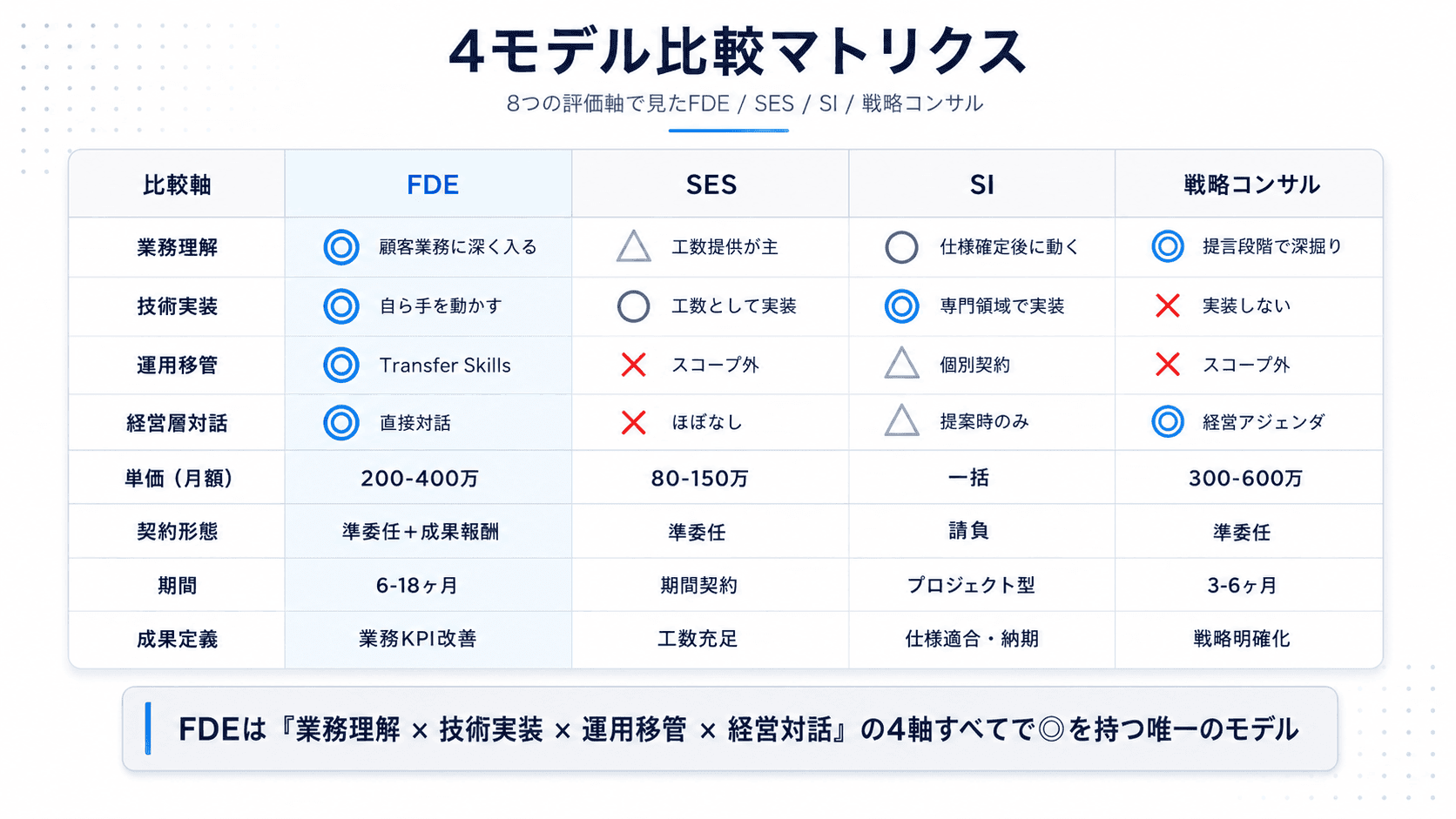
FDE vs SES vs SI vs Strategy Consulting | An In-Depth Comparison of Four Models
FDE (Forward Deployed Engineer) is often confused with SES, SIers, and strategy consulting. This article compares the four models in depth across eight dimensions—scope of responsibility, definition of deliverables, contract type, and cost structure—and presents criteria for choosing the implementation model that fits your company. Intended for executives, procurement leaders, and IT departments.
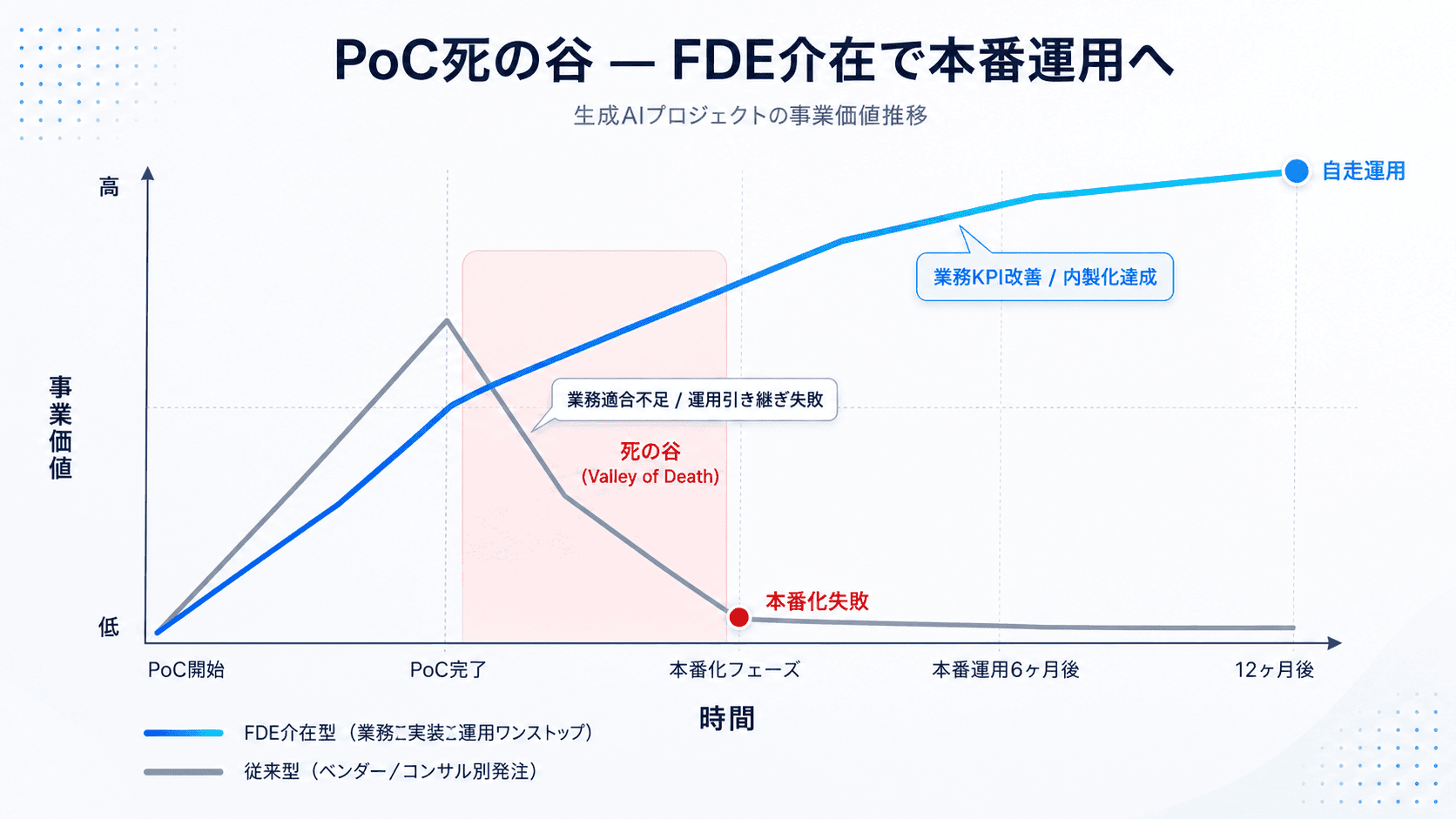
Why Japanese Companies Need FDEs Now | The Key to Moving Beyond PoCs
Forward Deployed Engineers (FDEs) break through the structure that kills most generative AI PoCs before they reach production. This article explains the three organizational constraints unique to Japan and the implementation patterns for overcoming them, aimed at executives and AX promotion leaders.
What Is an FDE? The Meaning and Role of a Forward Deployed Engineer
An FDE (Forward Deployed Engineer) is a role and organizational model that works on-site with customers and takes responsibility for turning AI and software into tangible business outcomes. FDX Inc. outlines its origins at Palantir, five key characteristics, how it differs from SES, SI, and consulting, and how to implement it in Japanese companies.