This is for executives and HR/DX managers who have heard the term FDE but cannot tell whether it is relevant to their company. An FDE (Forward Deployed Engineer) is an engineer who goes into the customer's workplace and solves problems with technology, starting from identifying the issues themselves. When this role is filled by a company's own employees, we call it an "in-house FDE."
If you want to clear immediate problems quickly, an external FDE is the right fit; if you want to keep fixing things in-house even as operations change, an in-house FDE is the right fit. This article covers four topics: what FDE work actually involves, how it differs from SES, why FDE training is spreading, and which option your company should start with.
What is an FDE, and what do they do?
An FDE is an engineer who embeds within a customer's organization and implements systems such as AI all the way to the point where they are actually used in operations. The role is said to have been popularized by Palantir in the US (Business Insider Japan, article from May 2026).
What sets it apart from ordinary development is how the work begins. Palantir's job postings state that projects often start from a "nebulous question" (Palantir job posting, as of November 2026). In other words, an FDE's work starts with verifying on-site what actually needs to be solved.
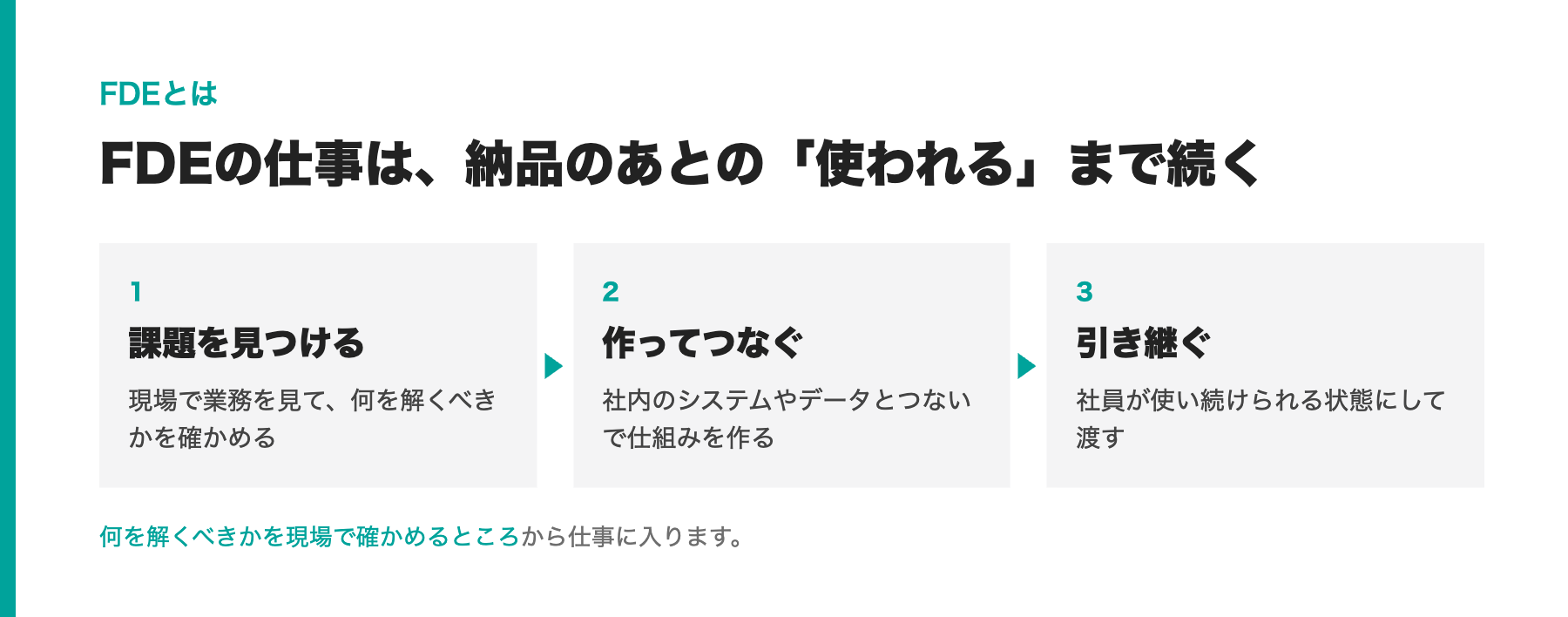
The workflow has three stages. First, they observe operations on-site and identify problems; next, they connect with internal systems and data to build the mechanism. Finally, they hand it over in a state where employees can keep using it. Seeing things through to actual use is what defines an FDE.
How do FDEs differ from SES and contracted development?
The three differences show up in who decides what before the work begins.
| 仕事の始まり | 終わったときに残るもの | |
|---|---|---|
| FDE | From identifying problems on-site | A mechanism that is actually used, plus employees who can fix it |
| Contracted development | From fixed requirements | The delivered mechanism |
| SES | From predefined tasks | The working hours of the provided engineers |
SES is a contract format that provides engineers' working hours for predefined tasks. An FDE, on the other hand, refers to a job type or role. For that reason, you cannot judge whether something is an FDE arrangement just by looking at the contract format.
There are also critical views of the FDE label. In the Business Insider Japan article mentioned earlier, Snowflake's former Chief Revenue Officer described FDEs as "professional services people in name only." There may also be cases where engineers who merely work on-site are given the FDE name, so as the client, it is safer to verify the actual substance of the work.
What we verify as an external FDE provider is the following four points: being embedded on-site, being a genuine engineer, building all the way to integration with internal systems, and handing over in a state where employees can fix things themselves. When comparing providers, ask about these four points.
In terms of contract format, our external FDE service is also a quasi-delegated contract, the same as SES. The difference is not visible in the contract document itself. The difference lies in who decides the substance of the work and what remains when it ends. With SES, the client defines the tasks and the engineer carries them out. An FDE starts by jointly deciding what to build, on-site, and their scope of work extends to handing over in a state where employees can fix things themselves. Before commissioning, clarify whether you will delegate from the problem-identification stage and whether handover is included; this prevents gaps between expectations and reality. Our external FDE service is offered on monthly contracts, starting from a minimum of three months. Details on engagement models and pricing are summarized on our external FDE page.
How does an in-house FDE differ from an external FDE?
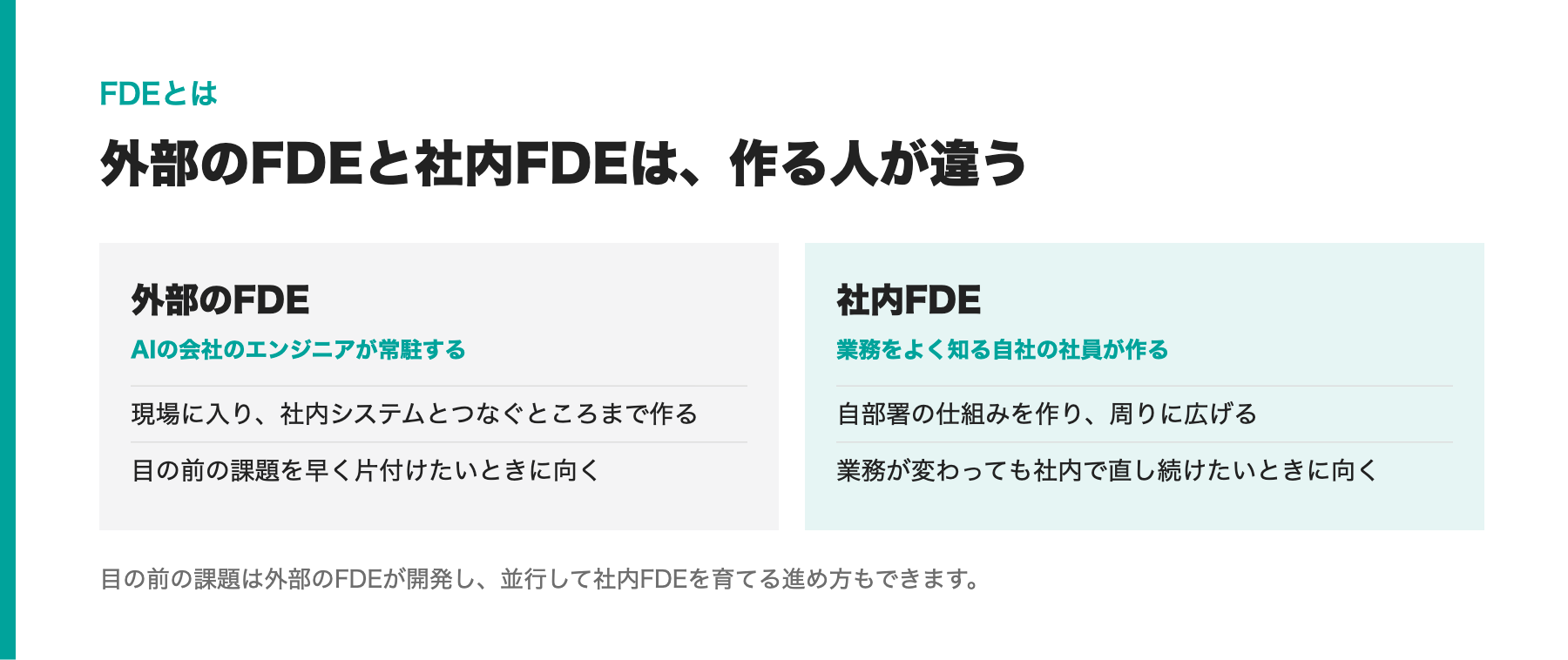
With an external FDE, an engineer from an AI company embeds on-site and builds the mechanism. With an in-house FDE, an employee who knows the operations well uses AI to build, fix, and spread the mechanism within their own department. Since FDE originally refers to engineers who enter the customer's workplace, "in-house FDE" is our term for applying that role internally.
For in-house FDEs, we do not require the ability to write programs. What we value is being able to explain the exceptions in the operations and the reasons behind the procedures. If you can describe the processing you want to build in words, AI can support the programming work, so you can build the initial mechanism.
However, there is a scope to the work suited for in-house FDEs. What you delegate is building mechanisms for drafting, tallying, cross-checking, and similar tasks. Final decisions involving quality, safety, or money remain a human responsibility even after the mechanism is built. When full-scale integration with internal systems is required, it becomes easier to proceed by teaming up with in-house engineers or external FDEs.
Why is FDE training attracting attention?
We believe there are two reasons.
The first is that demand for the FDE role itself is growing. According to Indeed data reported in a translated article by US Business Insider, FDE job postings in April 2026 increased by 5,230% compared to January 2025, and by about 729% year-over-year (Business Insider Japan, article from May 2026). The growth rate is this large presumably because the original number of postings was small.
In Japan as well, training programs launched one after another in 2026. A training program for an AI company's FDE organization started in May (Foundry Labs announcement), followed by corporate training in August (div announcement) and an online course for working professionals in September (Green Waters announcement). All of these are announcements from the providers themselves, and in our research we did not find any statistics showing how many companies are training FDEs in-house.
The second reason is that Japanese companies lack "builders." According to IPA's "DX Trends 2025," 85.1% of Japanese companies said they lack sufficient personnel to drive DX. Only 16.7% of Japanese companies said "necessary parts have already been internalized" for system development, less than half the figures for the US and Germany. Among challenges in advancing internalization, Japan stood out with responses citing "difficulty securing and training personnel."
If hiring is difficult, an alternative emerges: train employees who already know the operations well. Our in-house FDE training is a program designed around this idea.
Should your company start with an external FDE or an in-house FDE?
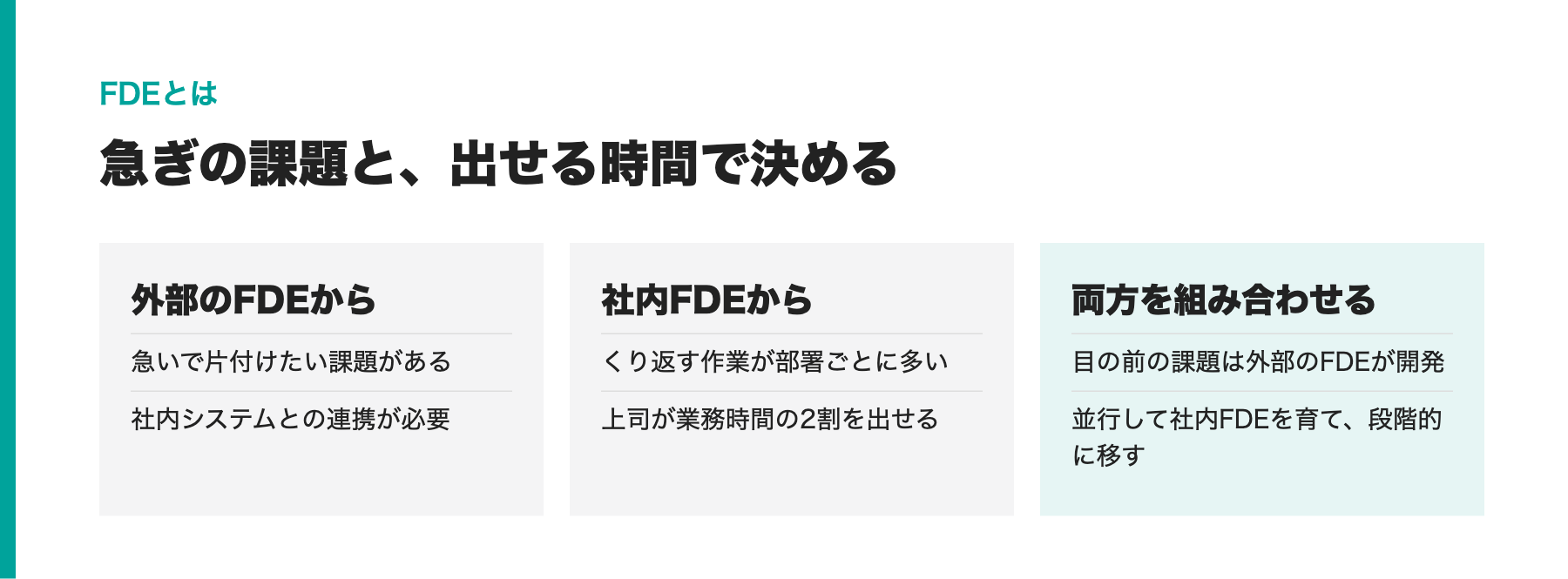
The decision hinges on whether you have urgent problems and whether you have employees who can dedicate time internally.
If you have urgent issues you want to resolve and need integration with internal systems, an external FDE is a good fit. If each department has many recurring monthly tasks and you have an employee who can dedicate 20% of their working time, starting with an internal FDE is the better option.
You can also combine both approaches: an external FDE develops solutions for immediate issues while you simultaneously train internal FDEs and gradually transfer the work in-house. Here are two examples from our support. In the employee-built model, employees from the non-IT division of a major payment services company received weekly one-hour coaching over six sessions, and all 11 departments combined completed working deliverables within the period. In the on-site co-building model, at the HR and General Affairs department of a holding company group, we built things like attendance data sorting together with employees, and handed over the system so employees could change the settings themselves.
When training internal FDEs, what should you decide first?
The first decisions are who to select and what to use as the subject matter. At our company, we select people who have handled the relevant work for at least two years and can articulate their pain points in their own words. Selecting two people per department gives them someone to consult with, making it less likely they will stall along the way.
For the subject matter, we recommend tasks that recur weekly or monthly, take 30 minutes or more each time, and have roughly fixed procedures. Start with tasks where a failure would not directly affect clients. Once you have chosen the people and the subject, measure the current time spent on the work. If you can compare before and after implementation with the same yardstick, you can use the results when explaining to your boss or executives.
Frequently asked questions
Q. What does FDE stand for?
A. It stands for Forward Deployed Engineer. It refers to engineers who go into the customer's workplace, identify issues, and solve them with technology.
Q. What is the difference between an FDE and SES?
A. SES is a contract format that provides an engineer's working hours for predefined tasks. An FDE's role starts with identifying issues on-site and extends to handing over the built system in a state where employees can modify it themselves.
Q. Can I ask an engineer provided under SES to take on the FDE role?
A. Under a contract with a fixed scope of work, it is difficult to delegate starting from issue identification. If you want to assign the FDE role, it is safest to renegotiate the contract so that issue identification and handover are included in the scope of work.
Q. Can an employee who cannot program become an internal FDE?
A. Our business department course does not require the ability to write code. If you can describe the processing you want in words, you can build the initial system with the support of AI. Integration with internal systems becomes easier when you team up with internal engineers.
Q. How long does it take to train an internal FDE?
A. Our standard is six months in total: three months of training with 12 weekly sessions, plus three months of coaching while using and refining the system in real operations. The goal of the three-month training is to complete one system that is used within the employee's own department.
Q. Can we get started even with a small team?
A. Yes. You can start by selecting two people in a single department and beginning with a small subject matter.
We will help you sort out which department to start training internal FDEs in, in 30 minutes
For program details and how it works, please see the Internal FDE Training page.
At AIworker Inc., we offer a free 30-minute consultation. We will ask about the departments you want to train and the tasks that are consuming time, and provide you with a clear picture of whether to start with an external FDE or an internal FDE.