Last December, OakMega posted an FDE job opening, a rarity in the Taiwan market. A week after the posting went live, a reporter from TVBS reached out to us. They said they had noticed how rare this role is in Taiwan and wanted to learn more about what it involves. That phone call made us realize something: we thought we were just solving an internal problem, but it actually reflects a transformation taking place across the entire industry.

At the end of last year, we started looking for
Last December, OakMega posted an FDE job opening, a rarity in the Taiwan market. Honestly, we didn't expect it to attract much outside attention—it was simply our way of solving a real problem: as companies adopt AI, they need someone to stand in the gap between technology and business and make things happen. But a week after the posting went live, a reporter from TVBS reached out to us. They said they had noticed how rare this role is in Taiwan and wanted to learn more about what it involves. That phone call made us realize something: we thought we were just solving an internal problem, but it actually reflects a transformation taking place across the entire industry.
Companies are no longer just buying AI tools—they need someone to help them actually put AI to work. The FDE is that person.
What we're looking for isn't a "jack of all trades," but someone who gets an itch when they see a problem, loves solving things on-site, and doesn't mind meeting with engineers and business executives at the same time.
If this sounds like you, check out our opening: 👉 OakMega FDE Job Opening
⬇️ You can also first watch TVBS's coverage of us to see what an FDE's day-to-day looks like ⬇️
Table of Contents
What Is an FDE (Forward Deployed Engineer)?
When AI adoption fails, it's usually not a technology problem.
If you've been through a few enterprise AI projects, this should sound familiar. The model performs brilliantly, the demo runs smoothly, the boss nods in approval—then it enters the client's environment and everything gets stuck. Data formats don't match, existing systems need customization, workflows need to be redesigned, and eventually the whole project enters a long state of "ongoing discussions."
The technology is ready. But the deployment isn't.
This is the starting point for how we designed the Forward Deployed Engineer (FDE) role.
The Way Technology Is Delivered Is Changing
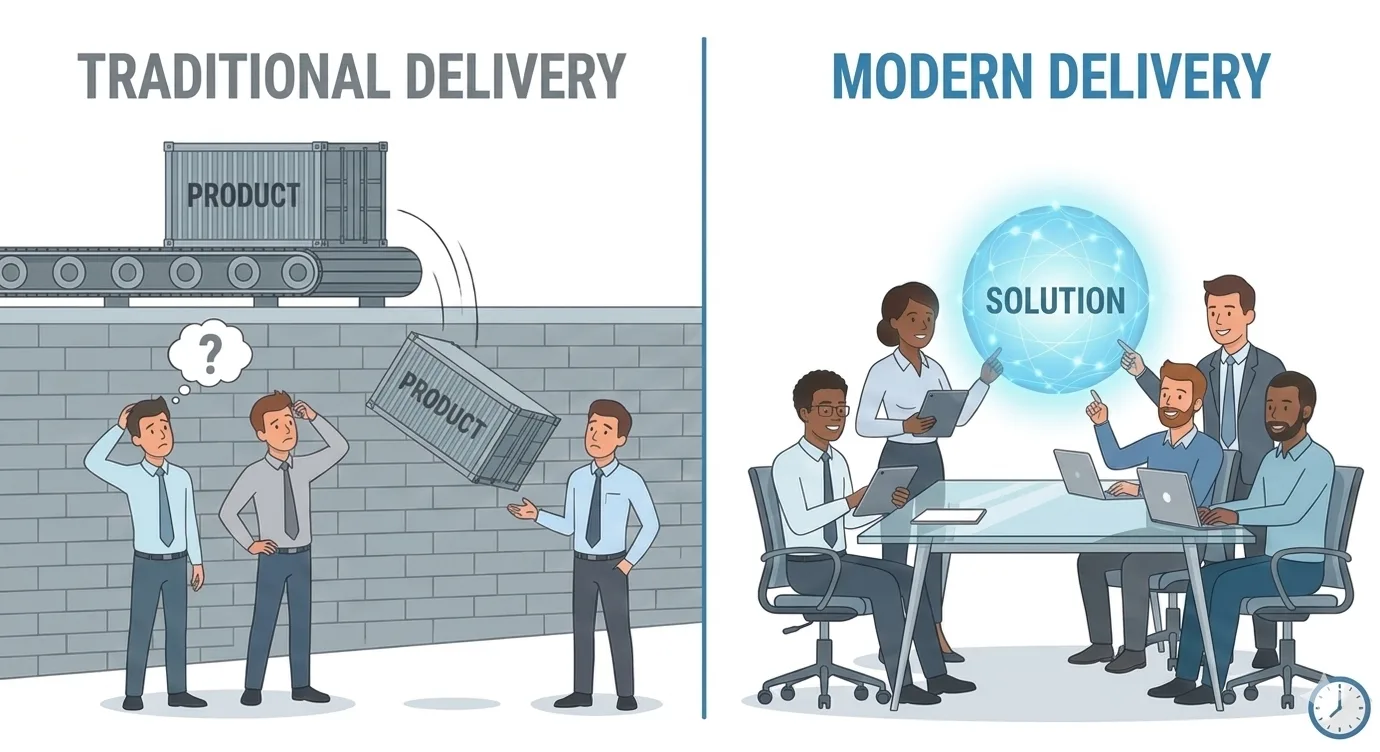
In the past, the logic of enterprise software delivery was clear: build the product, sell it to the customer, and the customer's IT handles the rest. Engineers stayed at the company, customers stayed on their side, and in between there was a document, a support inbox, and occasionally a training session.
This model is starting to break down in the face of more complex AI systems.
The reason isn't that the technology is too hard—it's that the distance between the technology and the field is too great. When an AI system needs to integrate with a client's ERP, collaborate with their data engineers, and explain to their executives "why the model made that judgment," a document simply isn't enough.
This is why technology delivery is shifting from "product delivery" to "solution delivery."
And the Forward Deployed Engineer is the concrete product of this shift.
So, What Does an FDE Actually Do?
The FDE concept was first introduced by Palantir in the early 2010s. They stationed engineers directly on-site with government and large enterprise clients—not to "provide support," but to "solve problems together." These engineers were internally called "Deltas," which later evolved into today's Forward Deployed Engineer.
You can think of an FDE as a solutions architect who can code, but it's more than that.
Traditional consultants tell you what to do; FDEs get it done for you. Traditional engineers wait for requirement documents; FDEs define the requirements together with you.
More specifically, an FDE needs to have all of the following:
- The ability to go deep into the field: able to discuss requirements with the client's business team and architecture with their engineers
- The ability to prototype quickly: turning vague business requirements into a working PoC in the shortest time possible
- The ability to integrate across systems: not just AI models, but also data pipelines, API integrations, and compatibility with existing systems
- The ability to bring field experience back into the product: every edge case from a client is an opportunity to make the product more complete
This role sits somewhere between an engineer, a consultant, and a product manager—but it's not any one of them; it's all of them combined, plus a little bit of magic.
One Project, Four Phases
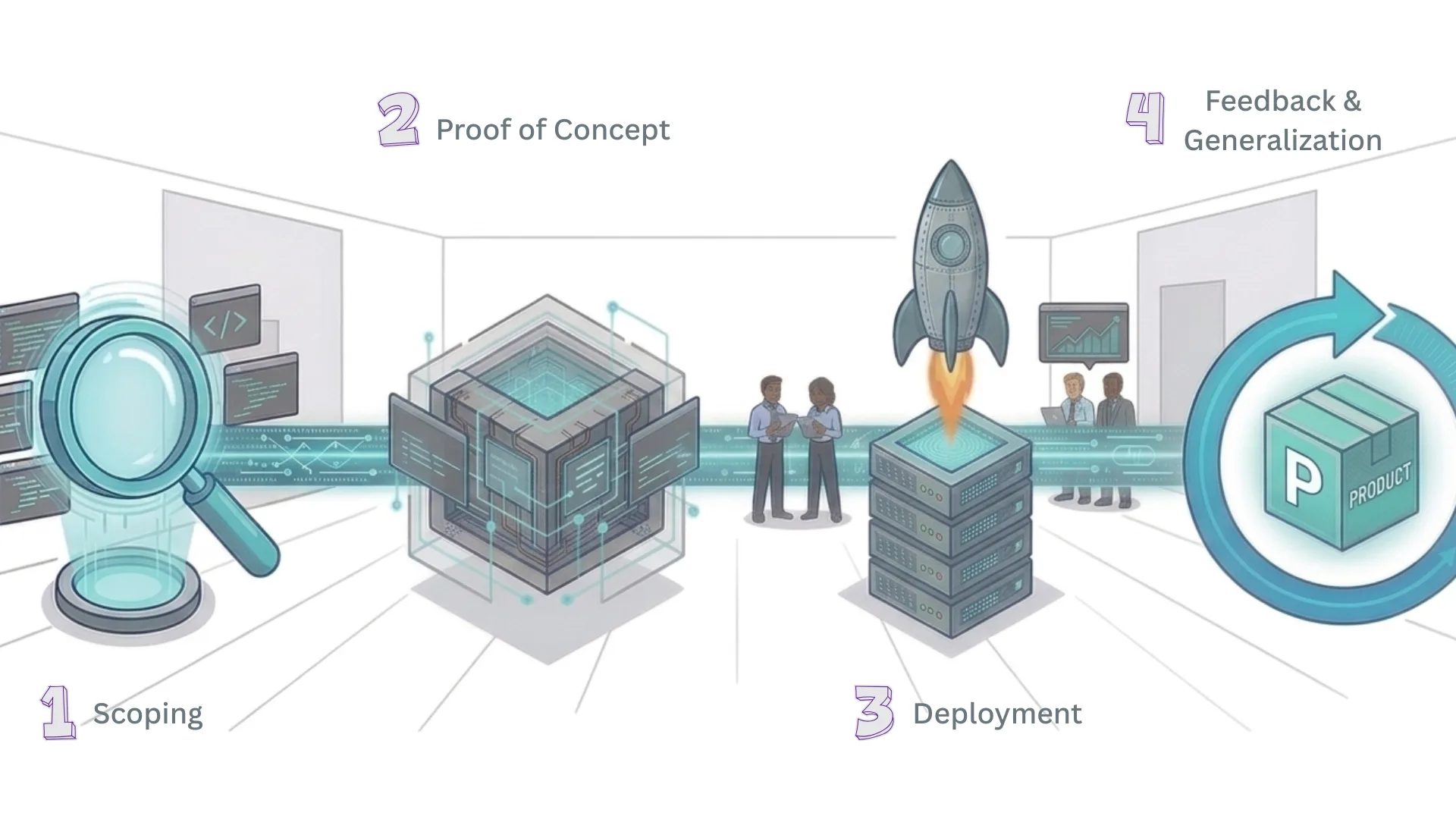
An FDE's job isn't to take tickets, fix bugs, and close them. Each project typically goes through four complete phases:
Phase 1: Scoping The client says, "We want to use AI to optimize our processes." The FDE's job is to translate that into "We will use method Y to process data Z at step X, with the goal of improving metric A by N%." Turning the vague into the concrete is the foundation of everything.
Phase 2: PoC Development and Validation First, run a proof of concept that's small enough and fast enough. Test technical feasibility on real data and let results do the talking, not slide decks. The goal of this phase isn't perfection—it's finding out quickly "whether this path is viable."
Phase 3: Deployment Once the PoC is validated, the next step is turning it into a system that can actually run in production. Data integration, system integration, workflow setup—one thing at a time, making sure it won't break at 2 a.m. after going live.
Phase 4: Feedback and Generalization This is the step many roles tend to overlook. An FDE doesn't just deliver and leave—they bring what was learned in the project back to the product team. Could this client's special need be a pain point that ten other clients share but haven't voiced yet? Client cases are the best material for evolving the product.
FAQ
Q: What is a Forward Deployed Engineer (FDE)? A: An FDE is a cross-disciplinary engineer who combines technical development, system integration, and business understanding. They go deep into client sites to deploy AI and automation solutions directly into real enterprise environments, ensuring the technology actually lands and delivers value.
Q: How is an FDE different from a regular engineer or consultant? A: Regular engineers usually develop products inside the company; consultants provide advice; FDEs solve problems together with clients on-site, while also being able to write code, define requirements, integrate systems, and feed insights back into the product.
Q: Why do companies need FDEs? A: The main reason AI adoption fails is usually not the technology itself, but the gap between the technology and real-world business processes. FDEs can turn vague requirements into deployable solutions and ensure systems run reliably in real environments.
Q: What does an OakMega FDE actually do? A: An OakMega FDE's work is divided into four phases: requirement scoping, proof of concept (PoC), deployment, and feeding field experience back to the product team so the solution keeps evolving.
Q: What kind of background suits the FDE role? A: It suits engineers with software development skills, an interest in business processes, the ability to communicate and collaborate with different roles on client sites, and a love of solving real problems quickly.