FDE has already become a job category with openings, salary bands, and clearly defined deliverables. Public job postings for this title can be found in Taipei too, but the employers are concentrated among cloud giants, AI startups, and system integrators. This piece takes stock of who is actually doing this work, and what criteria retail brands should use when hiring for it.
Deloitte opened a role called "Anthropic Forward Deployed Engineer"
A global management consulting firm is hiring for an engineering position named after an AI model company.
On Deloitte Consulting LLP's official recruiting page, the title reads "Anthropic Forward Deployed Engineer," with openings across 8 cities including Atlanta, Austin, Chicago, Nashville, and New York. The job description requires candidates to embed with clients—that is, go inside the client organization, work alongside the client's senior business and technical staff, and rapidly prototype and deliver generative AI solutions; the output requirements specify production-quality code, plus reusable code libraries and documentation. Average travel time is 50%.
The most hotly discussed version of the Forward Deployed Engineer (FDE) role over the past two years has been "engineers replacing consultants." At least in Deloitte's posting, the reality is exactly the opposite: a consulting firm itself adopted the title and is using this approach to take on AI projects.
The list keeps growing. From Palantir to OpenAI and Anthropic, to established large SaaS players like Salesforce, names can be pointed out and public information found. If you reframe the question as "who in Taiwan is doing this," the answer can actually be named too—it's just that the few companies that come up are completely different from what retail brands imagine.
We opened the job postings one by one and found the fields familiar—only the header was different
When our team compiled this overview, we opened up every publicly findable FDE job posting and compared them side by side. After a while it felt a bit surreal: the things listed in the job descriptions overlapped almost entirely with what data consultants do at client sites every day—going on-site at the client, wiring up the data, integrating it into the client's official processes, and feeding problems encountered in the field back into the product. The fields looked more and more familiar; only the header line at the top was different.
This thing currently lives in three completely different kinds of companies
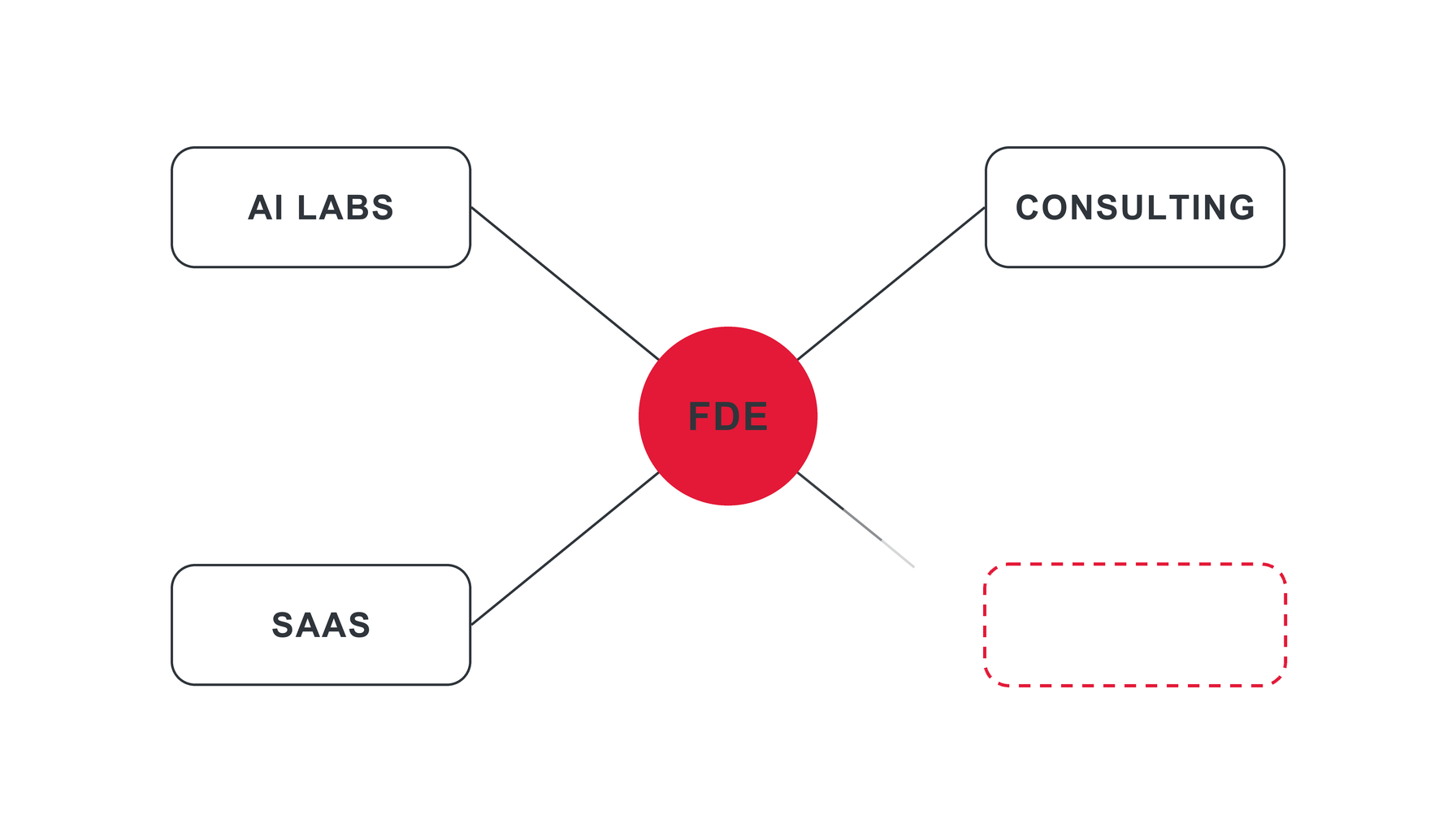
Laying out the public information, FDE work is happening in three types of organizations in different positions, each wanting something different.
| Who is doing it | What these companies are doing |
|---|---|
| Model companies | Grow their own engineers and push models into clients' official processes |
| Consulting and system integration firms | Adopt the title and use it to win AI projects |
| SaaS companies with existing platforms | Reorganize existing teams and fill in the delivery piece |
There is no sequence among these three groups. The same work is being done by three kinds of organizations, and the main incentives appear different: model companies want field feedback, consultancies want project revenue, and platforms want renewals. This is a tendency read from each company's public postings and statements, not something every company has said outright. Understanding this will keep you from thinking, when you look at each company's data later, that the names merely happen to collide.
One point of potential confusion worth clarifying: FDE and Field Application Engineer (FAE) are not the same role. This piece won't go into a comparison of the two titles; we're focusing our energy on "who is doing it."
Three international public sources, three ways of doing this work
Anthropic: deliverables described more clearly than the title
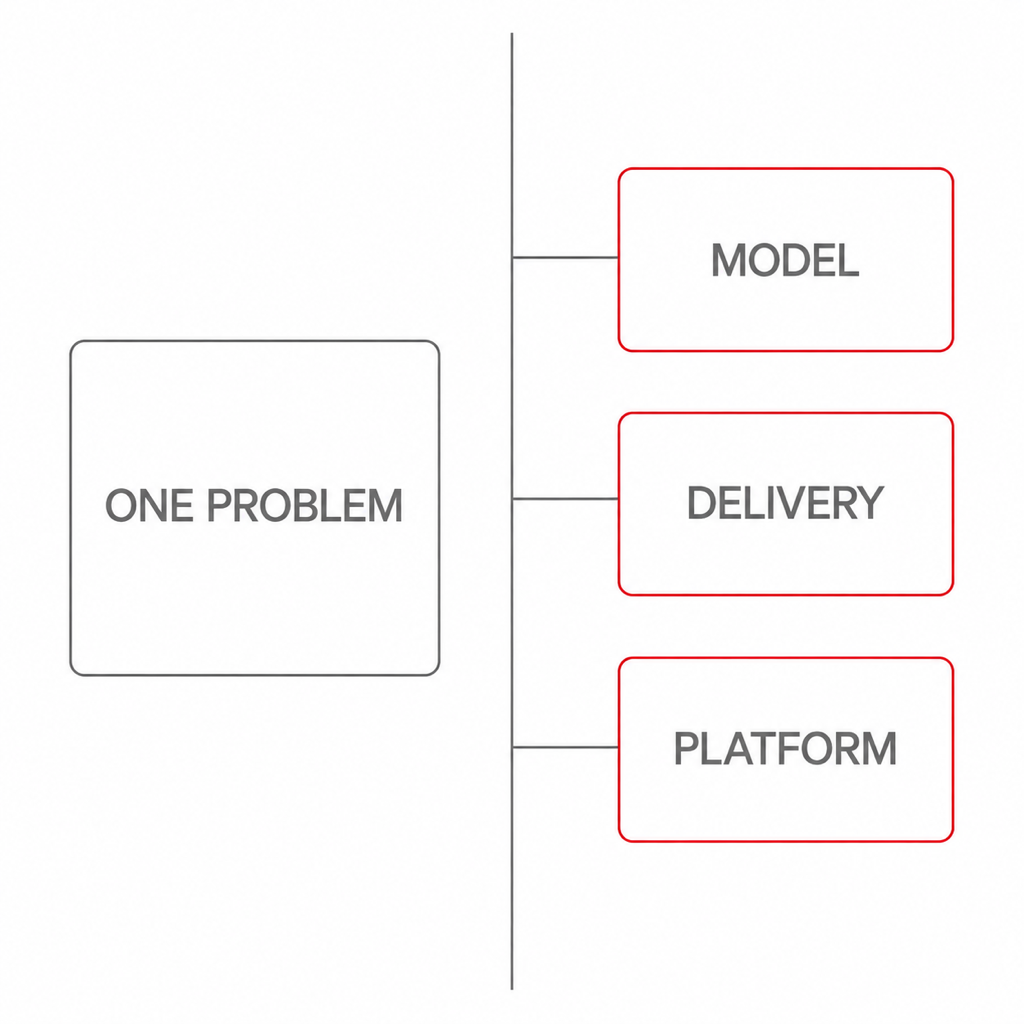
The Forward Deployed Engineer posting Anthropic listed on its own recruiting system sits under the Applied AI team, located in New York, San Francisco, and Seattle. This posting defines the deliverables with extreme specificity, making it well worth retail brands' reference: candidates must deliver MCP servers, sub-agents, and agent skills for clients, and it explicitly states these will be used in production workflows—that is, the client's real, running official processes.
These terms need a one-sentence translation for non-technical readers. MCP (Model Context Protocol) is a common interface that lets AI read and operate external systems; an MCP server is the interface that exposes a given system to AI. A sub-agent is an AI delegate assigned to handle a specific segment of tasks. An agent skill is a set of instructions, written so AI can execute them directly. What all three have in common is that they are called by systems, not read by humans.
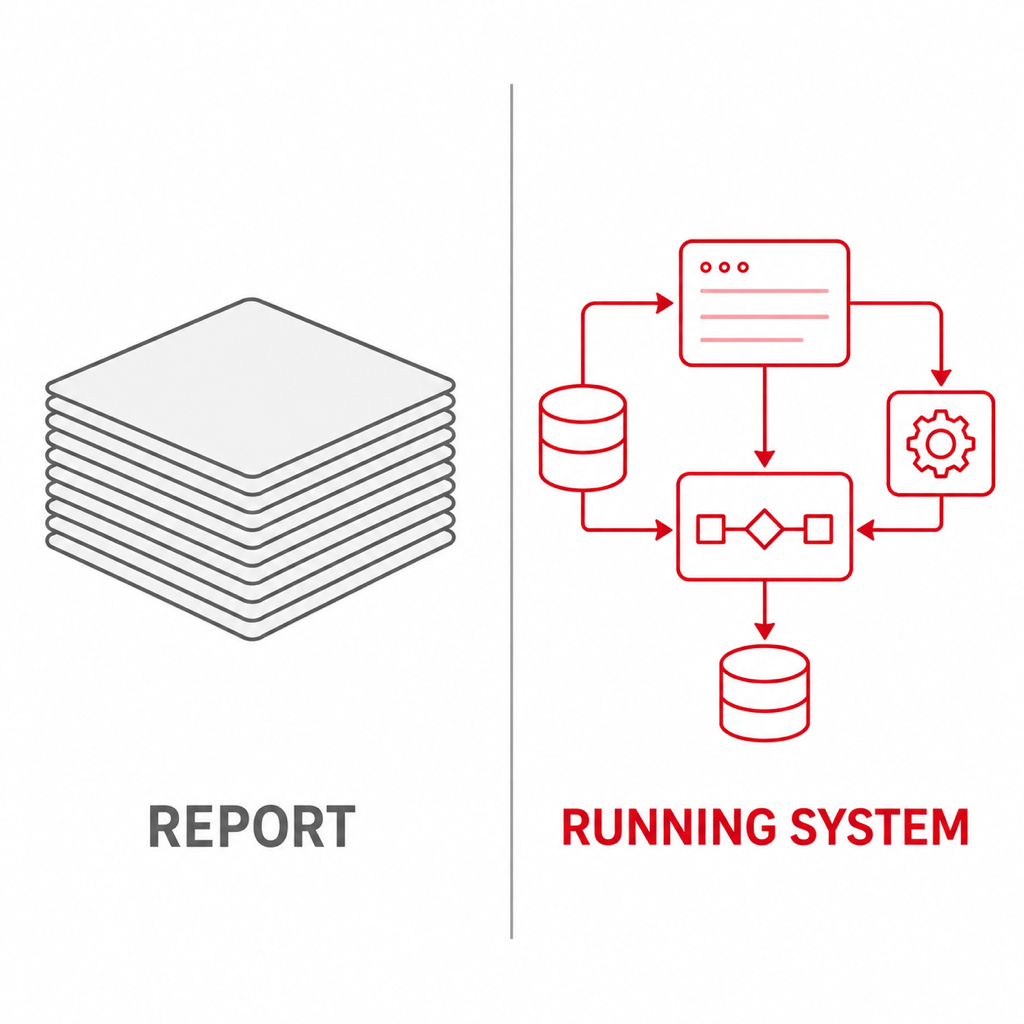
Taken apart, this sentence redefines "what consultants deliver." The deliverable is not an evaluation report; it is a set of programmatic assets that will be called by the client's systems. The posting also lists an annual salary of USD 280,000 to 320,000, with requirements of 4+ years of client-facing technical experience, production experience with large language models, and Python skills. Salary bands are affected by location, level, and each company's compensation strategy, and cannot alone serve as proof of difficulty—but it at least shows where enterprises place this work.
This is also why the real battlefield for AI systems is the legacy systems and production environment segment—the part of AI adoption that the fewest people are willing to take on.
Deloitte: a consulting firm adopting the title
Returning to the posting at the start. Deloitte opening this role signals that the company has adjusted its delivery standards for AI projects: the same team is required to produce code that can go into production, and to leave behind reusable assets. That is the extent a single posting can prove; whether the entire consulting industry is moving in this direction is more than current public information can support.
This posting is still directly useful for brands in Taiwan. If you are negotiating an AI project with a system integrator or consulting firm, you can hold up the posting's three requirements as a checklist: is the other party delivering a prototype or something deployable, do they leave behind reusable assets, and how much of their people's year is actually spent in your office. These three questions beat any methodology deck.
Salesforce: reorganizing existing teams
Salesforce's approach is different again. A March 2026 article on Salesforce's official newsroom states that the company tripled the size of its FDE team within six months, with members drawn from three existing teams: engineering, professional services, and customer success. One number in the article is worth noting: 40% to 50% of FDE personnel changes at Salesforce come from internal transfers.
This means FDEs are not necessarily a rare species that must be poached from outside at high salaries. For a company that already has service teams and customer success teams, it looks more like reorganizing existing people and changing their boundaries of responsibility and delivery standards.
The same article cites analyses from Indeed and the Financial Times, writing that FDE job postings grew more than 800% between January and September 2025. This figure also appeared in coverage by Business Weekly and Digital Times, though that article phrased it as "grew more than 800% year over year," a different comparison baseline from Salesforce's phrasing. We did not obtain the original data from Indeed or the Financial Times, so in this article the figure is treated only as a directional signal, not a precise value for planning. The same coverage notes that OpenAI and Anthropic are both building their own FDE teams, and records that the role originated at Palantir.
The title is findable in Taipei, but the openings are all on the AI-vendor side
Taiwan is not zero. On September 4, 2026, we scanned LinkedIn Taiwan, Yourator, and Cake using the keywords "Forward Deployed Engineer," "前線部署工程師," and "前端部署工程師," opened each job posting individually to verify, and found these seven postings, all located in Taipei:
- Google's Forward Deployed Engineer, Generative AI, Google Cloud, with the location listed as Taipei, Taiwan and Hong Kong. The role involves integrating frontier AI products into customers' production environments, turning prototypes into deployable agent workflows, building evals frameworks for accuracy and latency, and converting field observations into product recommendations. This posting has closed.
- Instrumental Inc.'s Senior Forward Deployed Engineer - Taiwan. This company builds AI inspection for manufacturing, with clients including NVIDIA and Meta. The posting explicitly requires on-site hardware and software deployment at customer factories and tuning of the company's AI software in production line environments. This posting is still open.
- Wonderful's Forward Deployed Engineer. This company rewrites enterprises' existing workflows into working AI agents, embedding engineers directly into client teams to find opportunities. This posting is still open.
- Going Cloud's Senior Forward Deployed Engineer (GenAI Solutions). This is a generative AI information services and consulting firm; the role combines client-side technical delivery with multi-agent system design. This posting has closed.
- GNTC - Forward Deployed Engineer, opened by Dcard for its enterprise AI platform team. The role requires working on-site or remotely in deep collaboration with enterprise clients, from requirements breakdown and prototype design to cloud deployment and operations, and writing technical white papers and playbooks to feed back into product planning. This posting has closed.
- OakMega's Forward Deployed Engineer (FDE), located in Zhongzheng District, Taipei, focused on enterprise AI automation workflows. The role spans requirements assessment, solution design, demos and proofs of concept, through to technical delivery and client collaboration. This posting is still open.
- Aiworks' Forward Deployed Engineer, located in Da'an District, Taipei, with an annual salary of NT$1.2 million to NT$2 million and a requirement of 3+ years of experience. This is a consulting firm focused on enterprise AI applications; the role turns consulting-side strategy into systems that run reliably, and delivers complete technical documentation and code to clients. This posting is still open.
The sample limitations need to be stated upfront. This list only covers postings publicly listed on the three platforms above that we could actually open and verify; it excludes referrals, headhunter listings, delisted postings, and roles advertised under existing titles like "Solutions Engineer" or "technical consultant." 104 Job Bank blocks automated scraping and was not included this time; based on titles indexed by search engines, other companies on that platform are also hiring for this title. In other words, the actual number is higher than these seven; this list can only undercount, never overcount.
The posting most worth noting for retail brands is that OakMega not only opened the role but also published a post on its own blog, "How We Make AI Actually Land Through Forward Deployed Engineers", breaking the FDE's work into four stages: turning vague business requests into technical specs, running proofs of concept on real data, integrating what has been validated into production environments, and bringing the lessons back to the product team. A Taiwanese company willing to write up this methodology as a public calling card shows that this role is already being seriously cultivated in Taiwan.
Even though this list can only undercount, these seven postings together still point to the same thing: everyone hiring is on the side selling AI or cloud. Two foreign companies (a major cloud vendor and a manufacturing AI company), four startups, consultancies, and system integrators doing enterprise AI, and one internet platform with its own in-house enterprise AI team. Not one is a retail or e-commerce brand, and not one is a service provider building member data for retail brands.
On the retail brand side, this list is empty.
A short list does not mean no one on the retail side is doing this work
Industry media has already offered an answer to why Taiwan is slow. A May 2026 analysis by Ho Hsin-ta in CIO Taiwan directly asked "why hasn't Taiwan kept up," and identified four structural reasons: the scale of Taiwanese companies' IT budgets cannot support a labor-intensive model like the FDE; procurement culture favors lowest-bid contracts, which doesn't match how FDE value is priced; the existing system integrator ecosystem is already doing similar but shallower work; and top engineers' career preference remains big tech and semiconductors, making it hard to find people willing to be stationed long-term at client sites. The article concluded at the time that this role was "almost invisible" in Taiwan.
Four months later, we scanned ourselves and found seven public postings. These two findings don't contradict each other: that article discussed scale relative to international markets, while we checked absolute existence. Looking at both together actually makes things clearer: this role in Taiwan is going from nonexistent to existent, but it is growing first on the AI-selling side.
Beyond the four reasons above, there is one possibility that matters most for retail brands: the same work has always existed on the brand side, just hidden under existing titles like data consultant, solutions consultant, customer success manager, and project manager, which is why it doesn't show up in title searches. These explanations are not mutually exclusive, and we don't have data to determine which is the main cause.
Job titles are a product of the recruiting market: for a title to become established, enough companies must simultaneously be looking for the same kind of person, and enough job seekers must be searching with the same set of keywords, before job boards create the category. FDE took shape internationally because a group of AI companies collectively ran into the same problem at the same time: the models could be built, but customers couldn't put them to use.
On the retail side, the work overlaps heavily: going into the brand's office, connecting member data scattered across systems, translating requirements the marketing team can't articulate into specs, and staying after launch to watch the numbers. This way of working is not new to the retail industry; it just has never had a unified public name. The hardest part, and the one least often written into job descriptions, is translating customers' unspoken real needs into specs, because it can't be measured by the page count of deliverables and can only be inferred from usage rates after the system goes live.
This role already has its own entry on Wikipedia, defined as an engineer who develops and deploys software on the client side, often working alongside client staff for a period of time, and noting that Palantir popularized the role, with AWS, OpenAI, and Anthropic following. The existence of an entry doesn't mean the profession has been formally recognized; it's more like a signal: public discussion has settled on using the same term for the same thing.
For brands, the practical consequence is concrete. When trying to find such people, the habit is to first think "what title should I search for," then type a keyword into a job board where Taiwan hasn't yet formed a category, get very few results, and then draw the wrong conclusion: these people don't exist in Taiwan. Many AI transformation projects get stuck here: the budget can be negotiated and the technology can be found; what actually gets stuck is a wrong search condition.
Looked at from another angle, titles not yet being established has its advantages. Since titles are unreliable, brands can only return to the most primitive and most accurate approach: look at what the person delivers, who they are accountable to, and whether they are still there after launch. What matters more than how fast a PoC runs is what happens in the period after the system goes live, and that cannot be hidden under any job title.
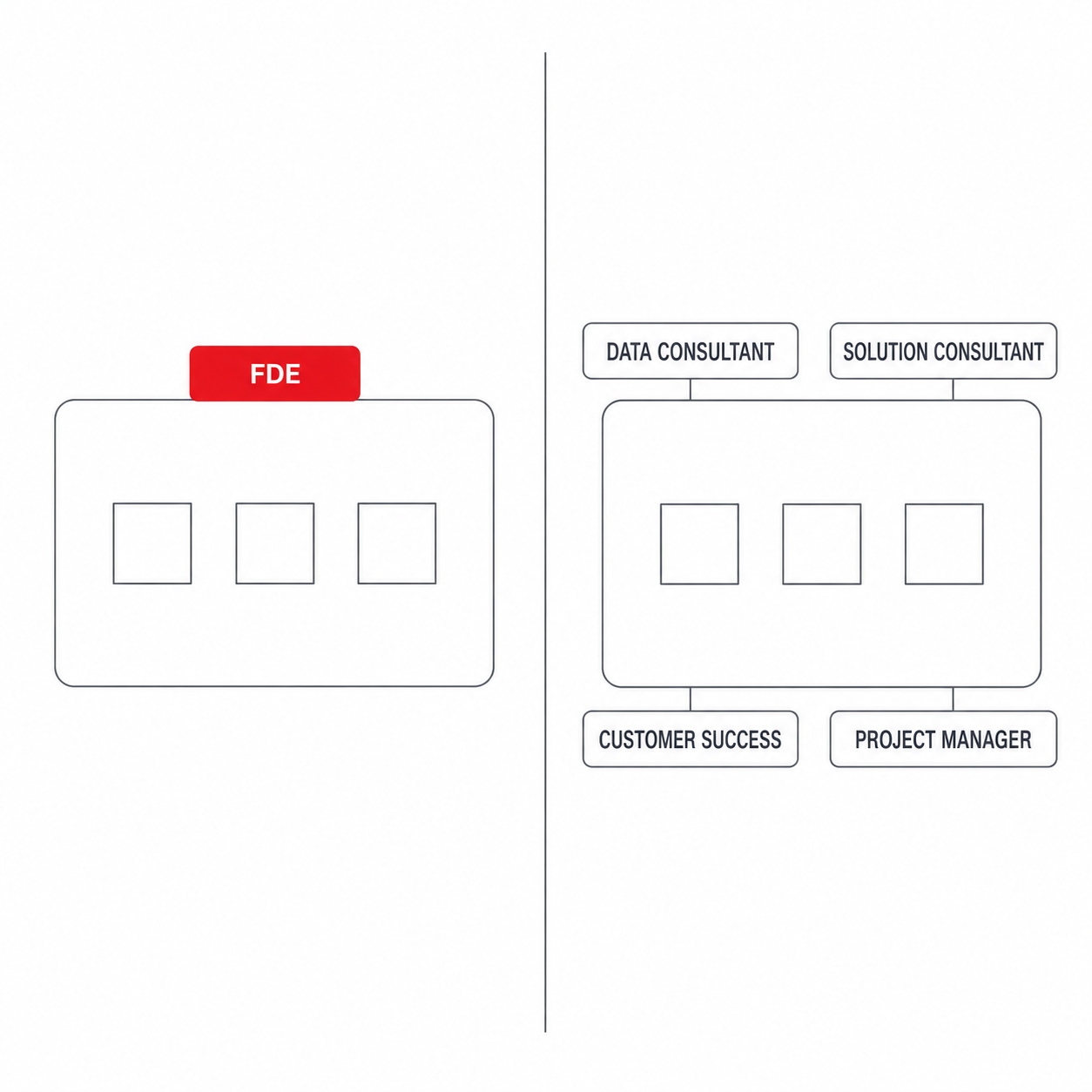
The empty cell on the retail side is exactly the one 91APP's CDMP consulting team is filling
Retail brands are empty on that list—not because no one is doing this work, but because the people doing it carry different job titles. 91APP's CDMP consulting team is doing exactly this, just in the retail version.
91APP's publicly listed Brand Growth Consulting Service describes three things that closely match the job postings above: assessing the performance and shortcomings of a brand's current systems and proposing system implementation and API integration plans; working alongside project managers throughout implementation, helping brands coordinate across departments to connect online and offline systems; and regularly reviewing the brand's marketing and operational results, adjusting based on data analysis. Going on-site, connecting systems, and continuing to monitor the numbers after launch—these three stages form the skeleton of FDE-style delivery.
In CDMP practice, these tasks take on very concrete forms.
Going into the customer's site means sitting inside the brand's member data. Getting an exported report isn't enough—you need to actually see where this brand's online orders, in-store transactions, coupon usage, and push notification responses each live, which ones can be matched up and which cannot. The most common situation for Taiwanese retail brands is that the same consumer has a separate identity on the official website, the app, and in stores, and no one can confidently say they are the same person.
Connecting into formal processes means hooking the organized segments and models back into the marketing actions the brand runs every day. In 91APP CDMP practice, this usually means turning member segments, purchase cycles, and product preferences into conditions that can be directly called by marketing scripts, so the marketing team can select the right people when setting up push notifications without having to create a separate list, manually export it, and paste it back into the backend. Every additional manual step in that chain raises the odds that the whole thing gets abandoned.
Bringing field problems back to the product means the limitations consultants hit on the brand side become product requirements. This part is most easily overlooked in outsourced engagements, because outsourcing contracts end on the delivery date and no one is obligated to carry the customer's field problems back to be fixed. This is exactly why you should ask a few questions clearly before choosing AI tools—one of them being: will the problems you find on the brand side become the next version of your product?
To be honest about the boundaries: not every part of this is done by consultants writing code with their own hands—data boundaries, privacy regulations, and the brand's internal permission structures all determine which layer consultants can touch. What can be stated publicly is where responsibility lands: the project doesn't end on the delivery date, performance reviews are periodic, and field problems have a path back to the product.
To find this kind of person, don't start with job titles
After going through this list, the most practical conclusion for Taiwanese brands is to switch the screening criteria from job titles to delivery methods. The following questions can be dropped directly into your next partnership evaluation meeting.
- Ask for a list of deliverables, not a service scope deck. Ask the other party to write out, item by item, what you will have when this project ends: a deck, a report, a list, or code and configurations that run inside your system. Also clarify ownership and licensing: when the subscription ends, the license isn't transferred, certificates expire, or the infrastructure is controlled by the vendor, whatever was running will stop too (expected effect: turning the engagement into something acceptance-testable; suggested cadence: settle it once before signing, then review quarterly).
- Ask who is responsible after go-live. The day a system goes live is often the first day problems start surfacing. In practice, responsibility is almost always shared—data quality is on your side, third-party platforms are on someone else's, system stability is on the vendor's—so the question isn't who bears full responsibility, but whether there is a written responsibility matrix, service levels, incident severity tiers, and an escalation path (expected effect: avoiding a post-launch vacuum where no one is accountable; suggested cadence: confirm before every project kickoff).
- Ask where field problems flow. When limitations are found on your side, are they recorded in the vendor's project documents, or do they enter the vendor's product roadmap? Also accept one fact: custom requirements aren't always suitable for productization and may be declined for privacy, security, or cost reasons—the key is whether the vendor will tell you the conclusion and the reasoning (expected effect: judging whether the vendor thinks in terms of projects or products; suggested cadence: review at the six-month mark of the engagement).
- Check whether the vendor has an obligation to understand your data structure. Retail data structures have their quirks—member identity resolution, returns, coupon redemption, and data boundaries across multi-brand groups all affect segmentation results. There are regulatory boundaries here too: data minimization and no-data-export environments limit what the vendor can see, so the question is how much time the vendor is willing to spend understanding your data within compliance constraints. Take the 91APP CDMP implementation as an example: in the early phase, cross-channel member identity resolution and transaction data structures are mapped out first, and how thoroughly this is done will show up in segmentation accuracy by the third month (expected effect: reducing inaccurate segmentation and duplicate communications to the same list; suggested cadence: complete the mapping in the first month of implementation).
- Ask questions before signing; don't use deck quality as the criterion. What brands should buy is a system that generates revenue, so the most critical question is always "will it actually change how your team works tomorrow?" There is one exception to this question: for data governance, security, and infrastructure projects, a reasonable outcome is reducing risk or building capability, not immediately changing revenue processes—so agree upfront which type you're after in this evaluation (expected effect: shifting vendor selection from feature comparison to process change; suggested cadence: run it in every selection process).
Different titles, same job
Back to that afternoon when we opened job listing pages one by one. The strongest feeling afterward was that the world is renaming an old thing, and Taiwan's retail side hasn't gotten its turn yet.
This isn't bad news for brands. When job titles are unreliable, you can only vet a partner through deliverables, responsibility boundaries, and post-launch behavior—and that is far more accurate than reading titles on a résumé.
Taipei's public job listings already contain these words; they're just hanging on the side that sells tools. What really determines how far a retail brand's AI transformation goes is whether the person sitting in your meeting room will open your system after the meeting ends.
FDE questions brands ask most often
Q1: What is an FDE?
A1: FDE stands for Forward Deployed Engineer, often translated into Chinese as 前線部署工程師. It refers to engineers who go inside customer organizations and develop and deploy software on the customer's real systems and data, usually working side by side with the customer's staff for a period of time. Palantir popularized this role, and in recent years it has been adopted by AI companies such as OpenAI and Anthropic.
Q2: Are there companies in Taiwan doing FDE work?
A2: Yes. On September 4, 2026, a scan of LinkedIn Taiwan, Yourator, and Cake found seven Taipei job listings that could be opened and verified one by one, from Google, Instrumental, Wonderful, Going Cloud, Dcard, OakMega, and Aiworks, some of which had already stopped accepting applications. This list excludes referrals, headhunter postings, delisted listings, and postings under other titles, and does not include 104 Job Bank, which blocks automated scraping—the actual number is higher than seven. What the seven companies have in common is that they all sell AI or cloud services; none are retail or e-commerce brands. The same work on the retail brand side usually sits under existing titles like data consultant, solutions consultant, or customer success manager.
Q3: How do FDEs differ from system integrators and traditional consultants?
A3: The difference lies in where the deliverables and responsibility end. The most accurate way to judge which type a vendor is: look at what you're left holding on the day the contract ends—a document that sits still, or a set of configurations and code that keeps running inside your system, and who is responsible for watching over it afterward.
Q4: Do brands with limited budgets need to cultivate this kind of person in-house?
A4: Not necessarily. Salesforce's public data shows that a significant proportion of its FDEs are internally transferred from existing engineering, professional services, and customer success teams, meaning the key is organizational responsibility rather than adding headcount. For small and mid-sized brands, a more practical approach is to write these standards into the evaluation criteria when choosing external partners, requiring them to deliver working configurations and processes, without budgeting for a new position.
Q5: How long after implementation until you see results?
A5: It depends on the starting point. If the brand's membership data hasn't yet been consolidated into unified profiles, the early stage will be spent matching online and offline identities. This part won't produce visible results right away, but it determines the accuracy of all subsequent segmentation. Skipping this step and jumping straight into marketing automation often leads to overlapping lists and the same person being contacted repeatedly by different campaigns. A reasonable expectation is to first check whether the process has actually changed, then look at the numbers.
Q6: If the other party doesn't have the FDE title, how do you judge whether they can actually do it?
A6: Verify with three questions: at the end of the project, do you get documents or something that actually works; how is responsibility divided after the system goes live; and will problems you discover feed into their product roadmap. These three questions can be answered without the other party holding any specific title—if a partner can't answer them, whatever title they carry makes no difference.