They're all called FDE, but some are faking it and some are playing for real
The term FDE has gone viral, but the job postings are a total mess: under the same title of Forward Deployed Engineer, salary ceilings differ by 4x. Some are doing implementation outsourcing, while others are genuinely feeding insights back into the product. The author has spent years embedded at customer sites and uses four criteria to expose real vs. fake FDEs, plus seven must-ask interview questions to help you see through a role's true identity and figure out which budget the money comes from.

A couple of days ago in a group chat, someone shared an article: "99% of FDEs in China Are Nonsense."

A row of people liked it, and one added a jab: "Isn't that just outsourcing with a new name?"
It kind of ticked me off. I've spent years embedded at customer sites—camped out in server rooms, going through data line by line with clients' business staff, getting called up at midnight to debug interfaces. Having all of that dismissed as "nonsense" in one sentence didn't sit well with me.
The term FDE has blown up way too fast these past two years. A few years ago, when I introduced my job to people, I had to spend forever explaining what a Forward Deployed Engineer was; now a search on job sites turns up pages and pages of them. That night I couldn't help myself—I went on Liepin and opened every FDE posting one by one, saving a dozen or so.
After reading them, I have just one thing to say: the "99%" figure is nonsense, but the word "nonsense" isn't entirely undeserved.
Same title, 4x difference
Let's start with the two most typical examples.
The first is from Shanghai Tanbang, with the job title literally "FDE Forward Deployed Engineer."
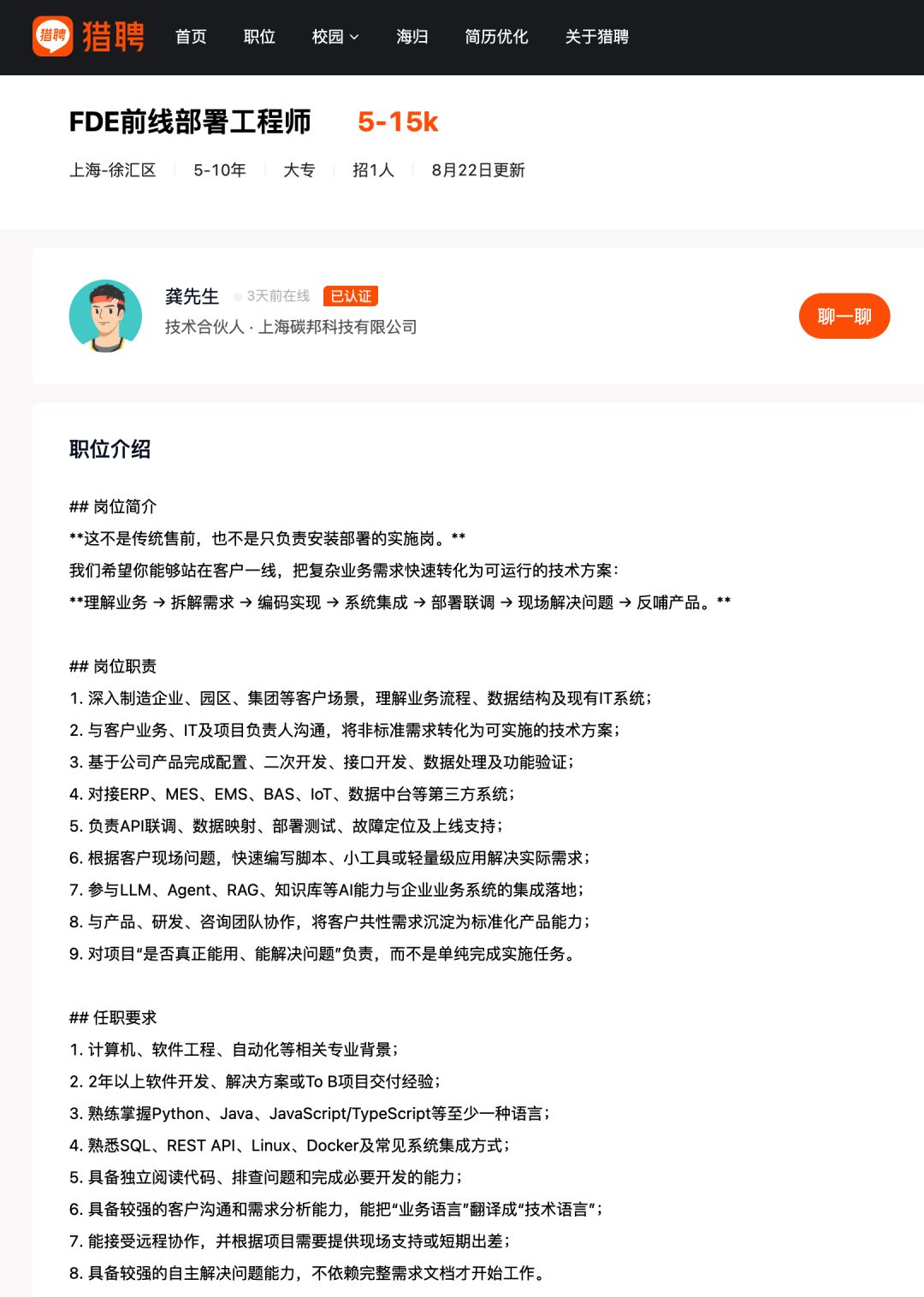
Monthly salary 5–15k, requiring 5–10 years of experience, associate degree or above. The responsibilities list nine items: understanding customer business, communicating requirements, configuration and secondary development, integrating with ERP/MES/EMS/BAS/IoT, joint debugging and go-live, writing scripts and small tools for on-site issues... Only at item eight does it mention "distilling common customer needs into standardized product capabilities."
I laughed when I saw this. I know this kind of work all too well—its original name on job sites was implementation development.
I did implementation for a few years, and I've personally done seven of those nine items. Joint debugging until 3 a.m., the client's IT insisting the interface was fine, and it finally turned out they'd changed their firewall policy—things like that happen several times a year. Implementation is genuinely hard work, and I never look down on it. I just think a name change doesn't make that hard work worth more.
What's even more interesting is the line at the top of the JD: "This is not traditional pre-sales, nor an implementation role that only handles installation and deployment."
Deliberately placed at the very beginning, and written with such emphasis—it actually makes you want to look closer.
The second is from the big tech company ByteDance: FDE (full AI product line, advertising/film industry), monthly salary 30–60k × 15 months, 3–10 years of experience, bachelor's degree or above.
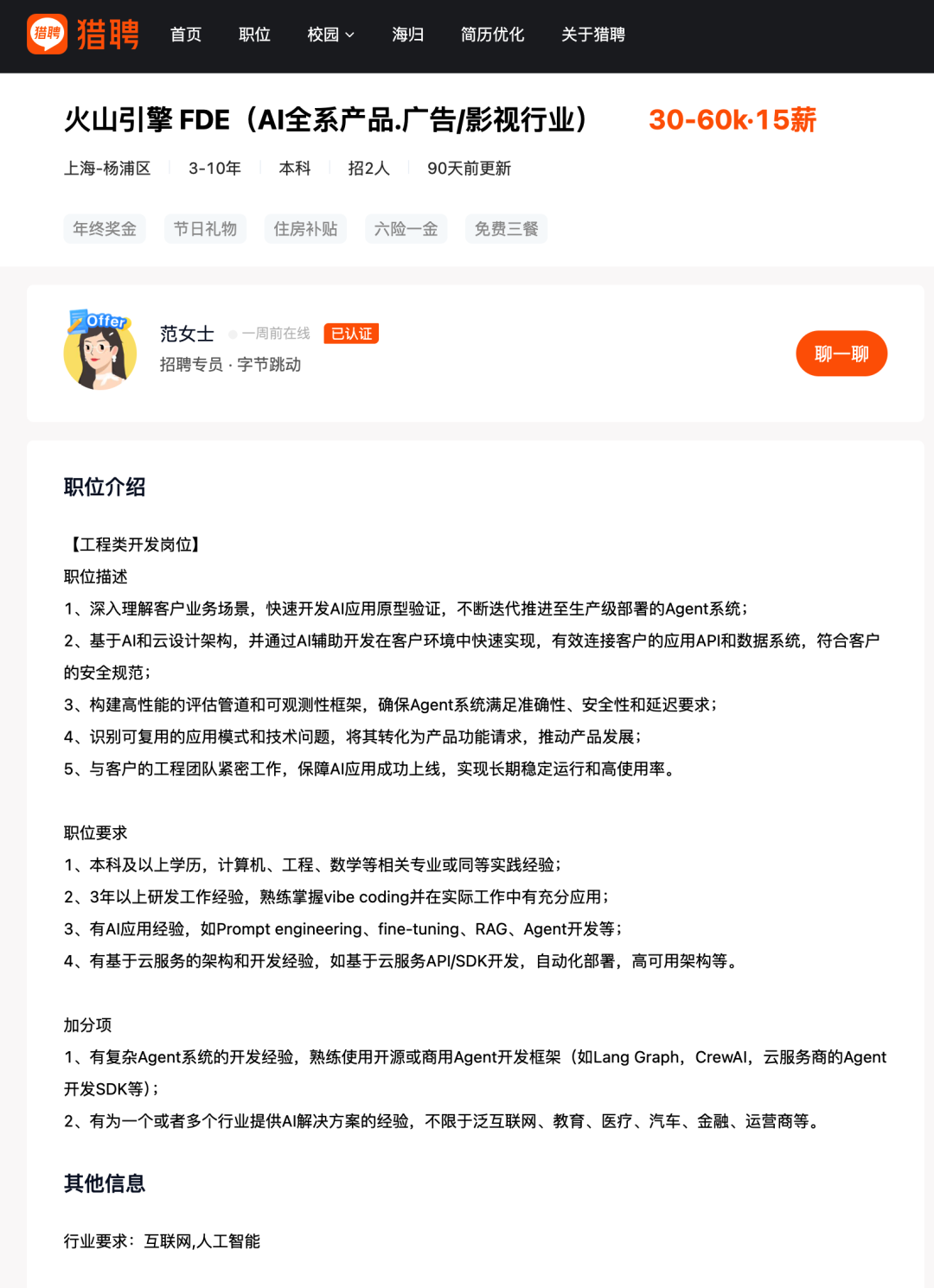
Put side by side, the salary ceilings differ by 4x.
I stared at them for a long time, and the more I looked, the more these seemed like two different jobs. In the Tanbang posting, the verbs are integrate, debug, troubleshoot, firefight—getting the product installed into the customer's home. In the Volcano posting, the verbs are develop, evaluate, convert into product requirements—bringing what's learned at customer sites back into the product.
Put simply, one is paid from the delivery budget, the other from the product budget.
When I first entered the industry, I thought these two were about the same. Only later did I figure it out: which budget the money comes from determines what kind of person you count as at the company. If you're counted as a delivery cost, once the project ends, the little tools you stayed up writing get archived along with it, never to be opened again. If you're counted as a product investment, the pitfalls you hit on site become a feature in the next release.
I've lived both kinds of days. The difference in how they feel is huge.
Once, I spent nearly half a year at one client. By day I went through data with their business staff; by night I went back to the hotel writing scripts, cleaning up the spreadsheets they exported, one by one. On acceptance day, the client took us out to dinner and kept praising how reliable we were. Back at the office, I found that those scripts had only ever run on that one client's servers—with a new client, you'd start from scratch.
Later I switched to a different team. Still embedded on site, but every week I had to submit feedback: which features customers couldn't get the hang of, which steps always required manual patching—written up clearly and handed to the product team. Two months later, an issue I'd raised showed up in the release notes of a new version. That feeling is a completely different thing from being praised as reliable by a client.
And it gets even more absurd
Scrolling further down, the absurd postings come one after another.
One third-party company is hiring "Big Tech FDE - Junior": master's degree minimum, 1–3 years of experience, under 30 years old, hiring 20 at once, on-site placement accepted.
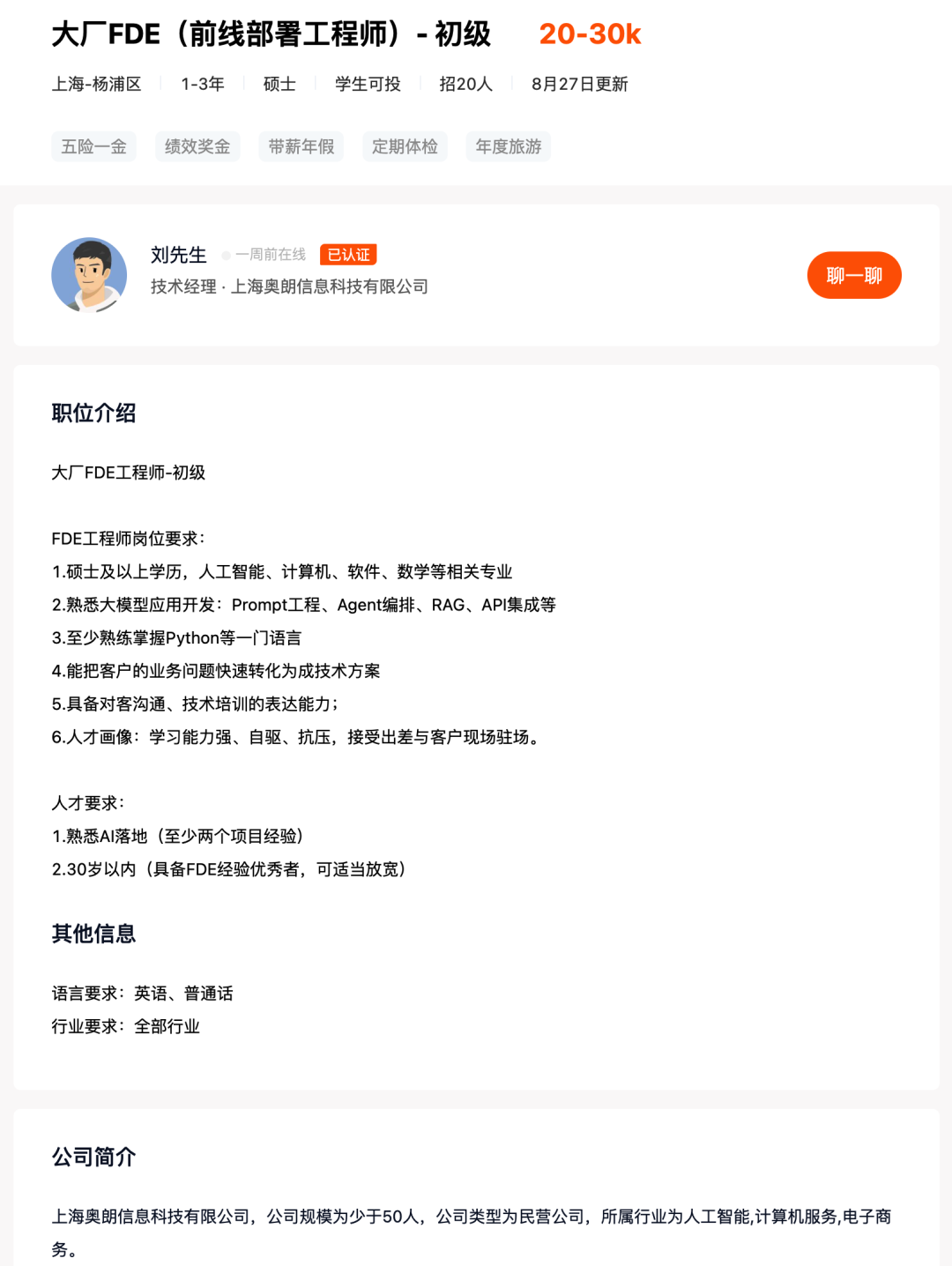
Now that's what I call proper "outsourcing."
Hiring 20 FDEs at once. I've been in this business a long time, and I've never seen a team that could take on 20 real FDEs in one go—there wouldn't even be enough mentors to go around.
I myself only became competent after running several projects on site with a senior colleague. He taught me how to listen to clients, how to judge which requirements to handle on the spot and which to take back. These things can't be written into a training manual; they can only be passed down one person at a time. Stuffing 20 new hires into a client site at once—that's called headcount filling.
Another company crams pre-sales, solution design, and delivery all into one set of responsibilities, with the last item reading "proactively identify and drive business upsell and expansion opportunities."
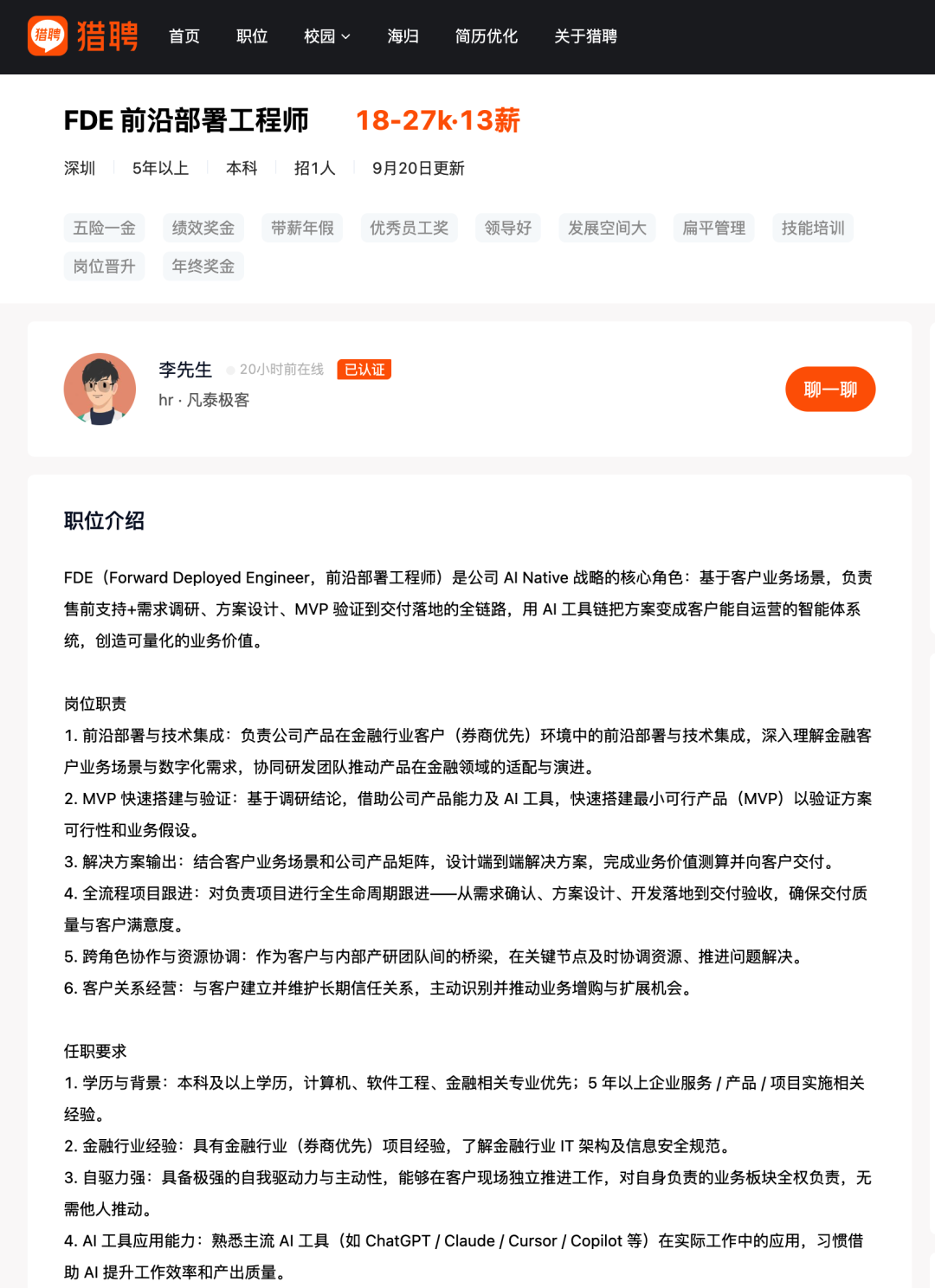
Well, well—a few years ago, this job was called sales.
What made me laugh and cry the most was a weekly report written by a practitioner themselves.
Three weeks: week one, swapping out laptops for trainees and setting up a tool library; week two, leading employees to build their own AI agents—his exact words were "I just need to drink tea, then do acceptance"; week three, building an intranet sharing platform. To be fair, he was quite honest—the title explicitly said training only, no implementation. But this kind of work is now also called FDE delivery.
I don't blame the HR folks writing the JDs, nor the people doing the work. When a name gets hot, everyone wants to ride the wave—it makes hiring easier and quoting prices easier too. The trouble is the name is running faster than the capability, and in the end, everyone bearing that name gets the flak—including the ones actually doing the real work.
How I tell real from fake
Over the years I've accumulated a very down-to-earth set of criteria—just four.
First, the product has to be complex enough that customers can't build it themselves
Volcano wants AI agent systems, eval pipelines, observability—stuff the client's IT department genuinely can't handle. Tanbang integrates with ERP, MES, IoT—the difficulty lies in the sheer number and messiness of systems; the product itself isn't hard.
Second, someone on site has to act as the translator
When the client's business staff says "this isn't easy to use," you need to be able to translate that into "which field, which step, and why."
Tanbang's posting says communicating with "customer business, IT, and project leads"; Volcano's says "working closely with the customer's engineering team." One is reporting; the other is working side by side.
Third, what's learned on site has to have somewhere to go
Both JDs mention feedback loops—one says "converted into product feature requests," the other "distilled into standardized product capabilities."
Anyone can write that on paper. What matters is whether someone picks it up on the other end: is there a platform team behind it, and does the version roadmap leave room for you.
The most heartbreaking scene I've witnessed was a colleague who organized a client's requirements into a dozen-plus pages of documentation and sent it to the product team—no response for three months.
After that he stopped writing them. When asked why, he said writing them was pointless. With feedback loops, once broken, a person goes cold.
Fourth, acceptance based on outcomes
Volcano says "long-term stable operation and high usage"; Tanbang says "whether it can truly be used and solve problems." They sound similar, but one looks at whether the product keeps running at the customer's site, the other at whether the project can be signed off.
Most JDs touch on the first two criteria. What really separates them is the last two.
Without the last two, an FDE is just implementation, just on-site development. No matter how fancy the new name, the work is still the same work.
Seven questions, ready to use
If you're currently looking at an FDE role, no matter how good the JD sounds at the top, just ask these seven questions:
- Are you delivering a system for this one client, or a feature of the product?
- Is performance measured by usage and stability, or by the acceptance form?
- Where does on-site feedback go, and who picks it up on the other end?
- Which salary band does the pay fall into?
- Is being on site a means, or the entire job?
- Are you on the hook for upsells?
- After go-live, who's responsible for the results?
When I interview people myself, I usually just ask about the third point. If the other side hem and haw and say "it depends on the project," I pretty much know the answer.
Compare these two and it's clear. For the Volcano one, points one, two, three, and seven all check out; for the Tanbang one, the return path is written down, but the salary band and job requirements can't back it up.
If three or more of the seven points match, you can basically guess the true nature of the role. Ones that say "on-site delivery, acceptance by deadline" and list 8–15k — don't even bother going to the interview.
Vent all you want, but don't paint them all with the same brush
After all that's been said, I still want to say a few words in defense of the FDE.
They really do exist.
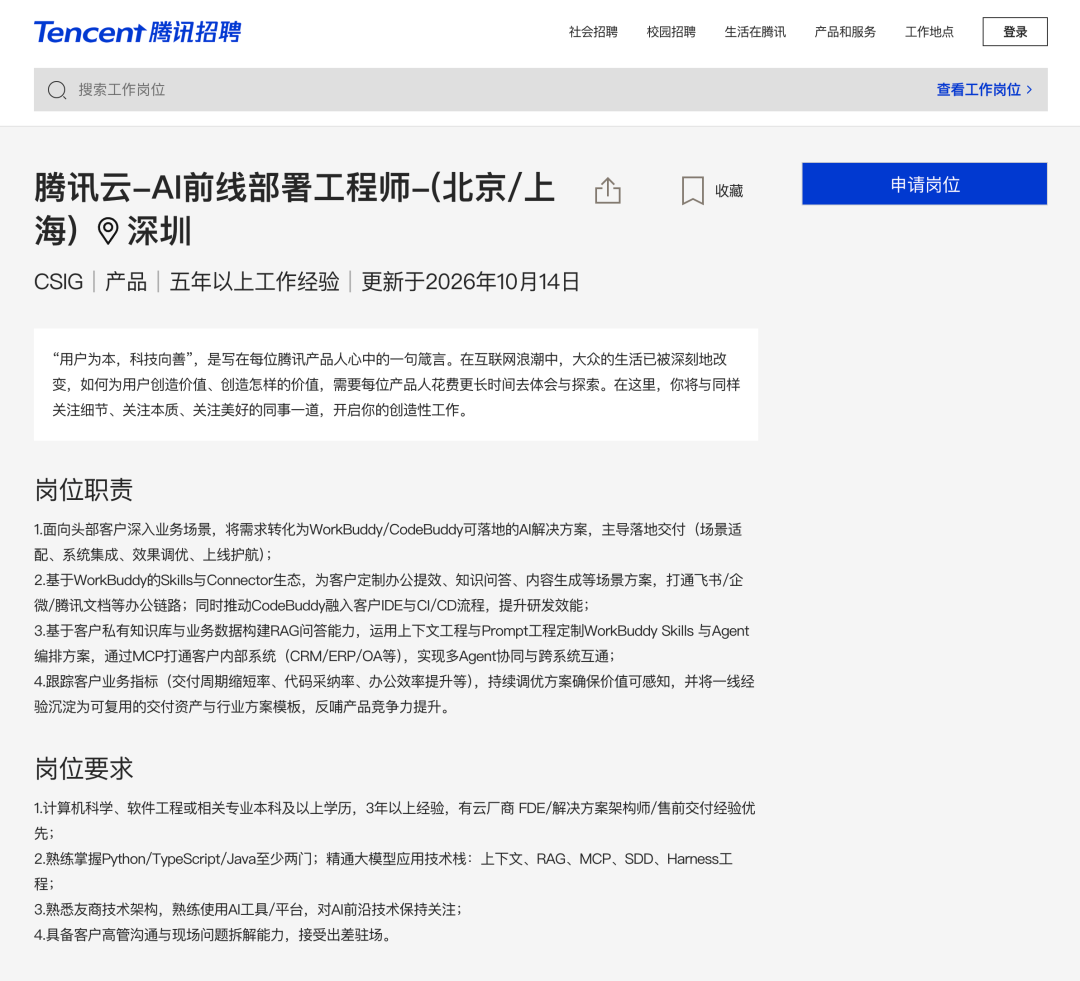
Take Tencent Cloud's "AI Forward Deployed Engineer" role, for example. Its responsibilities include "consolidating work into reusable delivery assets and industry solution templates to feed back into product competitiveness," and it lists three metrics: delivery cycle reduction rate, code adoption rate, and office efficiency.
Roles like this do exist in China; it's just that right now most of them are at companies that own their own large model platforms.
A company willing to write "feed back into the product" into the JD at least knows where the road should lead. Many products grow out of individual projects — delivery first, platform later. That's how this path has always been walked.
The term had barely taken shape before it got worn out through overuse.
A few years ago, when introducing my work to people, I was quite proud, saying that our job required understanding both technology and business, and also turning what happened on-site into products. Now when I say I'm an FDE, the first reaction is often: oh, on-site staffing. I can't even be bothered to explain anymore.
So I'd like to revise that line: In China, far more people are called FDEs than actually do FDE work.
This article was originally published on Everyone Is a Product Manager by @往事随风. Reproduction without the author's permission is prohibited.





- No comments yet — be the first to share your thoughts!