Yicai 2026-07-28 16:21:07
Editor: Zhang Xiaojie
For Chinese enterprises today, models no longer seem to be the most obvious bottleneck in AI implementation.
On July 14, Moonshot AI released Kimi K3 with 2.8 trillion total parameters; a few days later, Alibaba Qwen previewed Qwen3.8-Max-Preview with 2.4 trillion total parameters. Within less than a week, two domestic models with over 2 trillion total parameters appeared one after another, pushing forward the technical capabilities enterprises can call upon.
Models certainly determine the upper limit of AI capabilities.
However, as model supply has become so abundant in a short time, the decisions enterprises need to make have not actually decreased; instead, they quickly extended from "which model to choose" to a series of more specific questions: where the model's capability boundaries have been pushed to, which system holds the business context data, who has the authority to call it, who takes over when the model makes errors, whether generated results can go directly into business operations, and whether business staff need to change work practices they have followed for years, and so on.
We often say AI empowers thousands of industries, but those industries are highly diverse, and the people specifically responsible for AI implementation often want to hear first about a best practice: has a peer already done this, what model did they use, and what were the results?
A best practice can prove that a direction is worth trying, but it is very hard to copy another company's data, permissions, and workflows along with it. When these conditions have not been sorted out, what gets copied most easily is often just the appearance of the product. As a result, over the past two years, the easiest AI projects to complete in enterprises have often been a Demo. Gather some materials into a knowledge base, build a natural language interface for the large model, and within a few weeks the system can answer questions.
The gap between a Demo and a real environment is obviously enormous.
On launch day it seems capable of everything, but after a while no one keeps using it, and it no longer generates model calls. Monthly, weekly, or even daily disposable agents are very common.
Faced with this gap, people easily attribute the cause to large enterprises moving too slowly. But in decades of enterprise IT construction, "slow" was originally a reasonable norm, and in many cases it was also how large organizations controlled risk. In China, central and state-owned enterprises especially follow this approach.
During WAIC 2025, the World AI Conference, SASAC released the first batch of 40 strategic high-value AI scenarios for central enterprises, with an interesting formulation: promoting the shift from "potted-plant-style" pilots to "rainforest-style" large-scale applications. So what "shortcut" can achieve this leap? A company needs to find AI's destination while also building systems into the production environment — who takes on that middle stretch of work that few people have ever been fully responsible for?
At this year's WAIC 2026, on this question, we had conversations with leaders of several tech companies, including Huo Jia, Vice President of Alibaba Cloud Intelligence Group. One conclusion that can be drawn is that people are gradually converging on an answer: a role that was previously relatively unfamiliar but has existed for a long time — the FDE.
FDE Steps into the Spotlight
Forward Deployed Engineer, usually translated in China as 前沿部署工程师 or 前线部署工程师, abbreviated as FDE. This title did not appear only after the emergence of large models.
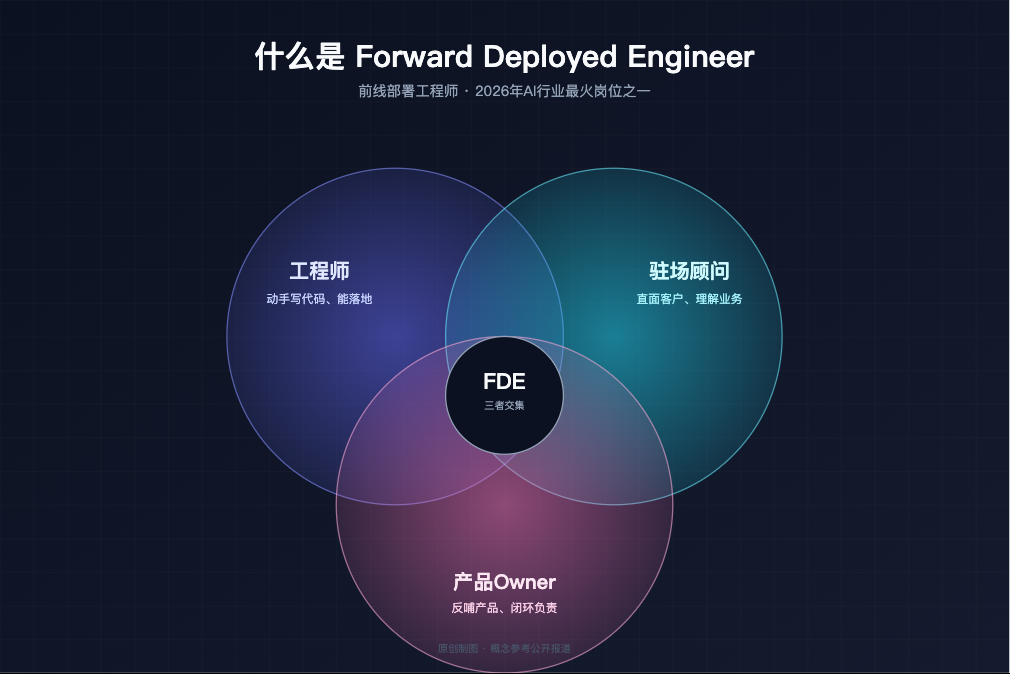
More than a decade ago, Palantir already used it to describe a group of solutions and integration engineers who went deep into customer sites. They connected, on one end, the problems customers were working on, and on the other, the company's platform R&D.
In the era of large models, FDE has become prominent again. Take a few AI labs as examples: OpenAI's description of this role's responsibilities extends from business discovery, project scoping, and system design all the way to development, production launch, and adoption outcomes. In May 2026, it also established a Deployment Company, making engineers entering complex organizations and co-transforming key workflows with customers into a formal business line. Anthropic and other model companies have also set up similar roles in multiple regions.
The resurgence of the FDE is first a global phenomenon, but AI implementation in China seems to need FDEs even more.
We often say China has abundant AI application scenarios. Rich scenarios are certainly an advantage, but on the implementation side, it also means it is hard to solve all problems with a single standard answer.
China has both highly digitalized large enterprises and a large number of companies still catching up on fundamentals; even within the same group, newly built data platforms, business software running for years, systems from different vendors, and data scattered across departments may all coexist. When AI enters such an enterprise, it does not bypass the legacy system relationships; instead, it encounters them one by one when reading data, invoking permissions, and changing processes.
Even if an enterprise's internal data is unified at the physical level, the data itself still raises questions of responsibility boundaries.
The information handled by finance, energy, transportation, healthcare, and large industrial enterprises often involves personal information or critical production data. What the model can see, whether data can leave the local environment, who reviews generated results, and how the system keeps audit trails and rolls back — all of these must be implemented within the project.
Finally, modern AI represented by large language models looks simple to use, but the underlying technical principles and engineering implementation are extremely complex. Huo Jia shared an observation: in reality, even the proportion of people who can clearly explain the Transformer architecture is not high. If you know that something works but not why, how can you do AI implementation well?
The significance of the FDE lies largely here.
It is not just about adding a new type of engineering headcount, but about letting people who understand AI architecture and capability boundaries enter scenarios early and work together with those who hold the business, data, and production responsibilities.
Pre-sales Takes a Bigger Share, Yet Total Project Time Shortens
Practical feedback from Alibaba Cloud shows that FDE involvement has indeed shortened project cycles and increased customers' sense of gain.
That is because the pre-sales phase (project justification) takes a longer share, yet the total time from idea to launch is actually shortened.
Two measuring sticks are used here.
One measures how time is allocated within a project; the other measures how long the entire project lasts.
Using an approximate 20% and 80% to describe it: in traditional enterprise projects, roughly the first 20% of time is spent confirming requirements, designing solutions, and signing the SOW, while most of the remaining time goes to development, integration, testing, deployment, and acceptance. This arrangement carries on the mindset of deterministic engineering: fix the scope as quickly as possible during pre-sales, and after the contract is signed, the construction team moves forward along the already-drawn route.
In AI projects, the ratio is being reversed.
Before formal construction, teams such as FDEs enter the business site to screen scenarios, check data and permissions, build an MVP (minimum viable product/solution), have actual users run through it, and then judge whether the technical path holds up and whether the input-output ratio is reasonable. If a scenario has no value, or the data conditions simply do not support it, it should stop at this stage; only after the direction has been validated in a real environment can development, deployment, and launch proceed quickly.
Thus, in an already shortened project cycle, about 80% of the time may be spent finding the right direction, and only the remaining 20% on construction after the direction is clear.
This does not mean moving 80% of the original six-month or one-year timeline wholesale into pre-sales. In traditional processes, a wrong assumption might not be overturned until development, integration, or even acceptance, with requirements then traveling back up the organizational hierarchy, turning earlier investments into rework. FDEs, by contrast, use one or two weeks of small-scale trials to expose the judgments most likely to fail in real data and processes.
Total time is thereby compressed.
But moving validation earlier alone is not enough to achieve this speed. After the MVP is done, if requirements still have to be handed sequentially to sales, Solutions Architects, product managers, development, and delivery teams, the understanding just gained in the trials will be lost in each round of retelling.
Alibaba Cloud's FDE practice is to form a One Team out of the customer's business, data, and IT staff and the vendor's product, algorithm, and engineering personnel. The point is not whether everyone sits in the same office, but that people who make different judgments enter the same working scene.
In the 1970s, MIT scholar Thomas Allen studied communication networks in R&D organizations and found that physical location significantly affects technical exchange; he later called those who connect the organization to the external technical world "gatekeepers". Alibaba Cloud's FDEs have become the "gatekeepers" of this AI era.
If the earlier changes compressed project time, what is shortened here is organizational space.
In model training and inference, communication overhead is the new bottleneck; the same is true for organizational coordination in AI deployment.
Two Projects, Testing Three Capabilities of the FDE
Having covered the FDE's past and present, let's now look at three Alibaba Cloud cases to get a feel for what FDEs can achieve.
The first is the World Cup "AI Viewing Assistant" in CCTV Sports' client app.
The World Cup has a schedule that waits for no project process: matches happen continuously, schedules, players, and scores change at any moment, and the timing of user questions may be out of sync with data updates. The system must answer promptly while relying on official sources to avoid the large model fabricating content. The Alibaba Cloud team pushed the application into production in about a week, letting real users and real-time data enter validation as early as possible.
Launching in a week is certainly fast, but speed is not the whole meaning of this case. Traditional projects try to eliminate uncertainty before delivery; this project instead made real usage itself part of validation. The system entered the matches first, then continuously optimized and adjusted based on on-site questions, with results kept under control.
The second project comes from PetroChina's Kunlun Digital Intelligence.
The crude distillation unit is the first step in refining and chemical production, with all downstream processes built on its stable operation. When an AI application enters such a system, it faces not just whether a single answer is accurate, but also continuous operation, exception handling, and coordination with existing systems. According to customer feedback relayed by Alibaba Cloud, this is the first AI application running 24 hours a day in a production system within the customer's organization. At this point, what the FDE must prove is no longer whether the model can answer, but whether AI can stay in the core business.
The third comes from Peking University International Hospital.
The FDE team completed full-chain delivery of AI agents for 7 major patient service scenarios in just 3 weeks—from architecture design and joint debugging of interfaces across 24 business systems to the gray-scale launch of the WeChat mini-program "Xiao'an" AI health manager—with intent understanding and recall accuracy both reaching 90%, enabling 1.5 million patients to enjoy 7×24 one-stop intelligent services covering "registration, guidance, report interpretation, and follow-up". It validated the MaaS delivery model of "rapid implementation through small entry points, cross-hospital replication of standardized solutions", providing a referenceable implementation sample for medical AI patient services to move from single-point pilots to large-scale, inclusive adoption.
These three projects are of course not a standard route every enterprise can copy. Yet they show some common signals of high-value scenarios: the AI application can be Always On, usage continuously generates new high-quality data, and after the base model is upgraded, business results continue to benefit.
FDE in China Needs Tech Giants to Take the Lead Even More
In our research, we found that anyone encountering the FDE concept initially has the same question.
If the responsibilities of the role have changed, but the contracts supporting these people are still mostly calculated by project, person-days, and deliverables. An FDE team composed of senior engineers is not cheap; if every customer requires the same investment of manpower from scratch, the more successful this approach is, the greater the delivery pressure the vendor bears.
So, how can FDE become a sustainable business?
At least three sets of books must balance at the same time.
The customer must first obtain observable value from the application: how much time saved, how much revenue added, how much risk reduced. Launch, acceptance, and accuracy are only intermediate metrics; sustained usage and business results determine whether the contract is renewed the following year.
Only after the customer uses it continuously can the vendor gain long-term revenue from model calls, compute supply, data platforms, and operations services, so that FDE does not have to survive entirely on one-time project fees.
At the same time, the experience FDEs accumulate on-site, the data feedback formed within authorized and compliant boundaries, and industry know-how must feed back into models, agent platforms, and related cloud products. As products improve through field practice, they can serve more customers and industries; the benefits FDE creates no longer stay within a single project, and delivery of subsequent projects may become lighter.
Customer value, vendor revenue, and product reuse—without any one of these, FDE can hardly go from a batch of successful projects to a sustainable industry mechanism.
Payment methods may also change accordingly. What is common today is still one deal at a time, with both parties specifying requirements, timelines, and deliverables in the contract. But when a new scenario can be judged within one or two weeks whether it is worth continuing, the time spent on re-initiating projects, bidding, quoting, and acceptance may be longer than the experiment itself.
Therefore, annual continuous service contracts may suit FDE better than purchasing projects one by one: the customer buys a team that continuously discovers, validates, and launches high-value scenarios within agreed boundaries, and when one direction fails, resources can be shifted to the next.
A step further, the ideal state is pay-by-results, i.e., the much-discussed Result as a Service. What the customer buys is no longer how many person-days engineers invested, nor just how many agents were delivered, but shorter turnaround time, lower failure rates, increased revenue, or reduced risk.
But this step clearly requires more mature conditions. Enterprises need comparable business baselines, and both parties must distinguish which results come from the model and which from process adjustments, data quality, and organizational cooperation; a vendor can only be accountable for results within the scope it can control. How to price safety responsibility, extreme events, and long-term benefits also requires more case data.
Project fees, long-term service contracts, and pay-by-results are more like three relationships evolving step by step, and the switch will not happen simultaneously in all enterprises.
And precisely because this loop requires frontline experience to quickly flow back into models, agent platforms, and product R&D, tech giants may be the more suitable leaders for FDE implementation in China.
Palantir calls this mechanism "backpropagation for humans". FDEs are not meant to manually solve each customer's problems forever, but to bring recurring problems back into the R&D system. If a gap that required engineers in the first project becomes a standard platform feature in the second, field service can become lighter and lighter.
A requirement raised by one enterprise may just be customization; only permission, evals, high-availability, and data governance problems repeatedly encountered across multiple industries are worth being made into standard capabilities. A platform company can observe this repetition across customers and also has the R&D resources to feed it into the product roadmap. If the frontline can only implement within a defined scope but cannot influence the product, its work is closer to advanced delivery.
Moreover, the production problems of enterprise AI rarely stay on a single layer. A slow response may stem from model inference, compute scheduling, or database issues; an agent unable to enter the workflow may also involve data governance, security permissions, and production operations. FDEs don't have to solve every layer themselves, but must find the corresponding product teams within the organization.
Take Alibaba Cloud: it has a product system spanning infrastructure, model services, AI development platforms, databases, security, and operations, so field problems have a fairly complete return path. The meaning of full-stack is not stuffing more products into customer solutions, but that cross-layer problems can find their owners and have the chance to be consolidated into models, agent platforms, and cloud products, so they no longer need to be re-solved in the next project.
Once applications truly run, they continuously generate demand for model calls, tokens, compute, databases, and platform services. Cloud vendors can use engineering services to drive adoption and then gain returns from sustained usage, so they don't have to rely entirely on selling engineer person-days to cover costs.
Looking back at the history of the Industrial Revolution and economic history, there is a passage quite similar to today's AI deployment.
In the late 19th century, factories began using electric motors; at first, many factory owners simply replaced steam engines with motors, leaving the belts, drive shafts, and machine layouts in the plant untouched.
When the economist Paul David studied the history of electrification, he pointed out that the bigger productivity gains came later: once each machine had its own small electric motor, factories no longer had to be laid out around a central drive shaft, and machine placement, material handling, and production flows could all be rearranged.
The real release of productivity doesn't come on the day a model is launched, but at the moment AI rearranges workflows according to business logic—and the FDE is precisely the person who drives that rearrangement.